
ADAM SMITH
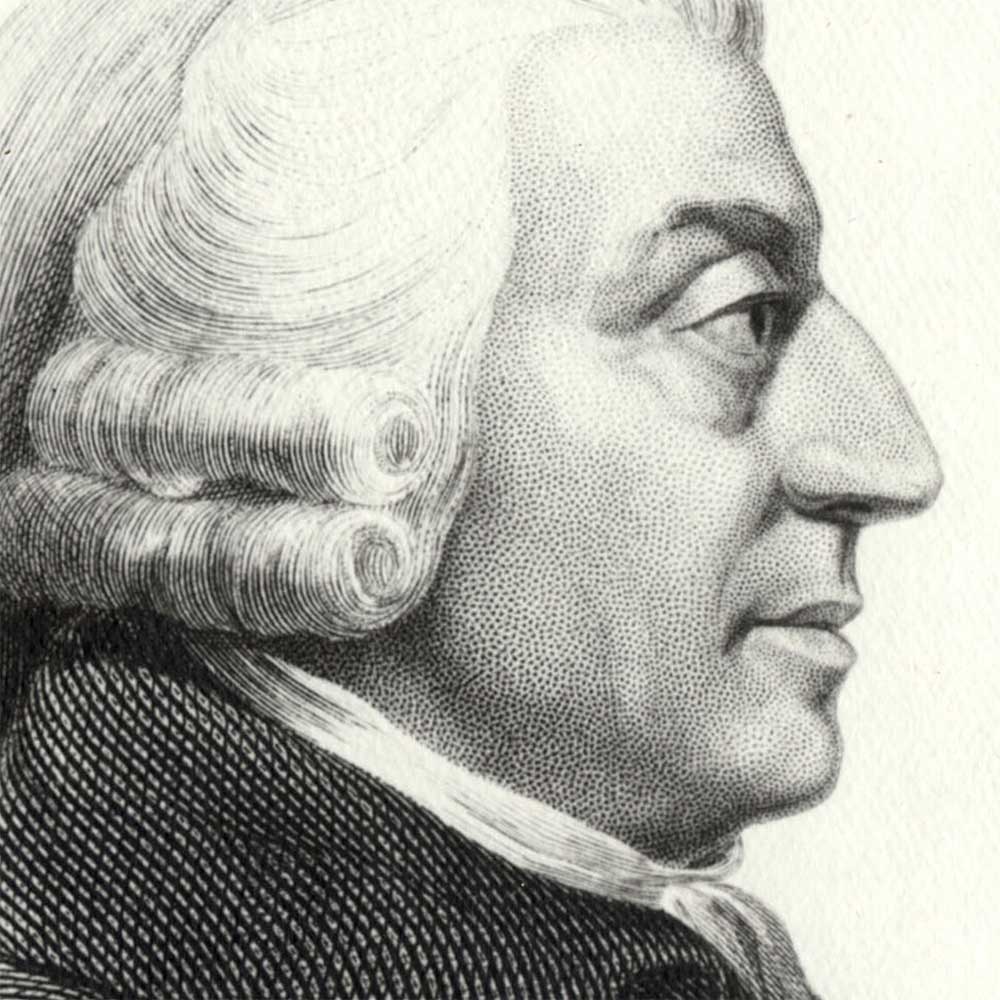
(Etching created by Cadell and Davies (1811), John Horsburgh (1828) or R.C. Bell (1872)., Public domain, via Wikimedia Commons)
Before he wrote about wealth, Adam Smith wrote about conscience.
Lived 1723–1790
Smith is best known as an economist, but economics was not his only interest. His first work, The Theory of Moral Sentiments (1759), explored human nature and how it shapes social institutions and behavior. Seventeen years later he published The Wealth of Nations (1776), carrying his ideas about self-regulation from the individual to the whole of society.
1776
- Often called the first modern economist, for his work on how market forces order themselves.
- First book: The Theory of Moral Sentiments (1759)
- Masterpiece: An Inquiry into the Nature and Causes of the Wealth of Nations (1776)
- Coined a famous phrase: the “Invisible Hand”
- Believed government had only three proper jobs: defense, justice, and certain public works.
How can free people, each pursuing their own interests, produce an orderly society?
Hover or tap each idea to follow Smith’s answer
- Moral JudgmentSmith asked how we can judge our own behavior when self-preservation pulls so strongly. His answer: we can sympathize with those who suffer injustice, and we can reflect on what makes conduct right.
- Reason Supports FeelingReason finds the sources of justice in usefulness and custom, giving added weight to our sentiments. Smith compared well-ordered conduct to “any well contrived machine.”
- The Invisible HandThe same clash of passion and reason that creates order in a person creates order in society. Competition restrains private action, producing a natural order Smith called the “Invisible Hand.”
- Limited GovernmentThis natural order works best with minimal regulation and expropriation. Smith opposed mercantilism and monopolies, and favored laissez-faire policy.
- Three Roles for GovernmentDefend the state, ensure justice, and provide public works and institutions no private person or group can provide.
Every economist since 1776 has had to answer Adam Smith.
Smith showed why free markets and the division of labor matter for producing a society’s wealth. His insight that order can arise from free individuals, without central direction, made him the founder of modern economics. All later economic works have had to address his contribution in one way or another.
- AdamSmithWorks: Digital portal providing primary texts and scholarly resources. https://www.adamsmithworks.org/
- University of Glasgow Archives: Holds Smith’s personal papers and lecture notes. https://www.gla.ac.uk
- Project Gutenberg: Public-domain editions of Smith’s major works. https://www.gutenberg.org
- National Library of Scotland: Early editions and manuscripts related to Smith’s life and work. https://www.nls.uk
- University of Glasgow, “Biography of Adam Smith,” accessed June 2025, https://www.gla.ac.uk.
- Adam Smith, The Theory of Moral Sentiments (Edinburgh: A. Millar, 1759).
- Adam Smith, An Inquiry into the Nature and Causes of the Wealth of Nations (London: W. Strahan and T. Cadell, 1776).
- Project Gutenberg, “The Wealth of Nations,” accessed June 2025, https://www.gutenberg.org/ebooks/3300.
- Project Gutenberg, “The Theory of Moral Sentiments,” accessed June 2025, https://www.gutenberg.org/ebooks/15491.
- Ian Simpson Ross, The Life of Adam Smith (Oxford: Oxford University Press, 1995).
- Andrew S. Skinner, A System of Social Science (Oxford: Oxford University Press, 1979).
- D.D. Raphael and A.L. Macfie, eds., The Theory of Moral Sentiments (Oxford: Oxford University Press, 1976).
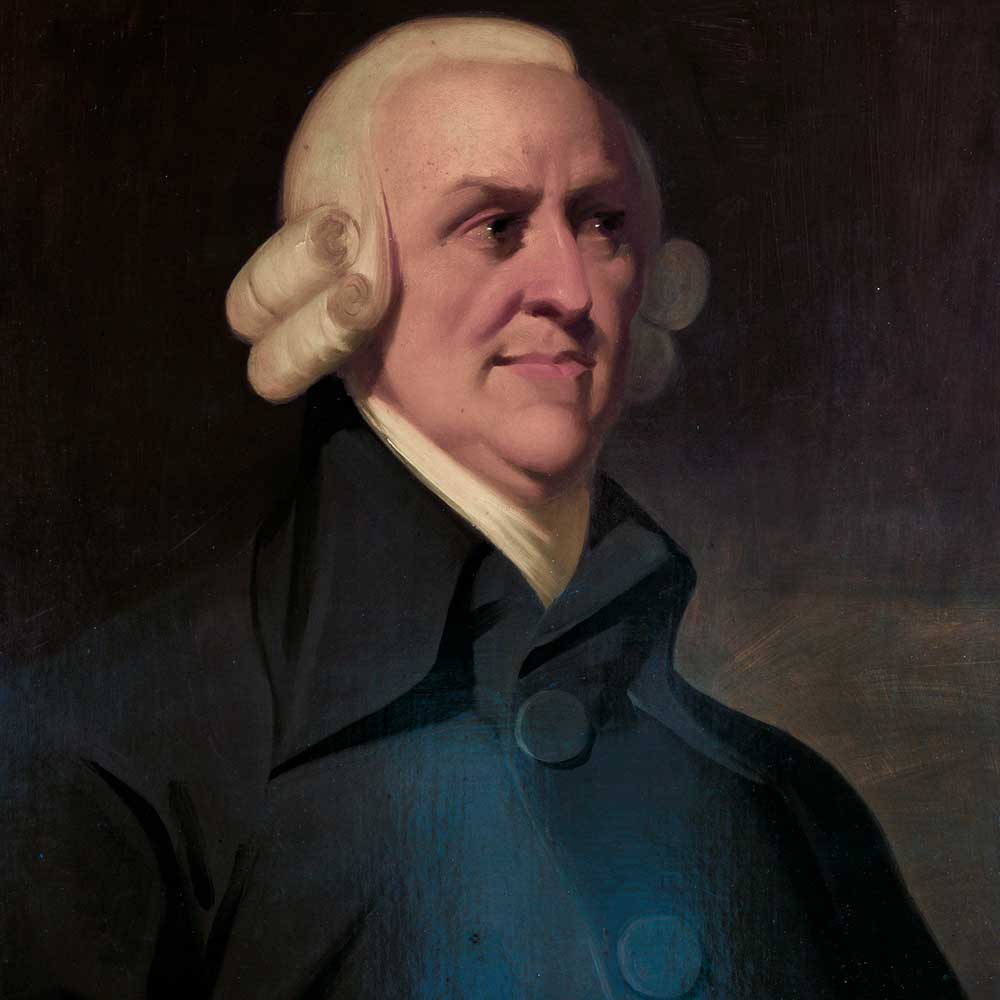
(Image: Scottish National Gallery, Public domain, via Wikimedia Commons)
Adam Smith (June 16, 1723 – July 17, 1790) was a Scottish moral philosopher and political economist, widely regarded as the “father of modern economics.”
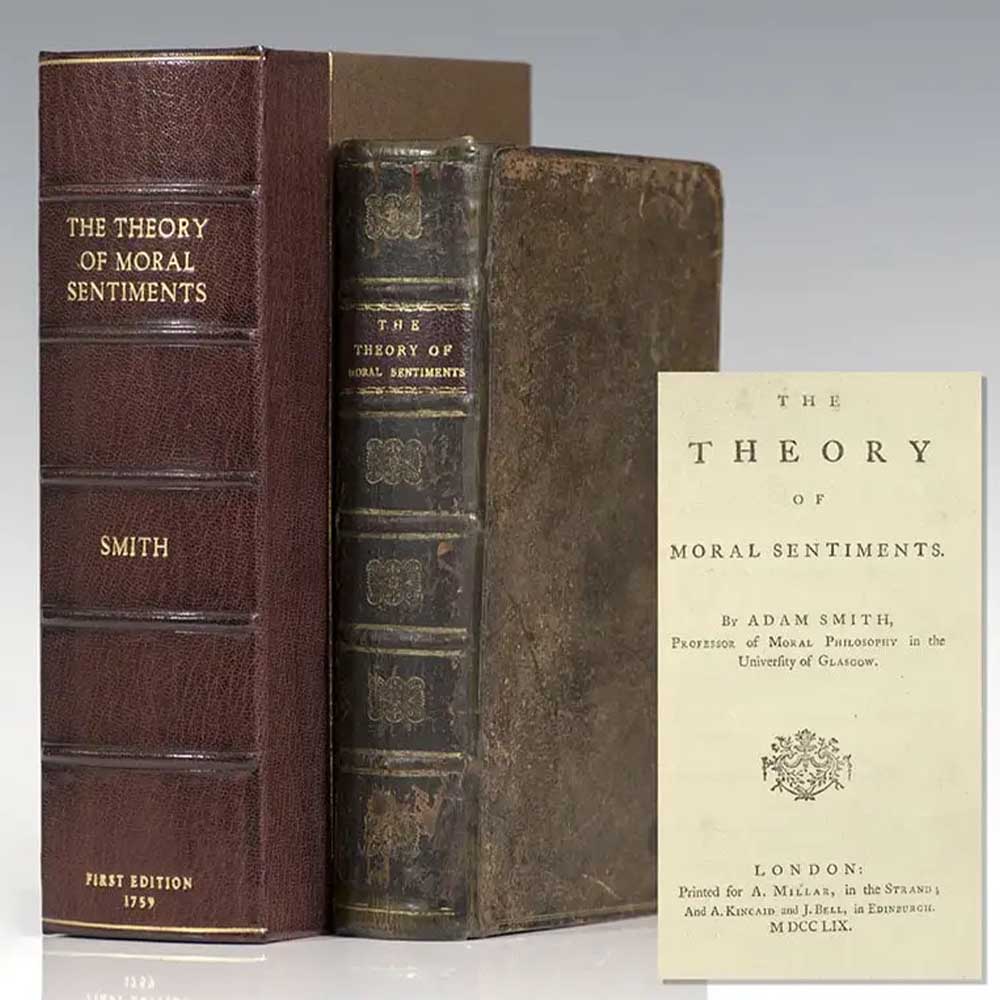
(Image: Stock Adobe)
First edition published in Edinburgh by A. Millar, (1759)
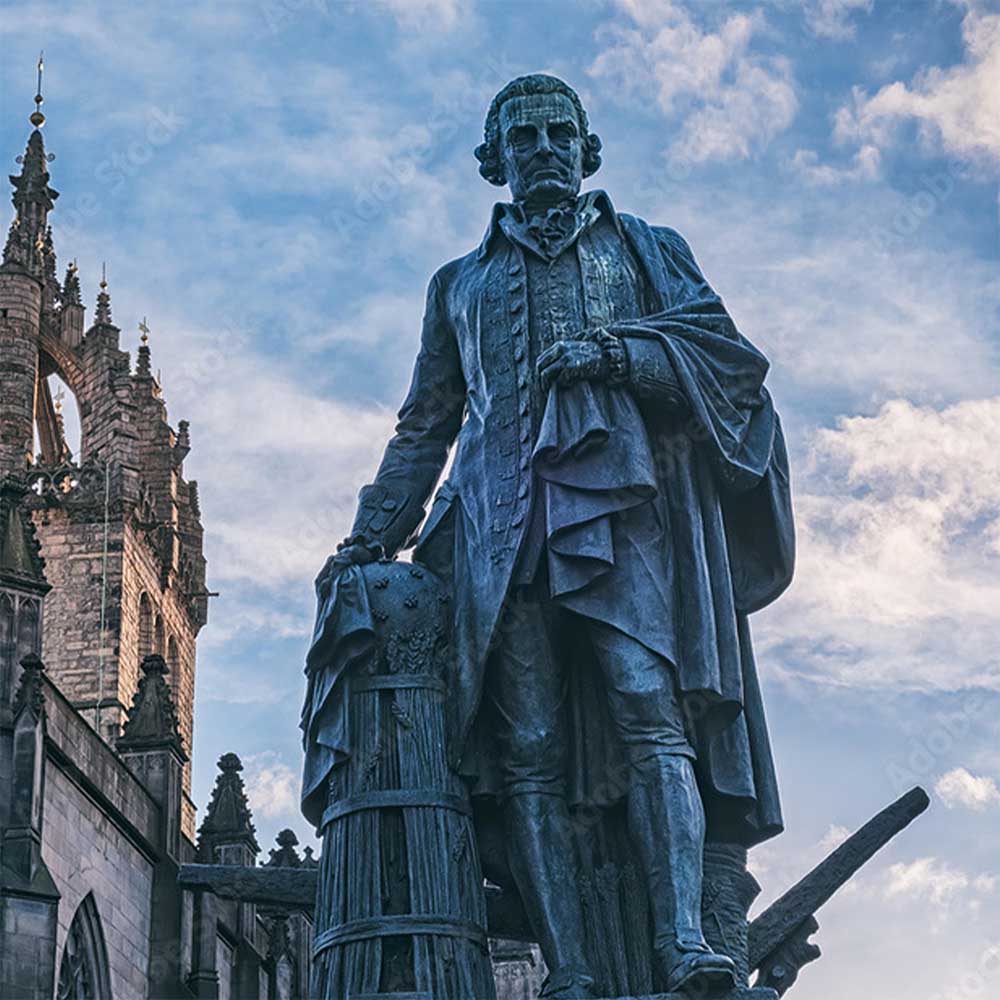
(Image: Stefan Schäfer, Lich, CC BY-SA 4.0 <https://creativecommons.org/licenses/by-sa/4.0>, via Wikimedia Commons)
The statue of Adam Smith, sculpted by Hans Gasser, was erected around 1867. It is located near the cloisters in the University of Glasgow's main building.