
AMOS
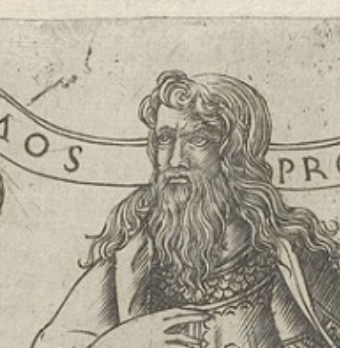
(Rosselli, Francesco, after Baccio Baldini. "The Prophet Amos, from Prophets and Sibyls." Wikimedia Commons. Ca. 1490. Accessed October 5, 2025. https://commons.wikimedia.org/wiki/File:The_Prophet_Amos,_from_Prophets_and_Sibyls_MET_DP835438.jpg.)
What happens when a shepherd warns two kingdoms they will fall?
Around 750 B.C. · Judah and Israel
Amos was among the earliest of the Hebrew prophets to have a biblical book named after him. Born in the kingdom of Judah sometime in the eighth century B.C., he worked most of his life as a shepherd. Around 750 B.C., during a period of divine revelation, he moved to the wealthier kingdom of Israel.
From shepherd to prophet
- Born: In the kingdom of Judah, in the eighth century B.C.
- Work: A shepherd for most of his life
- Taught at: The Shrine of Bethel, under the protection of Jeroboam II
- Sent away by: Amaziah, the high priest. Nothing more was heard from him.
- Remembered in: The biblical book that bears his name
Does God’s justice stop at a nation’s borders?
Hover or tap each idea to look closer
- Justice for AllAmos taught that God’s justice extends to all men, regardless of their nationality.
- A Duty to Pursue JusticeAll men, he taught, are expected to pursue justice.
- Teaching at BethelAmos taught for a time at the Shrine of Bethel, a sacred place of worship under the protection of Jeroboam II, until the high priest Amaziah asked him to leave.
- A Warning to Two KingdomsBecause Israel and Judah were increasingly falling under the influence of evil ways, Amos predicted the destruction of both kingdoms by plague and locusts.
- The Prophecy FulfilledDestruction did come, though not by plague or locusts. It came by conquering armies, beginning with the Assyrian Empire.
God’s justice extends to all men, regardless of their nationality.
Amos was among the earliest of the Hebrew prophets to have a biblical book named after him. A shepherd turned prophet, he taught that all men are expected to pursue justice, and he warned that kingdoms falling under the influence of evil ways would be destroyed.
Where to read more about Amos.
- 1978The Prophetic ImaginationBrueggemann, Walter · Fortress PressExplores Amos’s legacy in prophetic consciousness.
- 1988Hosea–Micah (Interpretation)Limburg, James · John Knox PressA readable, theological commentary.
- 1998The Book of Amos: A Commentary (Old Testament Library)Jeremias, Jörg · Westminster John Knox PressA scholarly commentary.
- 2002Amos—The Prophet and His Oracles: Research on the Book of AmosCarroll R., M. Daniel · Westminster John Knox PressAn in-depth study of Amos’s context and message.
- The Book of AmosFound in any standard Bible.
- The Dead Sea ScrollsFragments of the book, held at the Israel Museum, Jerusalem, and viewable in digital collections.Israel MuseumLeon Levy Digital Library
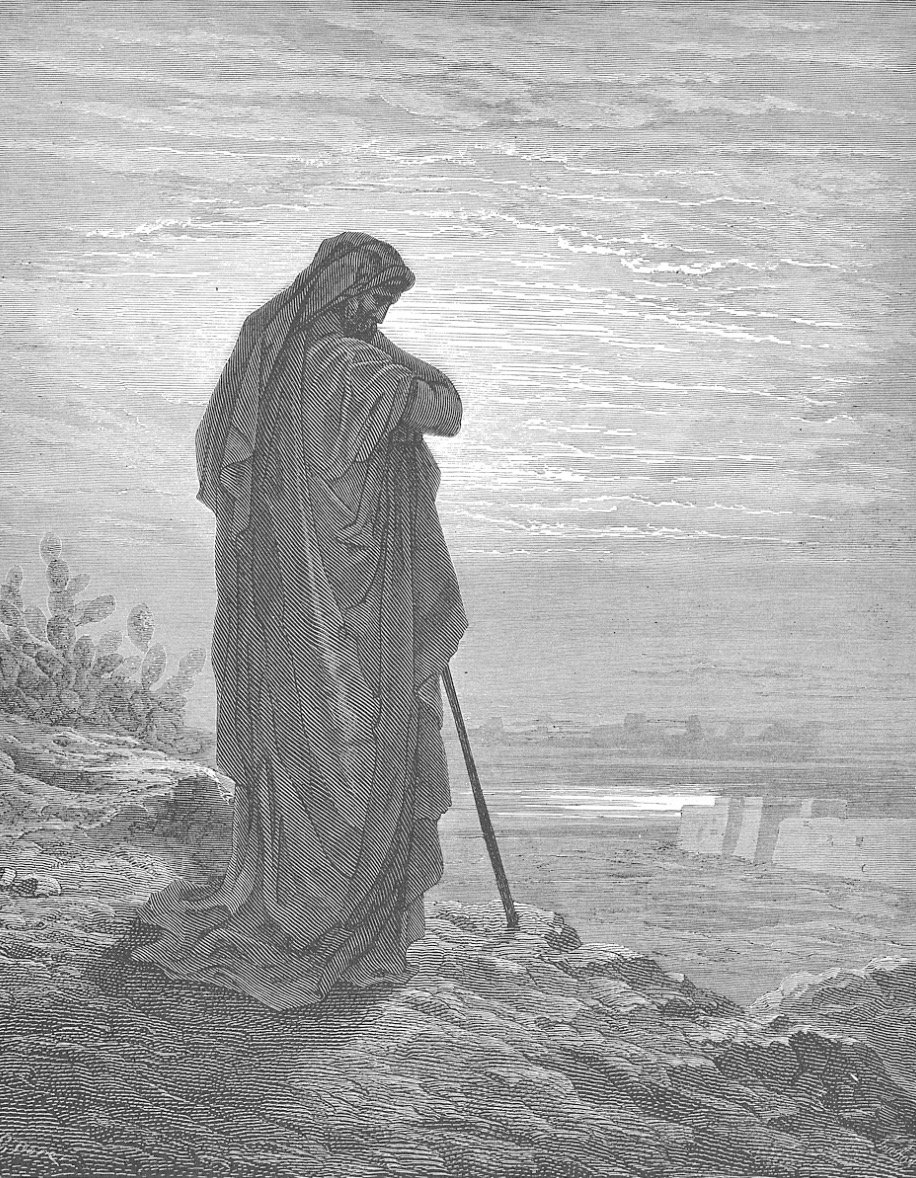
("Amos, PA08272.jpg." Wikimedia Commons. Accessed October 5, 2025. https://commons.wikimedia.org/wiki/File:Amos,_PA08272.jpg.)
A 16th-17th century Dutch engraving depicting the biblical prophet Amos in traditional attire, emphasizing his role as a shepherd-prophet.

(Amos - AI-generated image)
The vision of Prophet Amos, standing in awe as a radiant divine figure and celestial beings lower a plumb line from the heavens over a serene valley, signifies his profound role as the Oracle of Justice, delivering God's call for righteousness and condemning social injustice in ancient Israel.
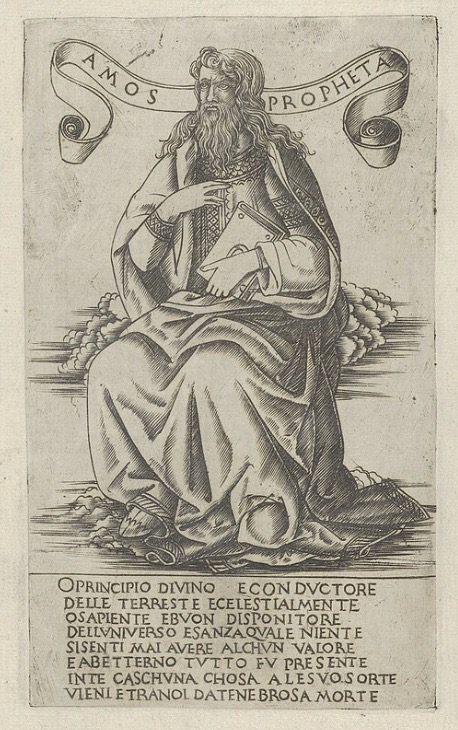
(Rosselli, Francesco, after Baccio Baldini. "The Prophet Amos, from Prophets and Sibyls." Wikimedia Commons. Ca. 1490. Accessed October 5, 2025. https://commons.wikimedia.org/wiki/File:The_Prophet_Amos,_from_Prophets_and_Sibyls_MET_DP835438.jpg.)
A 15th-century Italian engraving by Francesco Rosselli after Baccio Baldini, showing Amos holding a scroll as one of the prophets and sibyls.