ARCHIMEDES
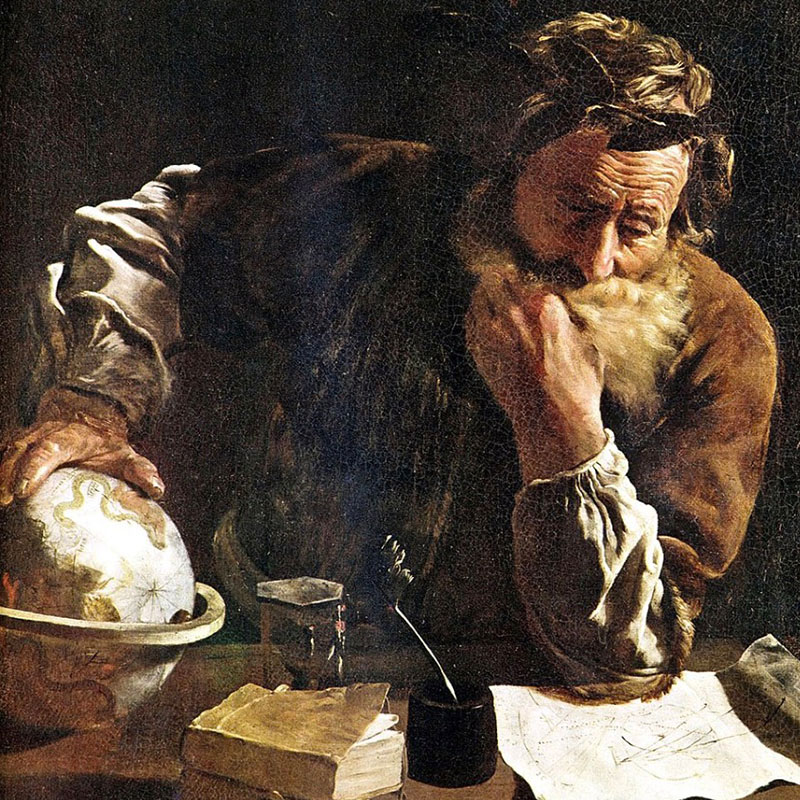
(“Fetti, Domenico. ‘Archimedes Thoughtful.’ Oil on canvas. 1620. 96.5 cm × 75 cm. Kunsthistorisches Museum, Vienna.” Wikimedia Commons. https://commons.wikimedia.org/wiki/File:Domenico-Fetti_Archimedes_1620.jpg.)
Born: c. 287 BCE, Syracuse, Sicily (modern-day Italy)
Died: c. 212 BCE, Syracuse, Sicily (modern-day Italy)
Notable
-
Genius of Mathematical Discovery: Archimedes, a Greek mathematician and inventor, is celebrated for his groundbreaking contributions to geometry, calculus, and physics, including the principles of buoyancy and the lever.
-
Innovator Through Adversity: Known for his inventive spirit, Archimedes’ development of war machines and scientific instruments during the Siege of Syracuse exemplifies his ability to apply intellect under pressure.
287-212 BCE
Biography
Archimedes (c. 287 BCE – c. 212 BCE) was a Greek mathematician, physicist, engineer, inventor, and astronomer, widely recognized as one of the greatest mathematicians of antiquity. He was born in Syracuse, Sicily, then a Greek city-state, to Phidias, an astronomer and mathematician.
Archimedes is believed to have studied in Alexandria, Egypt, the leading center of Greek learning, where he was influenced by the disciples of Euclid before returning to Syracuse for most of his life. He maintained correspondence with leading mathematicians of his era, such as Conon of Samos and Eratosthenes of Cyrene. Archimedes played a crucial role in defending Syracuse during the Roman siege by devising innovative war machines, ultimately dying during the sack of the city by Roman forces.
Bibliography / Primary Sources
Major extant works of Archimedes (originally written in Greek, surviving in medieval manuscript traditions):
On the Equilibrium of Planes (c. 3rd century BCE)
On the Measurement of a Circle (c. 3rd century BCE)
On Spirals (c. 3rd century BCE)
On the Sphere and Cylinder (c. 3rd century BCE)
On Floating Bodies (c. 3rd century BCE)
The Quadrature of the Parabola (c. 3rd century BCE)
The Sand Reckoner (c. 3rd century BCE)
The Method of Mechanical Theorems (c. 3rd century BCE)
Stomachion (c. 3rd century BCE)
Influences & Notable For
Notable For
Discovery of the principle of buoyancy (Archimedes’ Principle)
Foundational work in geometry, including formulas for the area and volume of spheres and cylinders
Development of the lever, pulley, and compound machines
Invention of the Archimedes screw for raising water
Source: Encyclopaedia Britannica – Archimedes
Influences
Educated in Alexandria, influenced by the mathematical tradition of Euclid
Engaged with the broader Hellenistic scientific community, including Conon of Samos and Eratosthenes
Built upon earlier Greek studies in geometry, mechanics, and astronomy
Archimedes’ intellectual development was deeply shaped by the vibrant Hellenistic scientific tradition. He is believed to have studied in Alexandria, Egypt, the premier center of learning in the ancient world, where he encountered the mathematical legacy of Euclid and interacted with leading scholars such as Conon of Samos and Eratosthenes of Cyrene. These connections placed Archimedes at the heart of the Alexandrian mathematical school, which emphasized rigorous deductive reasoning and the systematic exploration of geometry and mechanics. The influence of Eudoxus of Cnidus, who pioneered the method of exhaustion (an early form of integration), is particularly evident in Archimedes’ approach to calculating areas and volumes. Archimedes’ own correspondence with contemporaries and his engagement with the broader Greek tradition of mathematics and natural philosophy further enriched his work. While his inventions and practical achievements in mechanics made him famous in his lifetime, Archimedes’ true intellectual legacy lies in his synthesis of theoretical mathematics with mechanical reasoning, as exemplified in his treatise Method Concerning Mechanical Theorems—where he used mechanical analogies as heuristic tools for mathematical discovery, yet always grounded his conclusions in rigorous proof.
Famous quotes
- “Give me a place to stand, and a lever long enough, and I will move the world.” — Attributed in various ancient sources; see Encyclopaedia Britannica – Archimedes
- “Don’t disturb my circles!” (Noli turbare circulos meos!) — Attributed to Archimedes’ final moments; see Encyclopaedia Britannica – Archimedes
Legacy & Modern Significance
Archimedes’ contributions have shaped mathematics, physics, and engineering for over two millennia. His methods of mathematical proof influenced later mathematicians, including those of the Islamic Golden Age and the European Renaissance. The principle of buoyancy is foundational in fluid mechanics, and his inventions—such as the lever, screw, and compound pulley—remain central to mechanical engineering. Archimedes’ work on pi and large numbers laid groundwork for modern mathematical analysis and number theory. His legacy is visible in ongoing scientific research, educational curricula, and the continued study of his surviving texts.
Modern Moments & Impact on 21st Century
2002: The Archimedes Palimpsest, a 10th-century parchment containing previously lost works by Archimedes, was fully imaged and made accessible to scholars through a major project led by the Walters Art Museum and Stanford University. This discovery provided new insights into Archimedes’ mathematical methods, including his use of infinitesimals and combinatorics.
Source: Archimedes Palimpsest Project
Ongoing (21st century): Archimedes’ works are included in mathematics and physics curricula at universities and schools worldwide, with his principles on levers, buoyancy, and geometry forming foundational topics in STEM education.
Source: University of St Andrews – School of Mathematics History
Ongoing: The Archimedes screw remains in use globally for irrigation, drainage, and wastewater treatment, demonstrating the enduring practical relevance of his engineering innovations.
Source: Encyclopaedia Britannica – Archimedes Screw
2011–present: The publication of The Archimedes Palimpsest by Cambridge University Press and ongoing digital access to his works have enabled new generations of scholars to study his original texts and mathematical techniques.
Source: Cambridge University Press – The Archimedes Palimpsest
Annual events: Mathematics societies and academic institutions, such as the Mathematical Association of America and the European Mathematical Society, regularly hold lectures, conferences, and competitions named in Archimedes’ honor, reflecting his status as a foundational figure in the history of science.
Ongoing: Archimedes’ name and legacy are invoked in awards, educational initiatives, and public science outreach programs worldwide, such as the Archimedes Initiative, which promotes STEM learning and innovation.
Suggested Reading and Resources
Secondary Literature (Scholarship)
Netz, Reviel, William Noel, Natalie Tchernetska, and Nigel Wilson, eds. The Archimedes Palimpsest. Cambridge University Press, 2011.
Cambridge University Press – The Archimedes Palimpsest
Heath, Thomas L. The Works of Archimedes: Edited in Modern Notation with Introductory Chapters. Dover Publications, 2002 (original 1897).
Internet Archive – The Works of Archimedes
Dijksterhuis, E.J. Archimedes. Princeton University Press, 1987.
Princeton University Press – Archimedes
Netz, Reviel. The Shaping of Deduction in Greek Mathematics: A Study in Cognitive History. Cambridge University Press, 1999.
Cambridge University Press – The Shaping of Deduction in Greek Mathematics
Archival or Online Sources
“Archimedes’ Works,” Perseus Digital Library (public domain).
https://www.perseus.tufts.edu/
“Archimedes Palimpsest,” Walters Art Museum Digital Collection.
https://www.archimedespalimpsest.org/
“Biography of Archimedes,” Encyclopaedia Britannica.
https://www.britannica.com/biography/Archimedes
“Legacy of Archimedes,” Number Analytics.
https://www.numberanalytics.com/blog/legacy-of-archimedes
MASTER OF MATHEMATICAL MARVELS
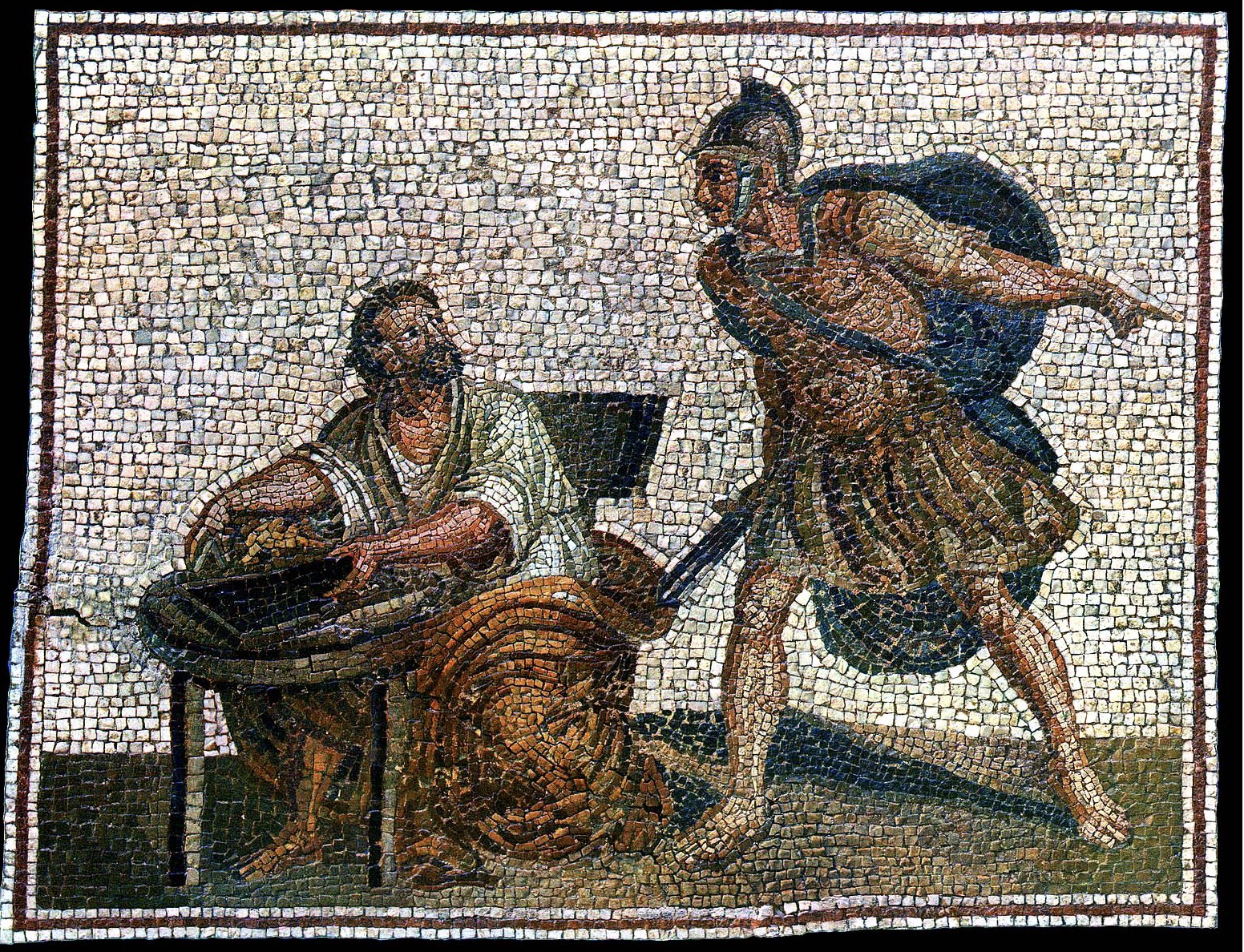
(“Archimedes before his death with the Roman soldier, Roman mosaic.” Photograph of mosaic. Roman period, circa 2nd century CE. Stone tesserae. Unknown location. Wikimedia Commons. https://commons.wikimedia.org/wiki/File:Archimedes_before_his_death_with_the_Roman_soldier%2C_Roman_mosaic.jpg.)
A Roman mosaic depicting Archimedes in his final confrontation with a Roman soldier, emphasizing his defiance and scholarly robes amid the chaos of invasion.
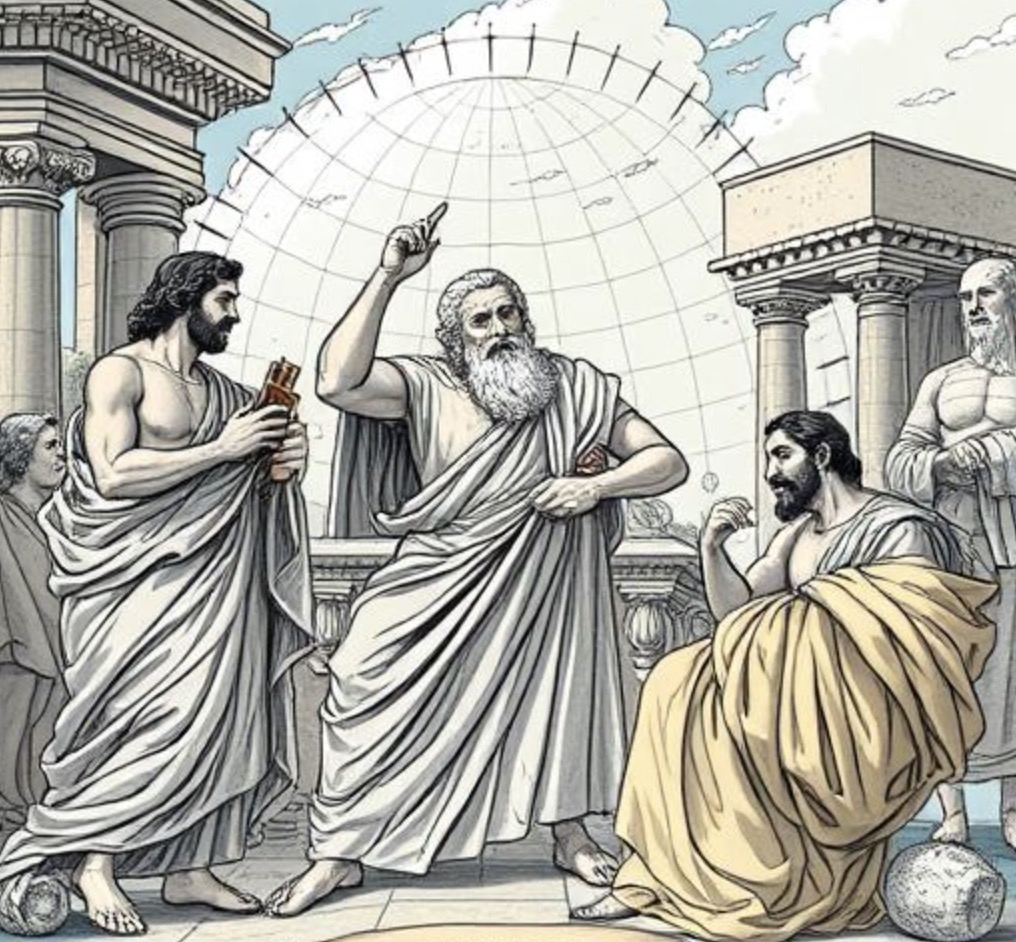
(AI-generated image)
Archimedes, the brilliant Greek mathematician and inventor, revolutionized science with his discoveries in geometry and buoyancy, leaving a lasting legacy through innovations like the lever and his ingenious defense of Syracuse.
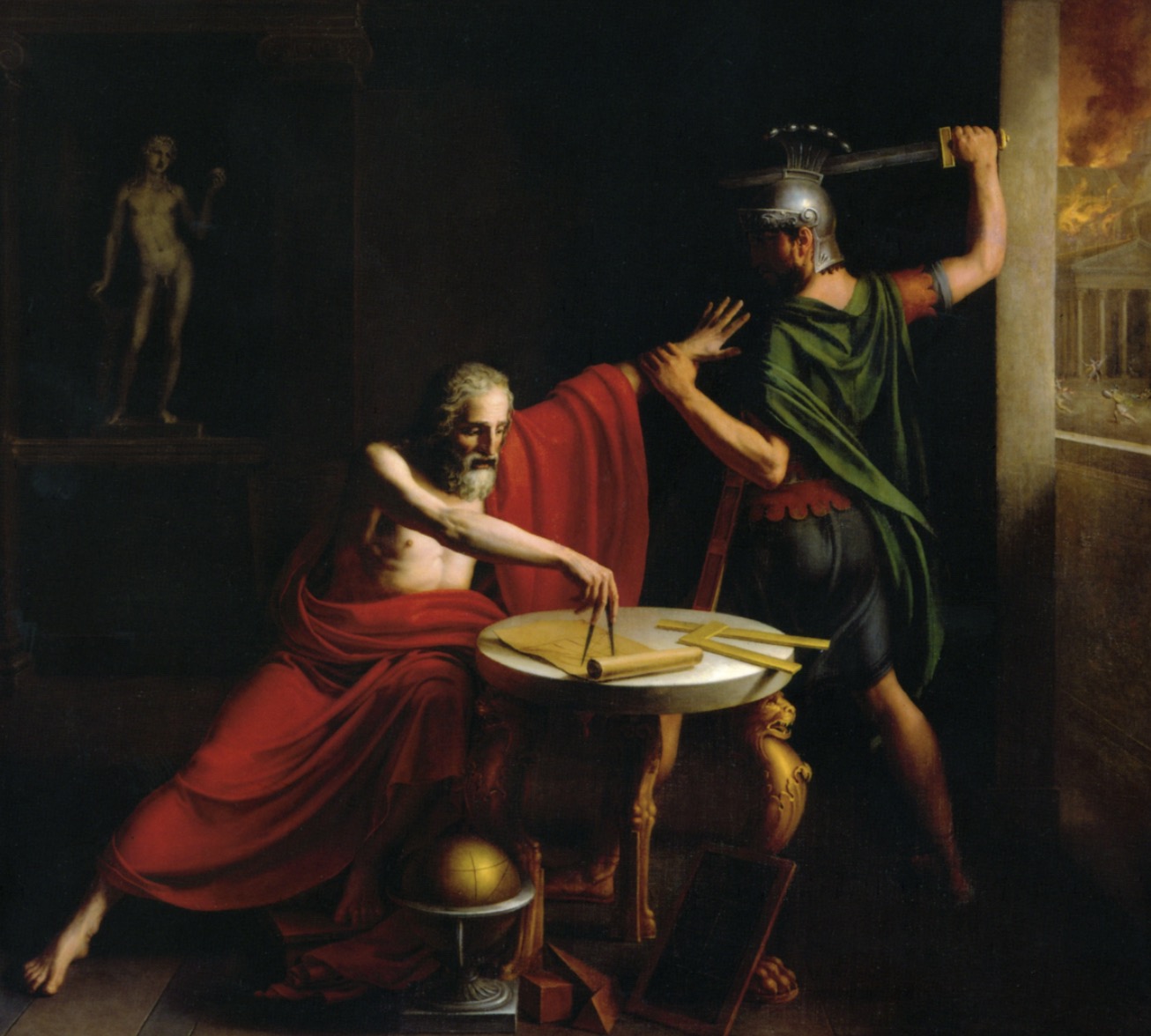
(“Archimedes before his death with the Roman soldier, Roman mosaic.” Photograph of mosaic. Roman period, circa 2nd century CE. Stone tesserae. Unknown location. Wikimedia Commons. https://commons.wikimedia.org/wiki/File:Archimedes_before_his_death_with_the_Roman_soldier%2C_Roman_mosaic.jpg.)
A Roman mosaic depicting Archimedes in his final confrontation with a Roman soldier, emphasizing his defiance and scholarly robes amid the chaos of invasion.