Aristotle

Aristotle

Aristotle
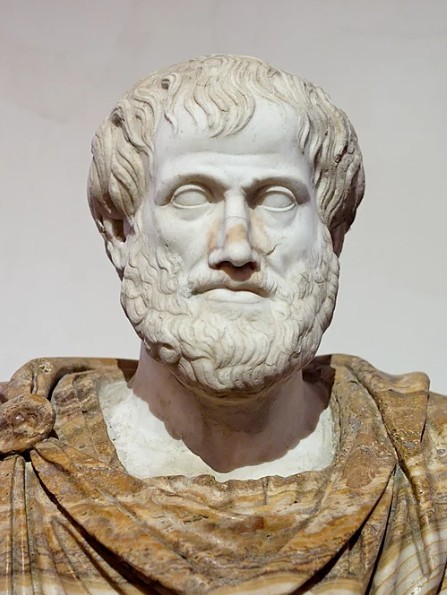
(“Aristoteles Louvre.” Photograph of marble bust. Roman copy, circa 1st century CE. Marble. Louvre Museum, Paris. Wikimedia Commons. https://commons.wikimedia.org/wiki/File:Aristoteles_Louvre.jpg.)

Born: 384 BCE, Stagira, Greece

Died: 322 BCE, Chalcis, Greece

Notable

  • Founder of Formal Logic: Developed syllogistic logic, which remained dominant in Western thought until the 19th century.
  • Pioneer in Biology: Conducted groundbreaking empirical studies in zoology and marine biology, with observations not matched until the early modern era.
  • Virtue Ethics: Introduced the concept of eudaimonia (human flourishing) and the doctrine of the mean in ethics.
  • Political Theory: Authored Politics, analyzing constitutions and the ideal state.

384–322 CE

Biography

Aristotle was born in 384 BCE in Stagira, a Greek city on the Chalcidic peninsula of Macedonia. His father, Nicomachus, was a physician to King Amyntas III of Macedon, providing Aristotle with early exposure to medicine and natural philosophy. After his father’s death, Aristotle moved to Athens at age seventeen, where he became a student at Plato’s Academy. He remained there for two decades, deeply engaging with Platonic philosophy and participating in philosophical debates.

Upon Plato’s death, Aristotle left Athens, traveling to Assus and later Mytilene, where he conducted extensive biological research and established close ties with Hermias, ruler of Assus. He tutored Alexander the Great while in Macedonia and, upon returning to Athens in 335 BCE, founded the Lyceum, a school that rivaled the Academy. Aristotle taught and wrote at the Lyceum until political turmoil forced him to leave Athens in 322 BCE; he died later that year in Chalcis.

Aristotelian ethics, metaphysics, and logic more broadly remained at the core of European and Middle Eastern thought well into the 18th century. Through Christian theologians such as Thomas Aquinas and Islamic philosophers such as Abu Nasr Muhammad al-Farabi, Aristotle became a mainstay of religious scholarship and critical commentary. Among other classical philosophers, Aristotle’s discussion of “virtue” would be reimagined by Renaissance and Enlightenment scholars alike.

    Bibliography & Major Works

    Aristotle’s surviving works, known collectively as the Corpus Aristotelicum, are divided into exoteric (public) and esoteric (technical, for students) writings. Most of what remains are lecture notes or treatises intended for his school. Key works include:

    Categories (ca. 350 BCE): Classifies the types of things that exist.
    On Interpretation (ca. 350 BCE): Analyzes propositions and language.
    Prior Analytics (ca. 350 BCE): Introduces syllogistic logic.
    Posterior Analytics (ca. 350 BCE): Discusses scientific demonstration.
    Topics (ca. 350 BCE): Deals with dialectical reasoning.
    Sophistical Refutations (ca. 350 BCE): Examines logical fallacies.
    Physics (ca. 335 BCE): Investigates nature, change, and causality.
    On the Soul (De Anima) (ca. 335 BCE): Explores the nature of the soul.
    Metaphysics (ca. 335–323 BCE): Examines being, substance, and the causes of things.
    Nicomachean Ethics (ca. 335–323 BCE): Discusses happiness, virtue, and the good life.
    Eudemian Ethics (ca. 335–323 BCE): Alternate treatise on ethics.
    Magna Moralia (ca. 335–323 BCE, debated authorship): Further ethical discussions.
    Politics (ca. 335–323 BCE): Analyzes forms of government.
    Rhetoric (ca. 335–323 BCE): Study of persuasive speech.
    Poetics (ca. 335–323 BCE): Analysis of tragedy and poetry.

    The standard scholarly reference is the Bekker edition, which assigns page and line numbers used universally in citations (e.g., 980a for Metaphysics).

    Influences & Notable For
    • Founder of Formal Logic: Developed syllogistic logic, which remained dominant in Western thought until the 19th century.
    • Pioneer in Biology: Conducted groundbreaking empirical studies in zoology and marine biology, with observations not matched until the early modern era.
    • Virtue Ethics: Introduced the concept of eudaimonia (human flourishing) and the doctrine of the mean in ethics.
    • Political Theory: Authored Politics, analyzing constitutions and the ideal state.
    Famous quotes
    • “All people by nature desire knowledge.”
      — Metaphysics, Book I, Chapter 1 (980a).

    • “Excellence is never an accident. It is always the result of high intention, sincere effort, and intelligent execution; it represents the wise choice of many alternatives—choice, not chance, determines your destiny.”
      — Often attributed to Aristotle, though likely a modern paraphrase inspired by Nicomachean Ethics.

    • “Man is by nature a political animal.”
      — Politics, Book I, Chapter 2 (1253a).

    Major Works

    Organon (Logic)
    Categories: Systematically classifies types of beings.
    On Interpretation: Analyzes the structure of propositions.
    Prior Analytics: Introduces syllogistic logic.
    Posterior Analytics: Explores scientific demonstration.
    Topics: Addresses dialectical reasoning.
    Sophistical Refutations: Identifies logical fallacies.

    Physics
    Examines the principles of nature, change, and causality.

    On the Soul (De Anima)
    Investigates the nature of the soul and its faculties.

    Metaphysics
    Explores being, substance, and the ultimate causes of things.

    Nicomachean Ethics
    Discusses the nature of happiness, virtues, and the good life.

    Politics
    Analyzes forms of government, citizenship, and the ideal state.

    Rhetoric
    Studies the art of persuasive speech.

    Poetics
    Analyzes the structure and purposes of tragedy and poetry.

    Legacy & Modern Significance

    Aristotle’s thought has profoundly shaped Western philosophy, science, and education. His works were foundational for medieval scholasticism, Renaissance humanism, and the development of the scientific method. Philosophers such as Thomas Aquinas, Immanuel Kant, and John Stuart Mill built upon or critiqued his theories. Aristotle’s logic, ethics, and political theory remain central to academic curricula in philosophy, political science, and biology. Ongoing debates persist regarding the universality of his ethical principles and the applicability of his scientific methodology in the modern world.


    Modern Moments & Impact on the 21st Century

    Ongoing (2000–Present): Nicomachean Ethics and Politics are required reading in philosophy and political science courses at major universities worldwide (e.g., Harvard, Oxford, Stanford).
    2012: The Aristotle Digital Archive project launched to digitize and annotate all extant works.
    2020: Aristotle University of Thessaloniki continues to host international conferences on Aristotelian philosophy.
    Ongoing: The “Aristotle Prize” is awarded by the European Academy of Sciences for outstanding contributions to philosophy and science.
    Ongoing: Scholarly societies, such as the International Association for Greek Philosophy, promote research and conferences on Aristotle’s thought.


    Influences & Intellectual Context

    Aristotle was profoundly influenced by his teacher Plato and the earlier Greek philosophical tradition, including thinkers such as Parmenides, Heraclitus, and Pythagoras. His father’s medical background also shaped his interest in biology and natural science. The intellectual context of 4th-century BCE Greece, marked by Athenian democracy and the rise of Macedon, deeply informed his political and ethical writings. Aristotle founded the Peripatetic school (the Lyceum), which emphasized empirical observation and systematic analysis, distinguishing his approach from Plato’s more idealistic philosophy.

    Suggested Reading & Resources

    Secondary Literature (Scholarship)
    Barnes, Jonathan. Aristotle: A Very Short Introduction. Oxford University Press, 2000.
    Ackrill, J. L. Aristotle the Philosopher. Oxford University Press, 1981.
    Ross, W. D. Aristotle. Routledge, 1995.
    Broadie, Sarah. Ethics with Aristotle. Oxford University Press, 1991.
    Lear, Jonathan. Aristotle: The Desire to Understand. Cambridge University Press, 1988.

    Archival or Online Sources