
Bede

BEDE

Bede
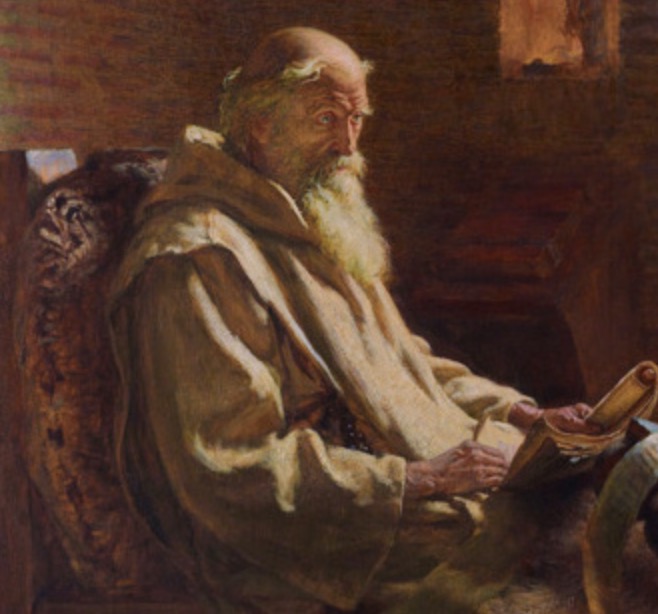
(Penrose, James Doyle. The Venerable Bede Translates John. Oil on canvas. 1902. Private collection. Wikimedia Commons. https://commons.wikimedia.org/wiki/File:The_Venerable_Bede_translates_John_1902.jpg.)

Born: circa 673 CE, Wearmouth-Jarrow, Kingdom of Northumbria (modern-day England)

Died: circa 735 CE, Jarrow, Kingdom of Northumbria

Notable

  • Father of English History: Authored Historia Ecclesiastica Gentis Anglorum (Ecclesiastical History of the English People), a foundational text for understanding early English history and Christianity.
  • Promotion of Christian Scholarship: Advanced theological and historical writing, integrating biblical exegesis with historical narrative, influencing medieval scholarship.

673-735 CE

Biography

Bede (circa 673–735 CE), better known as The Venerable Bede, was a monk, historian, and theologian whose scholarly contributions earned him the title “Father of English History.” Born in the kingdom of Northumbria, Bede entered the twin monasteries of Monkwearmouth and Jarrow as a child and remained there for life, dedicating himself to prayer, teaching, and extensive writing.

Though his physical travels were limited, Bede’s intellectual influence spanned centuries. Proficient in Latin and knowledgeable in Greek and Hebrew, he authored an array of works covering scriptural commentary, science, chronology, grammar, and saints’ lives. His most renowned work, Ecclesiastical History of the English People (731), is a foundational narrative documenting the Christianization of early England and remains a key text in medieval historiography.

Bede’s historical writing uniquely blends theological insight with meticulous research, and his adoption of the Anno Domini (AD) system played a major role in shaping how time was measured in Western history.

    Bibliography & Major Works

    Key Works:
    Ecclesiastical History of the English People (Historia Ecclesiastica Gentis Anglorum): A five-volume chronicle completed in 731 CE, detailing the emergence and growth of Christianity in England.

    De Natura Rerum (On the Nature of Things): A work of natural science and cosmology modeled after Isidore of Seville’s writings.

    De Temporibus and De Temporum Ratione (On Time and The Reckoning of Time): Treatises on the computation of time and calendar reform, in which Bede advocates for the Anno Domini system.

    Biblical Commentaries: Includes detailed exegeses on texts such as Genesis, Samuel, Ezra, the Gospels, and Revelation.

    Hagiographies: Including Lives of the Abbots of Wearmouth and Jarrow, among others.

    Manuscript Legacy:
    Bede’s writings were widely circulated in Latin and eventually translated into various vernacular languages. Numerous early manuscripts of the Ecclesiastical History survive, most notably the 8th-century St. Petersburg Bede, preserved in the British Library.


    Major Works / Textual Contents

    Ecclesiastical History of the English People
    Chronicles the Roman mission to Britain, the conversion of the Anglo-Saxons, and the intertwining of ecclesiastical and royal authority.
    Combines historical record with theological commentary.
    Ends with a vision of a unified Christian England under divine providence.

    De Temporum Ratione (On the Reckoning of Time)
    Explores calendrical systems, the calculation of Easter, and the theological significance of time.
    Introduced and popularized the AD system, which became essential for later historical chronology.

    Biblical Commentaries
    Strongly influenced by patristic sources such as Augustine, Jerome, and Gregory the Great.
    Utilize moral and allegorical readings in addition to historical analysis.

    Influences & Notable For

    Notable For

    Authoring the Ecclesiastical History of the English People, a pivotal source for early English Christianity and identity.

    Promoting the Anno Domini (AD) system, which became the standard framework for Western historical dating.

    Being declared a Doctor of the Church by Pope Leo XIII in 1899—the only Briton ever to receive that honor.

    Contributing significantly to biblical scholarship through detailed commentaries grounded in linguistic, historical, and theological expertise.

    Blending theological insight with historical narrative, setting the standard for medieval historiography.

    Influences 

    Bede was deeply shaped by the writings of the Church Fathers, particularly Augustine of Hippo and Jerome, as well as classical thinkers like Isidore of Seville. He worked within the Benedictine tradition, where monastic life prioritized scriptural study, liturgical devotion, and scholarly pursuit. His work arose during a period of increasing unity in the English Church and growing Christian outreach across Europe.


    Famous quotes
    • “It is better to suffer wrong than to do it.” — Ecclesiastical History
    • “Christ is the morning star, who, when the night of this world is past, brings to his saints the promise of the light of life.” — Homily on the Gospels
    • “I have devoted my energies to the study of the Scriptures, observing monastic discipline, and singing the daily services in church; study, teaching, and writing have always been my delight.” — Letter to Cuthbert
    Legacy & Modern Significance

    Historical Impact:
    Bede’s Ecclesiastical History remains a cornerstone for understanding Anglo-Saxon England and early Christian Europe.

    Theological Contribution:
    His scriptural exegesis influenced generations of medieval theologians and still holds value for modern biblical scholars.

    Chronological Influence:
    His promotion of the AD system had lasting effects on how Western cultures understand and track historical time.

    Academic Reputation:
    Celebrated as one of the most learned men of his era, Bede is honored across Catholic, Anglican, and Orthodox traditions alike.

    Modern Moments & Impact on 21st Century

    Historiography:
    Modern historians continue to reference Bede for his methodological rigor and nuanced blending of theology with history.

    Education:
    Bede’s writings are taught widely in courses on medieval studies, religious history, and historical writing.

    Cultural Legacy:
    He helped shape the narrative of a unified English Christian identity that continues to influence national history.

    Digital Access:
    His works are now digitized, studied through manuscript databases, and explored in interdisciplinary research projects within the digital humanities.

    Suggested Reading and Resources

    Secondary Literature
    Blair, Peter Hunter. The World of Bede. Cambridge University Press, 1990.
    Brown, George Hardin. A Companion to Bede. Boydell Press, 2009.
    Higham, N. J. Re-Reading Bede: The Ecclesiastical History in Context. Routledge, 2006.

    Archival and Online Resources
    Oxford University Press Edition:
    Bede’s Ecclesiastical History of the English People, trans. Bertram Colgrave & R. A. B. Mynors (1969).

    Jarrow Hall / Bede’s World:
    https://jarrowhall.com – A living history museum and research site.

    British Library (St. Petersburg Bede):
    www.bl.uk – Digital facsimile and scholarly commentary.

    Internet Medieval Sourcebook:
    https://sourcebooks.fordham.edu

    Anglo-Saxon England (Journal):
    Academic journal featuring articles on Bede’s writings and legacy.