
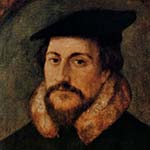
CALVIN
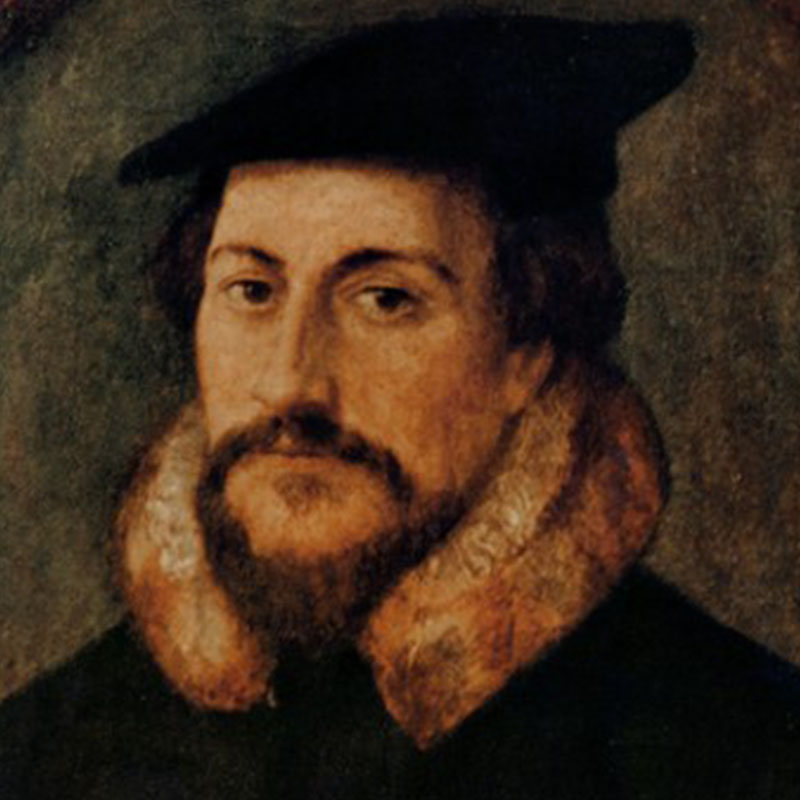
(Holbein the Younger, Hans. John Calvin. Drawing. ca. 1540. Wikimedia Commons. https://commons.wikimedia.org/wiki/File:John_Calvin_by_Holbein.png.)

Born: July 10, 1509, Noyon, Picardy, France
Died: May 27, 1564, Geneva, Switzerland
Notable
- Architect of Institutes of the Christian Religion: systematic theology of the Reformation
- Doctrines of Predestination and the Sovereignty of God
- Organizational reforms in Geneva: Ecclesiastical Ordinances (pastors, teachers, elders, deacons)
- Groundbreaking commentaries on most books of the Bible
1500–1600 AD works
Biography
John Calvin (born Jean Cauvin, July 10, 1509 – May 27, 1564) was a French theologian, pastor, and principal figure of the second generation of the Protestant Reformation. Born in Noyon, Picardy, France, to a notary father and a devout mother, Calvin originally trained as a humanist lawyer. After breaking from the Roman Catholic Church around 1530 during a period of intense anti-Protestant violence in France, he sought refuge in Basel, Switzerland. There, he began his major theological writings, including the first edition of his magnum opus, Institutes of the Christian Religion, published in 1536. Calvin’s influence soon made him a leader among the Protestant Reformers. He shaped the Reformation in Geneva, Switzerland, where he spent most of his later life, instituting reforms in theology, church practice, and education that would lay the groundwork for what became Reformed and Presbyterian traditions. His strict discipline and emphasis on the sovereignty of God remain central to Calvinist thought.
Influences & Notable For
Architect of Institutes of the Christian Religion: systematic theology of the Reformation
Doctrines of Predestination and the Sovereignty of God
Organizational reforms in Geneva: Ecclesiastical Ordinances (pastors, teachers, elders, deacons)
Groundbreaking commentaries on most books of the Bible
Famous quotes
“True wisdom consists in two things: Knowledge of God and knowledge of self.” (Institutes of the Christian Religion)
“There is no worse screen to block out the Spirit than confidence in our own intelligence.”
“Man's nature, so to speak, is a perpetual factory of idols.
"The gospel is not a doctrine of the tongue, but of life. It cannot be grasped by reason and memory only, but it is fully understood when it possesses the whole soul and penetrates to the inner recesses of the heart.”
Legacy & Modern Significance
Calvin’s Geneva set the pattern for Reformed church governance and social welfare, influencing later forms of religious, civic, and political life.
His theology impacted religious thought in Great Britain, the Netherlands, and spread globally with the expansion of Reformed churches.
The concept of vocation (“calling”) helped shape the Protestant work ethic and, via Puritanism, influenced Anglo-American culture and law.
Scholars continue to both build on and critique his doctrines—especially predestination, church-state relations, and scriptural interpretation.
His contributions to ideas of education, poor relief, freedom of the church, and even early democratic principles are frequently referenced in modern academic, theological, and political discourse.
Modern Moments & Impact on the 21st Century
2009: 500th-anniversary celebrations of Calvin’s birth, including international conferences and new scholarly editions (Calvin 09 initiative across Europe).
2009: Princeton University Press released Bruce Gordon's widely acclaimed John Calvin’s Institutes of the Christian Religion: A Biography.
Ongoing: Calvin’s works are used in Reformed theology curricula worldwide; Calvin University and Calvin Theological Seminary (Grand Rapids, Michigan, USA) continue as major centers for Calvin scholarship and public engagement.
Present: Numerous digital public domain editions of Institutes and other works are available via Internet Archive, HathiTrust, and various university libraries.
Influences & Intellectual Context
Influenced by Desiderius Erasmus (Christian humanism)
Early Reformation theology, especially Martin Luther and Philipp Melanchthon
Legal and philosophical training in Paris and Orléans
Renaissance humanist methods and classical scholarship
Swiss Reformation leader Guillaume Farel facilitated Calvin’s move to Geneva
Suggested Reading & Resources
Secondary Literature (Scholarship)
Bruce Gordon, Calvin, Yale University Press, 2009
https://yalebooks.yale.edu/book/9780300170849/calvin/
T.H.L. Parker, John Calvin: A Biography, Westminster Press, 1976
https://www.cambridge.org/core/product/identifier/S0009640700073807/type/journal_article
Alister E. McGrath, A Life of John Calvin, Blackwell, 1990Stanford Reid, John Calvin: His Influence in the Western World, Zondervan, 1982
Archival or Online Sources
“John Calvin bibliography,” Wikipedia.
https://en.wikipedia.org/wiki/John_Calvin_bibliography
“The Works of Jean Calvin,” Musée protestant (public domain facsimiles).
https://museeprotestant.org/en/notice/the-works-of-jean-calvin/
“John Calvin Archive,” Calvin University, digital collection.
https://calvin.edu/about/history/john-calvin.html
THE LEGACY OF DIVINE SOVEREIGNTY
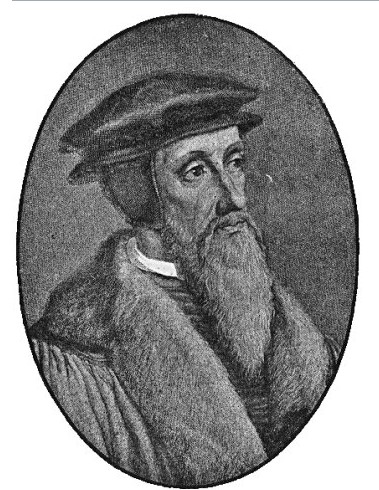
(Unknown. John Calvin. Oil on canvas. ca. 1550. Wikimedia Commons. https://commons.wikimedia.org/wiki/File:John_Calvin.jpg.)

An anonymous 16th-century oil portrait of John Calvin, the French theologian, in black robes with a stern expression, holding a book representing his Institutes of the Christian Religion and development of Reformed doctrine.
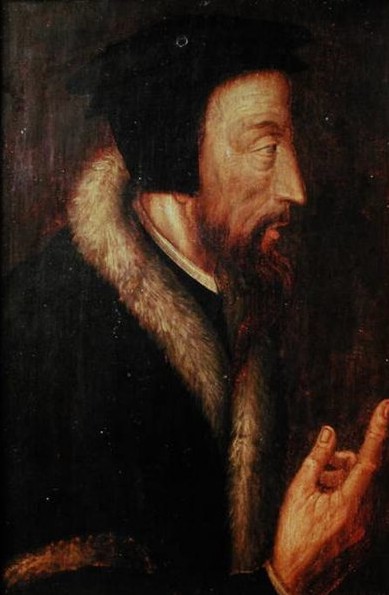
(Unknown. Portrait of John Calvin. Oil on panel. ca. 1550. Bibliothèque de Genève. Wikimedia Commons. https://commons.wikimedia.org/wiki/File:Portrait_john_calvin.jpg.)

A 16th-century portrait of John Calvin by an unknown artist, depicting him in profile with a beard and cap, emphasizing his leadership in Geneva and emphasis on predestination and church discipline.
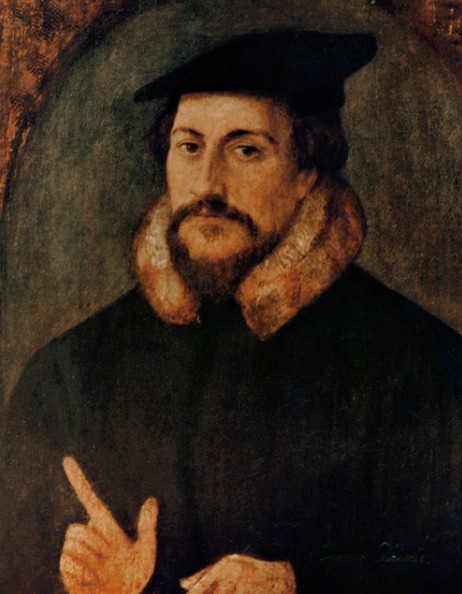
(Holbein the Younger, Hans. John Calvin. Drawing. ca. 1540. Wikimedia Commons. https://commons.wikimedia.org/wiki/File:John_Calvin_by_Holbein.png.)
Hans Holbein the Younger's drawing of John Calvin, showing the reformer in simple attire with a thoughtful gaze, highlighting his role in the Protestant Reformation and establishment of Presbyterian governance.