
Copernicus
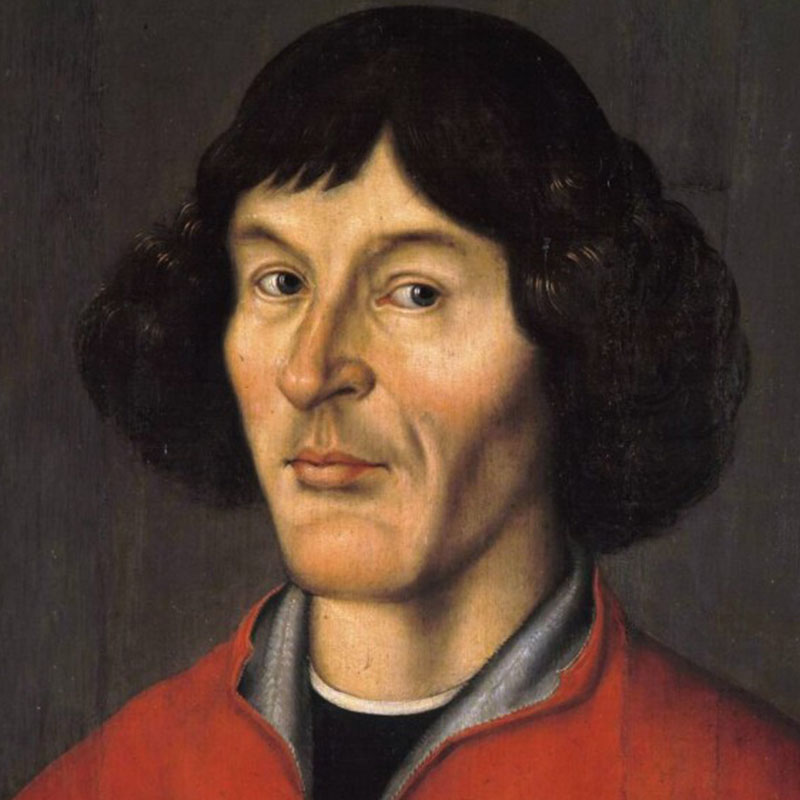
(Unknown. Nikolaus Kopernikus. Oil on canvas. ca. 1650. Wikimedia Commons. https://commons.wikimedia.org/wiki/File:Nikolaus_Kopernikus.jpg.)

Born: February 19, 1473 – Toruń, in the Kingdom of Poland
Died: May 24, 1543 – Frombork, in the region of Warmia
Notable
-
Heliocentrism: Proposed the Sun-centered model of the universe.
-
Scientific Revolution: Authored De revolutionibus, reshaping cosmology.
-
Enduring Impact: Transformed views of the cosmos and influenced Galileo, Kepler, and Newton.
Biography
Nicolaus Copernicus (1473–1543) was a Polish astronomer, mathematician, physician, and
church official who completely changed the way we understand the universe. Born in the city of
Toruń, he studied in places like Cracow, Bologna, and Padua, picking up knowledge in
everything from astronomy and math to law and medicine. Even though he spent much of his life
working as a canon in the Church, his true passion was watching the skies. His groundbreaking
book, On the Revolutions of the Celestial Spheres (1543), introduced the radical idea that the
Earth wasn’t the center of the universe—instead, it moves around the Sun. This idea, known as
heliocentrism, kicked off what we now call the Copernican Revolution. While he didn’t live long
enough to see the full impact of his work, it laid the foundation for modern astronomy and
inspired later scientists like Galileo, Kepler, and Newton.
Influences & Notable For
Coming up with the heliocentric model—putting the Sun, not the Earth, at the center.
Writing De revolutionibus, which played a major role in the Scientific Revolution.
Changing the way people saw their place in the universe.
Influencing great minds like Galileo, Kepler, and Newton.
Famous quotes
“Finally, we shall place the Sun at the center of the Universe.”
“To know that we know what we know, and to know that we do not know what we do not
know—that is true knowledge.”“Mathematics is written for mathematicians.”
Legacy & Modern Significance
Changed Astronomy Forever: His model redefined how we understand space and motion.
Started the Scientific Revolution: Inspired a whole new way of thinking based on observation
and evidence.
Symbol of Intellectual Bravery: He took a huge risk by challenging the status quo.
Philosophical Shockwave: His theory shook not just science, but theology and philosophy
too—changing how people saw themselves in the universe.
Modern Moments & Impact on the 21st Century
His name lives on through institutions like the Copernicus Science Centre in Warsaw.
The Copernicus Crater on the Moon honors his contributions.
His model is still used as a symbol of paradigm shifts—how bold ideas can change the world.
Modern science educators and historians still turn to his work when talking about the roots of
rational inquiry.
Copernicus waited decades to publish his book, knowing it would cause controversy—but he
made sure it would eventually be heard.
Influences & Intellectual Context
Copernicus was familiar with ancient and medieval astronomy, especially the geocentric ideas of
Ptolemy. But he also looked into earlier and less mainstream models—some from Islamic
scholars like Al-Tusi and Al-Bitruji, whose mathematical ideas helped shape his own. He
worked within the Church’s intellectual traditions and believed that science and faith could work
together. His work reflected both classical thinking (like Plato and Aristotle) and the spirit of the
Renaissance.
Suggested Reading & Resources
Books:
Copernicus, On the Revolutions of the Heavenly Spheres, trans. Edward Rosen – Johns Hopkins
University Press, 1992
Arthur Koestler, The Sleepwalkers – A deep dive into the history of astronomy
Robert Westman, The Copernican Question – Focuses on Copernicus’s intellectual world
Thomas Kuhn, The Copernican Revolution – Classic analysis of Copernicus’s impact on science
Online Resources:
Stanford Encyclopedia of Philosophy – Copernicus
NASA – Legacy of Copernicus
Copernicus Science Centre
Digital copy of De revolutionibus – Jagiellonian Library
REVOLUTION OF ASTRONOMICAL THOUGHT
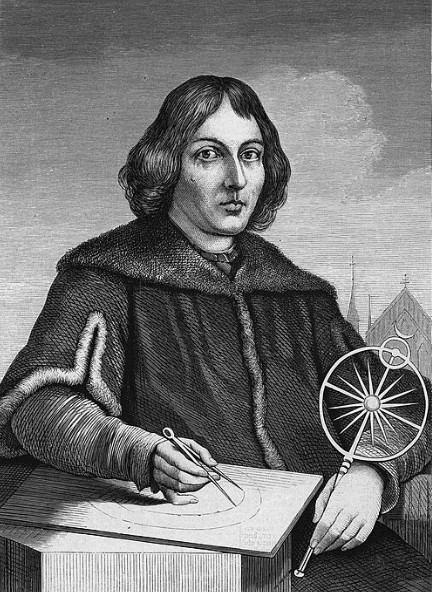
(Unknown. Portrait of Nicolaus Copernicus. Oil on canvas. ca. 1580. Wikimedia Commons. https://commons.wikimedia.org/wiki/File:Copernicus.jpg.)

A 16th-century portrait of Nicolaus Copernicus, the Polish astronomer, depicted in profile with fur collar and cap, holding a compass and armillary sphere, symbolizing his heliocentric theory in De revolutionibus orbium coelestium that revolutionized cosmology.
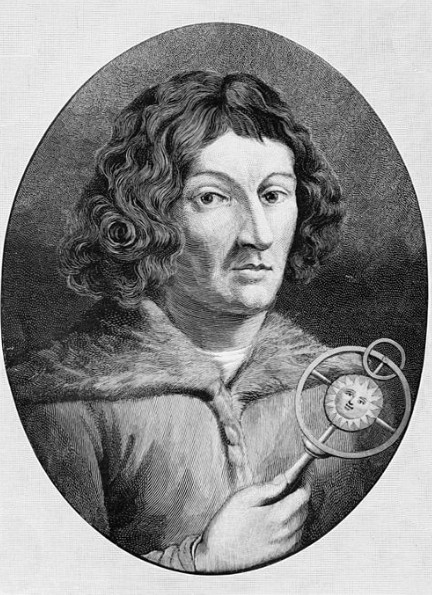
(Unknown. Nikolaus Copernicus. Engraving. 1891. From Popular Science Monthly, vol. 39. Wikimedia Commons. https://commons.wikimedia.org/wiki/File:PSM_V39_D156_Nikolaus_Copernicus.jpg.)

An engraved portrait from the 19th-century Popular Science Monthly, showing Nicolaus Copernicus with a stern expression and scholarly attire, based on historical sources, highlighting his mathematical contributions to astronomy and the shift from geocentric models.
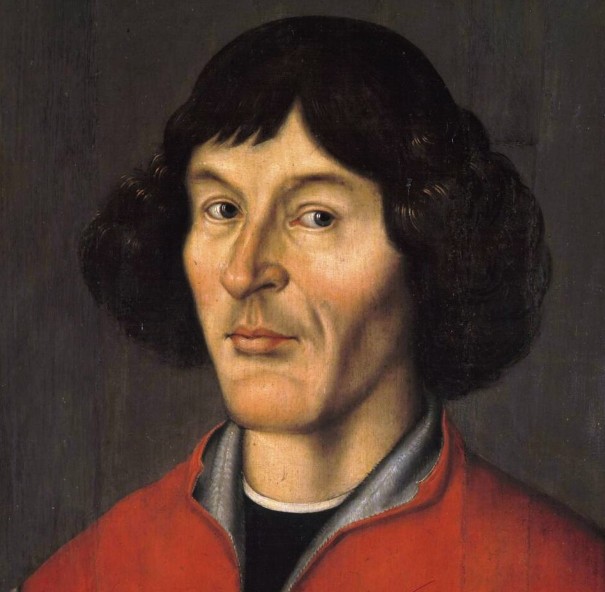
(Unknown. Nikolaus Kopernikus. Oil on canvas. ca. 1650. Wikimedia Commons. https://commons.wikimedia.org/wiki/File:Nikolaus_Kopernikus.jpg.)
A 17th-century posthumous portrait of Nicolaus Copernicus, rendered in oils with a globe and books, capturing his legacy as the father of modern astronomy and his work on planetary motion that influenced the Scientific Revolution.