
DANTE
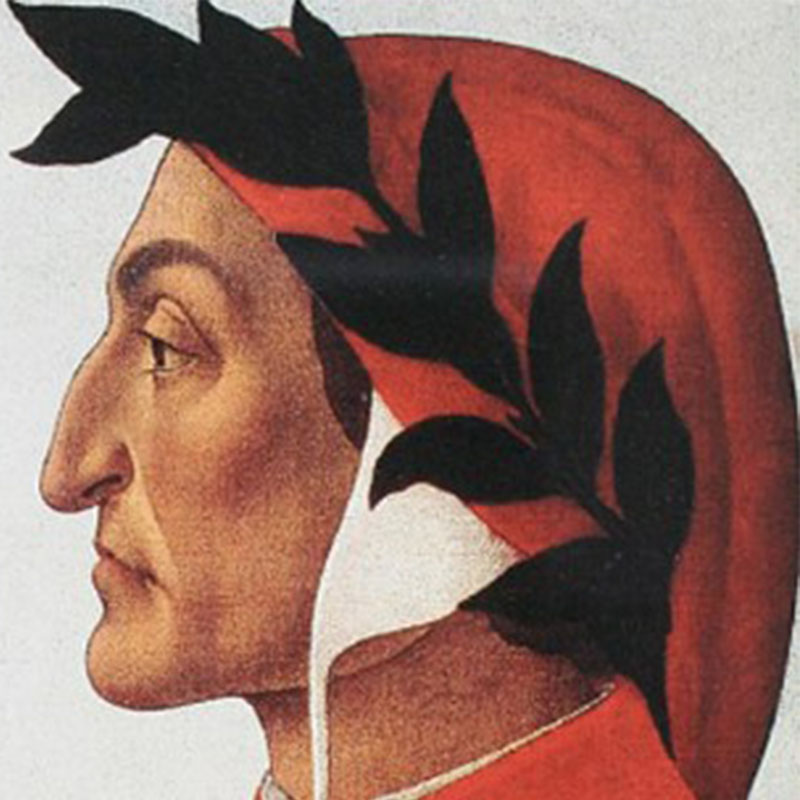
(Unknown artist. "Medal Portrait of Dante." Bronze. 15th century. Musée du Louvre, Paris. Wikimedia Commons. https://commons.wikimedia.org/wiki/File:Portrait_de_Dante.jpg.)

Born: c. May 21–June 20, 1265, Florence, Italy
Died: September 13/14, 1321, Ravenna, Italy
Notable
- “Father of the Italian Language”: Established the Tuscan dialect as the basis for standard Italian.
- Author of The Divine Comedy: Considered one of the greatest literary works of the Middle Ages and the Western canon.
- Pioneering use of the Italian vernacular in major literary works at a time when Latin dominated intellectual life.
- Political theorist and advocate for the independence of secular authority (as expressed in De Monarchia).
1200–1300 AD works
Biography
Dante Alighieri was born in Florence, Italy, around May 21–June 20, 1265, to a family of lesser nobility. Florence at the time was a hotbed of political intrigue and factionalism, with the Guelph and Ghibelline parties vying for power—a scenario that would profoundly shape Dante’s life and work. His mother died in his childhood, and his father died when Dante was still young. He married Gemma Donati around 1285, though his great muse was Beatrice Portinari, who inspired much of his poetry. Dante played significant roles in the civic life of Florence, holding several public posts. However, his political affiliations led to his permanent exile in 1302 after the Black Guelphs came into power. He spent the remainder of his life in various Italian cities, including Verona, Bologna, and Ravenna, where he died on September 13 or 14, 1321. Dante’s experiences in exile and his erudition in philosophy, theology, and classical literature profoundly influenced his literary achievements, most famously The Divine Comedy—a journey through Hell (Inferno), Purgatory (Purgatorio), and Paradise (Paradiso) that became a foundational work in Western literature and established the Tuscan dialect as the Italian literary standard.
Influences & Notable For
- “Father of the Italian Language”: Established the Tuscan dialect as the basis for standard Italian.
- Author of The Divine Comedy: Considered one of the greatest literary works of the Middle Ages and the Western canon.
- Pioneering use of the Italian vernacular in major literary works at a time when Latin dominated intellectual life.
- Political theorist and advocate for the independence of secular authority (as expressed in De Monarchia).
Famous quotes
“Abandon every hope, you who enter.” (Inferno, Canto III)
“In His will is our peace.” (Paradiso, Canto III)
“The darkest places in hell are reserved for those who maintain their neutrality in times of moral crisis.” (Inferno, misattributed but widely connected with Dante or his themes)
“Midway upon the journey of our life, I found myself within a forest dark, for the straightforward path had been lost.” (Inferno, Canto I)
Legacy & Modern Significance
Dante’s influence pervades Western literature, philosophy, theology, and the arts. He is venerated in Italy as the “Supreme Poet” and “Father of the Italian Language.” The Divine Comedy shaped representations of the afterlife in both religious and secular contexts, impacting writers from Chaucer to T.S. Eliot. Dante’s alignment of personal, political, and universal themes allowed his poetry to function as an ongoing metaphor for spiritual and social journeys. His works have inspired translations, adaptations, operas, artworks, films, and countless scholarly studies. The founding of societies like the Dante Society of America and the continued inclusion of his works in curricula worldwide underscore his lasting relevance. Ongoing debates continue regarding his political views, religious interpretations, and vision of justice, with new perspectives emerging in modern contexts.
Modern Moments & Impact on the 21st Century
2006: The Princeton Dante Project launched, offering a digital edition of Dante’s works.
2021: 700th anniversary of Dante’s death, commemorated by UNESCO and Italian cultural organizations with international conferences, exhibitions, and performances.
2025: Planned launch of “La Divina Commedia Opera Musical” in China, showing global reach and adaptation of Dante’s narrative for a new audience.
Ongoing (2000–present): Dante’s Divine Comedy remains required reading in university literature courses worldwide, with digital critical editions published by institutions like Columbia University and Oxford University Press.
Annual: Dante readings and lectures hosted by the Dante Society of America and the Accademia della Crusca in Italy.
Influences & Intellectual Context
Influenced by classical writers, especially Virgil (who appears as a guide in The Divine Comedy).
Strongly shaped by Christian and Catholic theology, including the scholastic tradition.
Context influenced by the turmoil of Florentine politics, battles between Guelphs and Ghibellines.
Draws from Provençal poetry, the dolce stil nuovo literary movement, and encounters with philosophers like Boethius and Thomas Aquinas.
Suggested Reading & Resources
Secondary Literature (Scholarship):
Barolini, Teodolinda. Dante’s Poets: Textuality and Truth in the “Comedy”. Princeton University Press, 1984.
Hollander, Robert. Dante: A Life in Works. Yale University Press, 2001.
Jacoff, Rachel, ed. The Cambridge Companion to Dante. Cambridge University Press, 1993.
Kirkpatrick, Robin, ed. and trans. The Divine Comedy. Penguin Classics, 2012.
Zygmont, Bryan, ed. A Companion to Dante. Blackwell, 2007.
Archival or Online Sources:
“Dante Alighieri,” Stanford Encyclopedia of Philosophy: https://plato.stanford.edu/entries/dante/
“Dante’s Divine Comedy,” Columbia University Digital Dante: https://digitaldante.columbia.edu/
Princeton Dante Project: https://dante.princeton.edu/
Beinecke Rare Book & Manuscript Library (Yale): https://beinecke.library.yale.edu/
Dante Society of America: https://dantesociety.org/
FATHER OF THE ITALIAN LANGUAGE
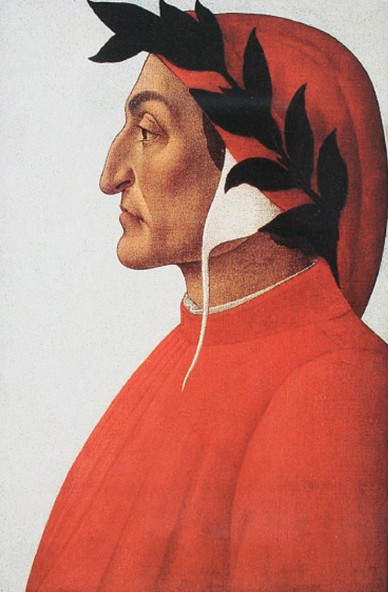
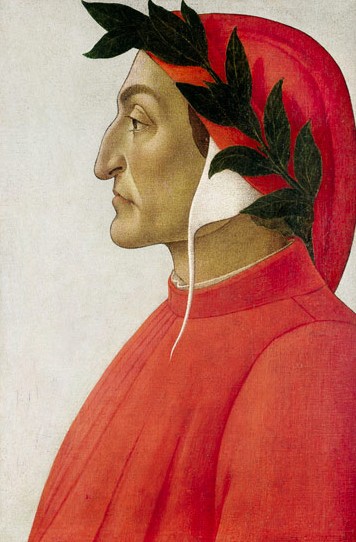
(Botticelli, Sandro. "Portrait of Dante." Tempera on panel. Circa 1495. Biblioteca Laurenziana, Florence. Wikimedia Commons. https://commons.wikimedia.org/wiki/File:Dante_Alighieri%27s_portrait_by_Sandro_Botticelli.jpg.)

A renowned portrait of Dante Alighieri by Sandro Botticelli, showing the poet in red robes with a laurel wreath, gazing thoughtfully amid a landscape.
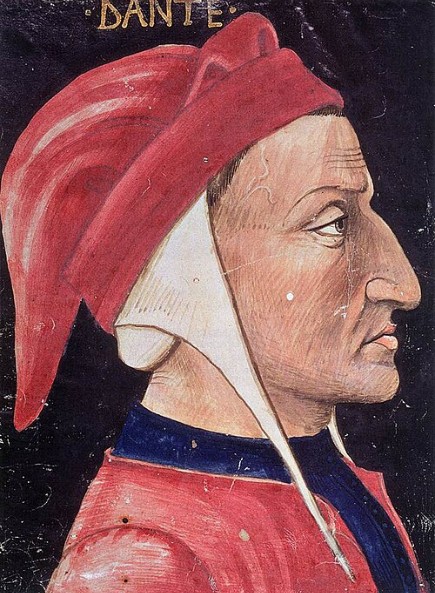
(Unknown 15th-century illuminator. "Portrait of Dante Alighieri." Ink and color on vellum. Circa 1450–1475. Private collection. Wikimedia Commons.)
An anonymous 15th-century manuscript illumination portraying Dante with his characteristic aquiline nose and somber expression, from a collection of his rhymes.
(Unknown artist. "Medal Portrait of Dante." Bronze. 15th century. Musée du Louvre, Paris. Wikimedia Commons. https://commons.wikimedia.org/wiki/File:Portrait_de_Dante.jpg.)
A bronze medal portrait of Dante by an unknown Renaissance artist, capturing his profile in high relief against a classical background.