
DECLARATION OF INDEPENDENCE
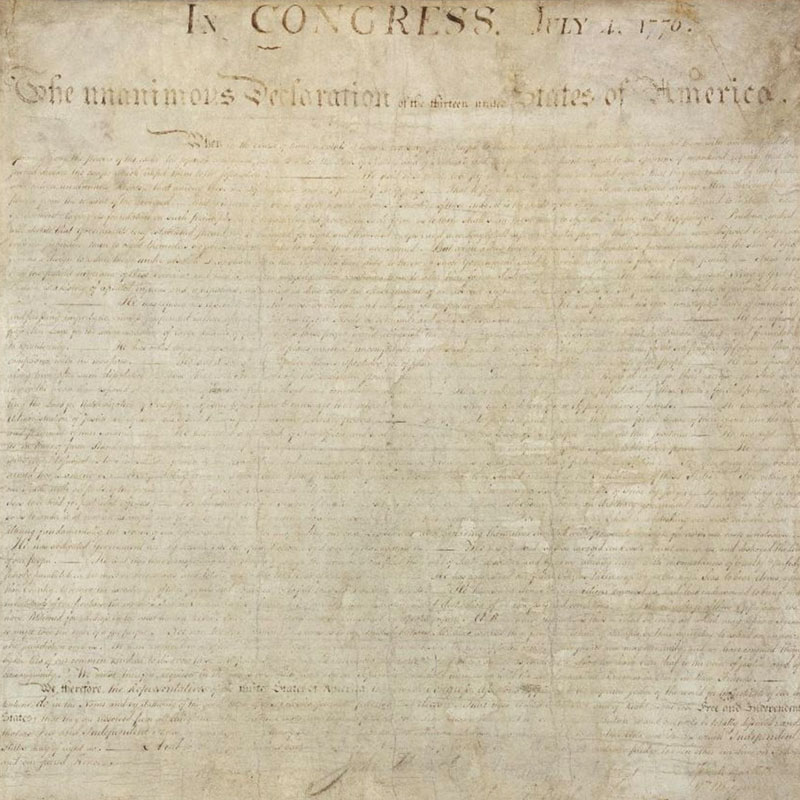
(https://www.archives.gov/founding-docs/declaration)
What would compel a people to dissolve their political bonds?
Accepted July 4, 1776 · Second Continental Congress
The Declaration of Independence made known to the world the causes compelling the inhabitants of regions once considered possessions of Great Britain to dissolve their political bonds to the British Empire, and so “assume among the powers of the earth the separate and equal station to which the laws of nature and of nature’s God entitle them.”
Two days in 1776
- The motion: Richard Henry Lee of Virginia moved for independence, accepted July 2, 1776.
- The author: Thomas Jefferson, also of Virginia, with minor alterations by the drafting committee and the Congress.
- Before the break: Nearly two years of appeals and petitions to the king in Parliament to avoid separation.
- A first: The first written declaration issued by a people proclaiming the liberty to choose their own political regime.
- In the Goodrich Room: The final inscription on the wall at Wabash College.
Did Parliament have the authority to tax a people it did not directly represent?
Hover or tap each idea to weigh both sides
- The Empire’s CaseSome argue the empire expected only its just due for supporting the government’s long-standing debt, made worse in part by the French and Indian War of the 1750s, in which the mother country had helped defend the colonies.
- The American FearTo Americans, more was being asked than help with the debt. Excessive imperial spending had troubled England for over a century. If Parliament could claim the colonists’ domestic revenues, it would likely become a permanent yoke with no relief through appeal.
- A Habit of Self-GovernmentFrom nearly their founding, England’s rule was hardly felt in the colonies. Colonists were expected to govern themselves in all internal matters, with few exceptions, such as the Dominion of New England under Governor Andros (1684–1689), which were glaring and quickly reversed.
- The King, Not ParliamentPrecedent held that the king reigned over the colonies through their own legislatures, not through Parliament. When Charles II sought a permanent revenue for Virginia, he applied “not to the English Parliament, but to the General Assembly [of Virginia].”
- No Internal TaxationRichard Bland of the Virginia House of Burgesses and John Dickinson of Philadelphia argued that Parliament could not impose internal colonial taxes on a people it did not directly represent.
- Unwritten LawOn the basis of leges non scriptae, unwritten law, Parliament’s past inability, and at times unwillingness, to involve itself in colonial affairs defined its position as separate from, and nonbinding on, colonial practice.
- King and Parliament in ConcertRevenue acts after 1764 revealed an effort to change the colonies’ legal standing. When petitions failed, the king appeared to be acting with Parliament to subjugate colonial liberties, confirming the Declaration’s charge that he had:“erected a multitude of new offices, and sent hither swarms of new officers to harass our people and eat out their substance.”
The first written declaration issued by a people proclaiming the liberty to choose their own political regime.
The final inscription on the wall of the Goodrich Room at Wabash College needs little explanation. Yet the validity of the case it presents has long been disputed by revisionists on both sides of the Atlantic.
- National Archives (U.S.): Official repository for the Declaration of Independence, including high-resolution images of the engrossed parchment, transcript, and historical context. https://www.archives.gov/founding-docs/declaration
- Library of Congress: Provides digitized early printings, Jefferson’s draft manuscript, and related revolutionary-era documents. https://www.loc.gov/item/90898042/
- Avalon Project (Yale Law School): Full text of the Declaration alongside other foundational American documents with scholarly annotations. https://avalon.law.yale.edu/18th_century/declare.asp
- National Archives (U.S.), “Declaration of Independence,” accessed January 2026, https://www.archives.gov/founding-docs/declaration.
- Thomas Jefferson, The Declaration of Independence (Philadelphia: Printed by John Dunlap, 1776).
- Library of Congress, “Jefferson’s Draft of the Declaration of Independence,” accessed January 2026, https://www.loc.gov/item/mtjbib000156/.
- Avalon Project, Yale Law School, “Declaration of Independence,” accessed January 2026, https://avalon.law.yale.edu/18th_century/declare.asp.
- Project Gutenberg, “The Declaration of Independence,” accessed January 2026, https://www.gutenberg.org/ebooks/1.
- Pauline Maier, American Scripture: Making the Declaration of Independence (New York: Knopf, 1997).
- Carl L. Becker, The Declaration of Independence: A Study in the History of Political Ideas (New York: Harcourt, Brace, 1922; Vintage Books ed., 1958).
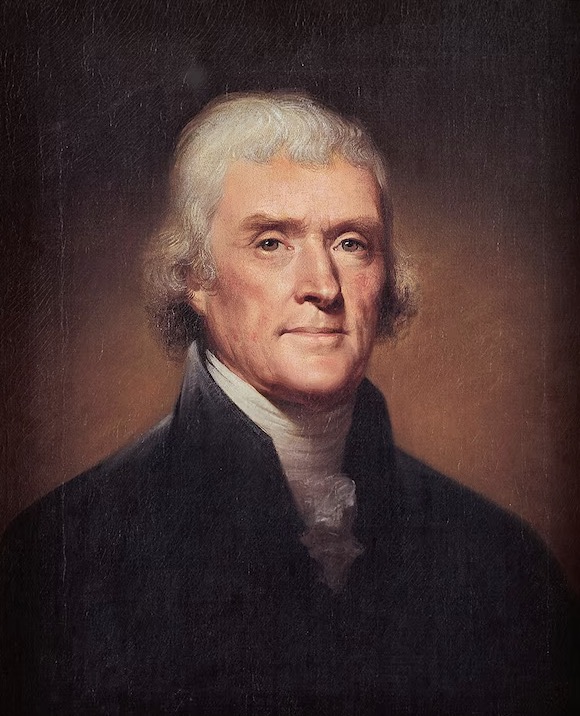
Rembrandt Peale, Thomas Jefferson, oil on canvas, ca. 1800 (or later copy), National Portrait Gallery or similar collection, accessed via National Geographic Kids, https://kids.nationalgeographic.com/history/article/thomas-jefferson
This famous portrait captures Thomas Jefferson, the primary author of the Declaration of Independence, in his prime—symbolizing the intellectual force behind the document's Enlightenment ideals of liberty and equality.
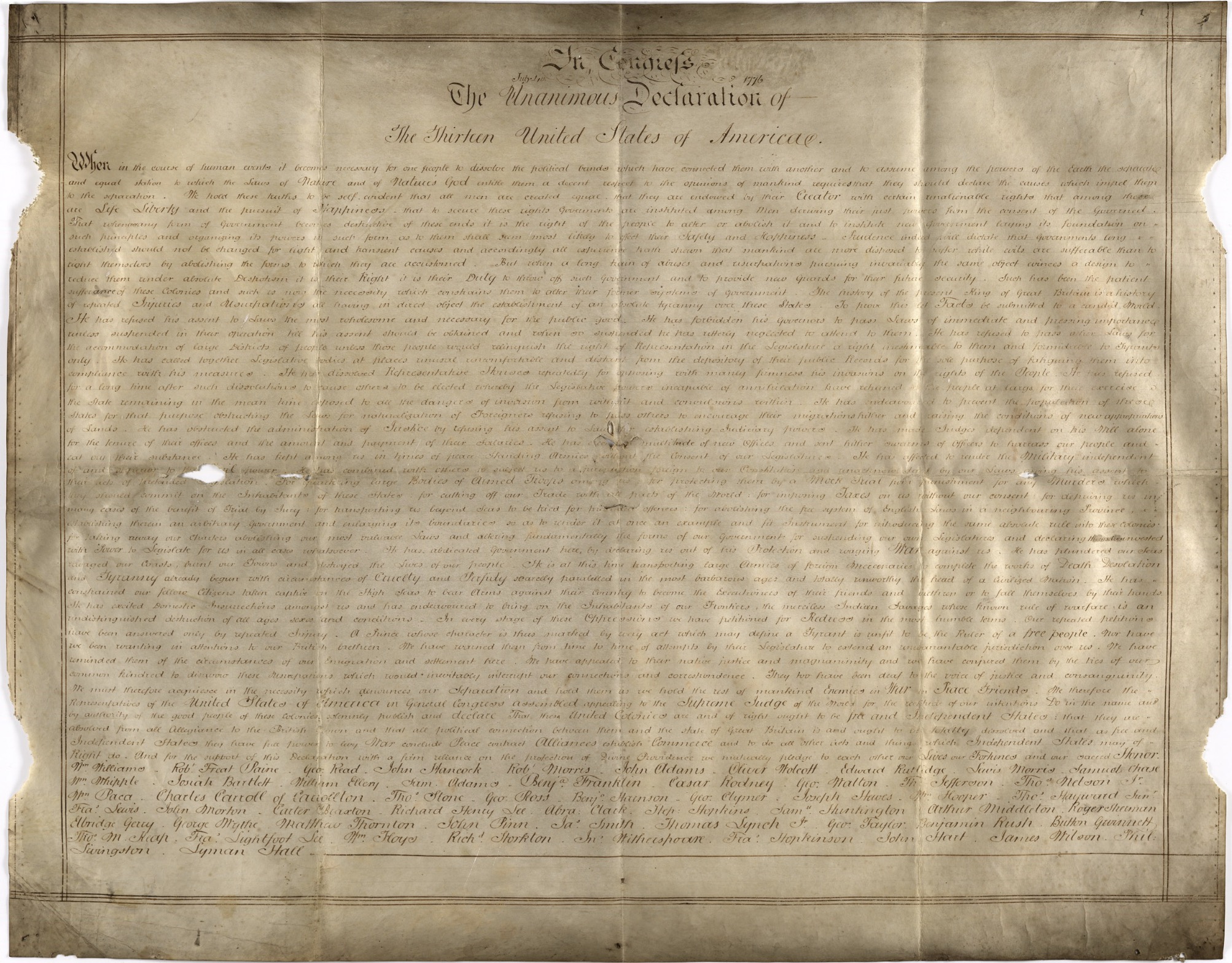
The Declaration of Independence, engrossed parchment, July 4, 1776, National Archives, accessed via William & Mary News, https://news.wm.edu/2022/06/29/the-declaration-of-independence-as-breaking-news-how-word-of-americas-founding-reached-the-atlantic-world
The original engrossed parchment, with its faded ink and elegant script, is the official signed version adopted on July 4, 1776—preserved as a foundational artifact of American independence at the National Archives.
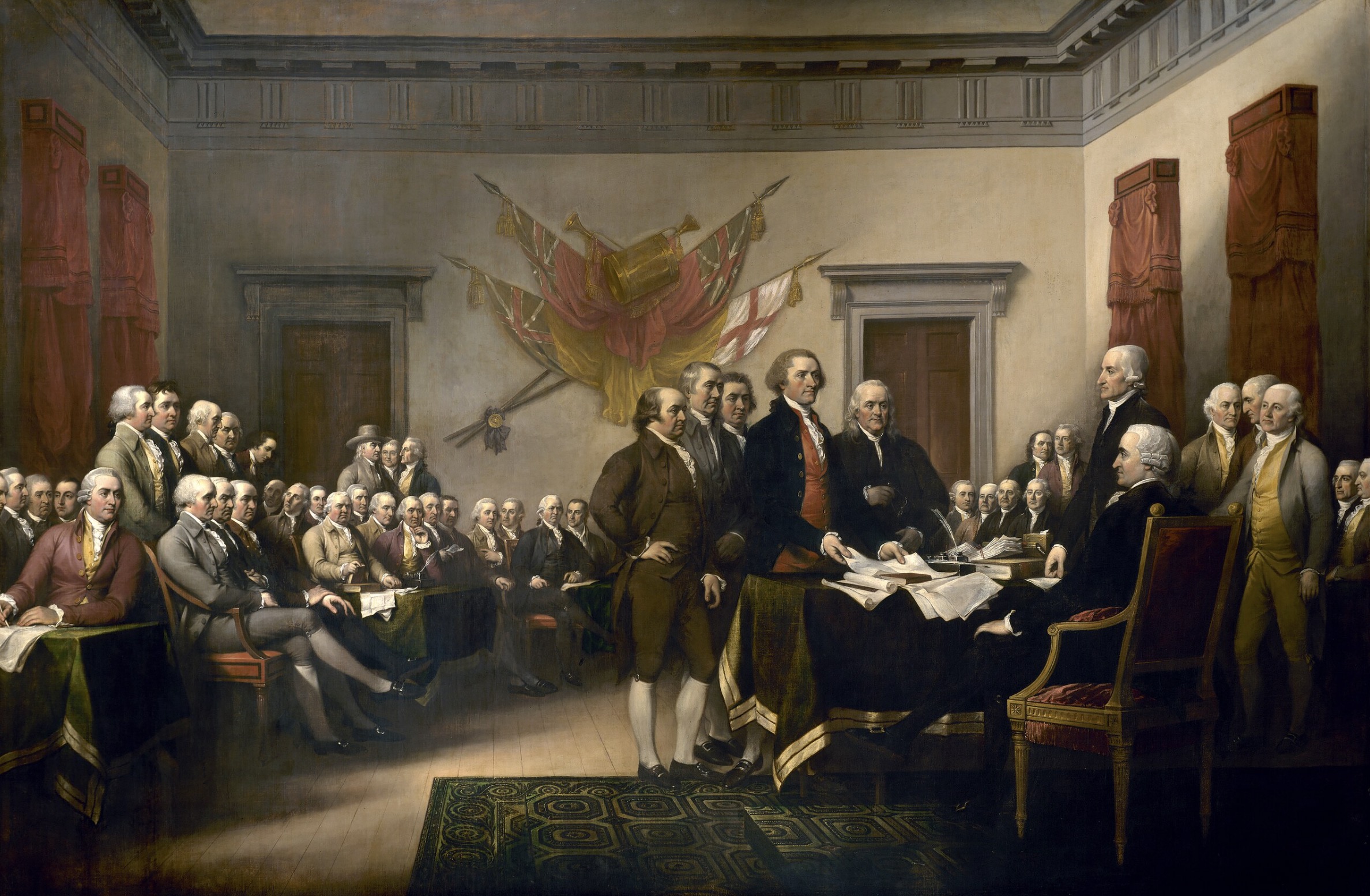
John Trumbull, Declaration of Independence, oil on canvas, 1819, Yale University Art Gallery / U.S. Capitol, accessed via Wikipedia, https://en.wikipedia.org/wiki/Declaration_of_Independence_(painting).
John Trumbull's iconic 1819 oil painting depicts the presentation of the draft to Congress on June 28, 1776, with Jefferson, Adams, and Franklin central—immortalizing the moment and the 56 signers in a dramatic, heroic composition displayed in the U.S. Capitol Rotunda.