Epictetus

EPICTETUS

Epictetus
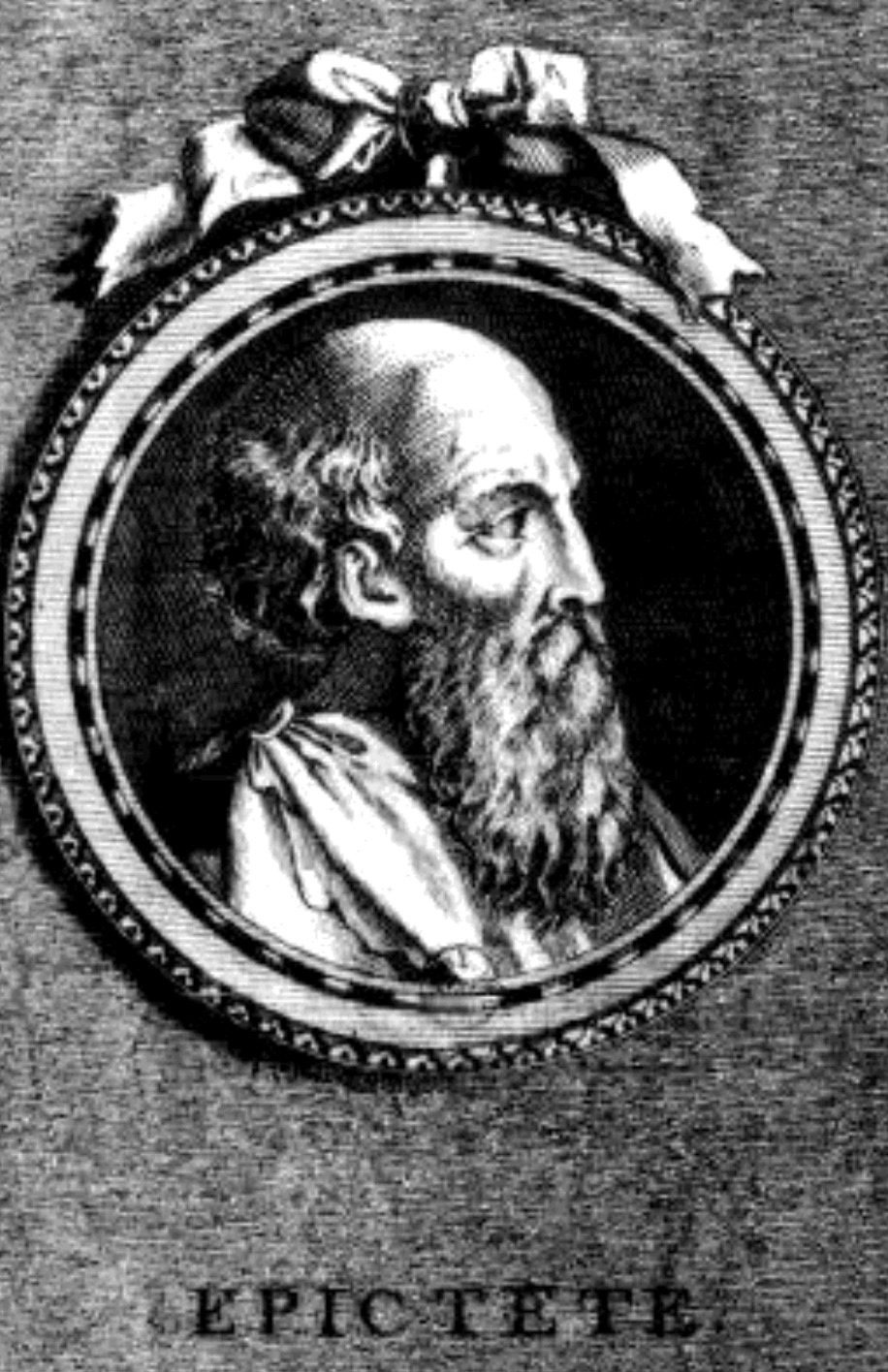
(Unknown. Frontispiece of Epicteti Enchiridion. Engraving. 1715. Wikimedia Commons. https://commons.wikimedia.org/wiki/File:Epicteti_Enchiridion_Latinis_versibus_adumbratum_(Oxford_1715)_frontispiece.jpg.)

Born: c. 50 CE, Hierapolis, Phrygia (modern Turkey)

Died: c. 135 CE, Nicopolis, Greece

Notable

  • Founder of Practical Stoicism: Transformed philosophy into a handbook for daily life, teaching that freedom lies in controlling one’s judgments, not external events.
  • Discourses and Enchiridion (c. 125 CE): Through student Arrian’s records, he outlined the dichotomy of control, the discipline of desire, and the art of endurance amid slavery and exile.
  • Principle of Inner Citadel: Argued that true happiness stems from virtue alone, as the mind is an impregnable fortress against fortune’s assaults, rendering external chains irrelevant.

50-135 CE

Biography

Epictetus was a Greek Stoic philosopher born in Hierapolis, Phrygia (present-day Pamukkale, Turkey) around 55 CE. He was born as a slave and later gained his freedom to become one of the most influential thinkers of Rome. Due to a lack of concrete information, very little is known about his early life, but it is believed that Epictetus studied Stoic philosophy under the guidance of Musonius Rufus (a renowned Stoic philosopher) and eventually established his own philosophical school in Nicopolis, Greece.

Epictetus is considered one of Rome’s greatest orators and prose stylists, which later came to be known as “Ciceronian rhetoric.” Epictetus did not write down his teachings himself, but his student Arrian recorded his lectures in the Discourses and the Enchiridion (or Handbook). These texts form the foundation of Epictetus’s philosophical legacy, emphasizing the importance of self-control, virtue, and acceptance of the natural order. Epictetus’s Stoicism was characterized by its practical approach to ethics, focusing on personal development and inner tranquility in the face of external challenges. His teachings have influenced countless individuals throughout history, including Roman Emperor Marcus Aurelius and modern philosophers like Michel de Montaigne and René Descartes.

Despite facing numerous challenges and hardships throughout his life, including exile from Rome due to Emperor Domitian’s expulsion of philosophers, Epictetus remained committed to his philosophical principles until his death, believed to have occurred around 135 CE. His legacy and philosophy continue to inspire modern cognitive therapy and self-help movements.

Bibliography & Major Works

Epictetus didn’t write any of the texts himself, but works were written by his student Arrian. These primary works include:

“Discourses” (Diatribai) – Originally eight books of Epictetus’s classroom lectures recorded by his student Arrian. However, only four books survive today. The book introduces Stoic philosophy through dialogues and discussions.

“Enchiridion” (Handbook) – A short manual of 53 chapters summarizing Epictetus’s key teachings. This is meant to be an easy guide for daily Stoic practice such as ethics, self-discipline, and acceptance of fate. This book serves as a concise manual for living a virtuous life according to Stoic principles.

“Fragments” – These include scattered quotes and sayings of Epictetus preserved in writings by other ancient authors like Roman historian Lucian, Marcus Aurelius, and Stobaeus.


Influences & Notable For

Notable For

Epictetus is best known for his contributions to Stoic philosophy, particularly his teachings on ethics, self-discipline, and personal development. His emphasis on the importance of virtue, inner tranquility, and acceptance of the natural order has resonated with individuals seeking guidance on leading a meaningful and virtuous life. Epictetus’s practical approach to philosophy, focusing on applying Stoic principles in daily life, distinguishes him as a prominent figure in the Stoic tradition.

One of the key aspects of Epictetus’s philosophy is his distinction between what is within our control (our thoughts, actions, and attitudes) and what is outside of our control (external events, circumstances, and other people’s actions). By focusing on cultivating virtues such as wisdom, courage, moderation, and justice, individuals can achieve a sense of inner peace and contentment, regardless of external challenges or hardships. This Stoic perspective on living in accordance with nature and reason continues to inspire readers and philosophers seeking guidance on navigating life’s uncertainties.

Influences

Epictetus was mainly influenced by earlier Stoic philosophers. His teacher, Musonius Rufus, had the biggest impact on him as he showed how Stoicism could be lived practically, even in difficult circumstances. Epictetus also followed the ideas of the early Greek Stoics like Zeno and Chrysippus, who founded the first Stoic school and developed its core beliefs about logic, nature, and virtue.

Even though Epictetus lived under the Roman Empire, he focused on personal ethics and on how a person should behave, much like Seneca, another Roman Stoic. While he didn’t agree with every philosophy, he engaged with ideas from Cicero (who wrote about Stoicism even if he wasn’t one) and responded to thinkers like the Skeptics and Epicureans. Epictetus built on Stoic tradition, especially its focus on self-control, reason, and accepting what you can’t change. He was influenced by the teachings of Socrates, whose emphasis on self-examination, moral integrity, and the pursuit of wisdom resonated with Epictetus’s own philosophical outlook. By integrating these philosophical influences into his teachings, Epictetus created a unique and practical approach to Stoic philosophy that continues to inspire individuals seeking guidance on leading a virtuous and meaningful life.

Famous quotes
  • “Wealth consists not in having great possessions, but in having few wants.” – Discourses by Epictetus
  • “Men are disturbed not by things, but by the views which they take of them.” – Enchiridion by Epictetus
  • “It’s not what happens to you, but how you react to it that matters.” – Enchiridion by Epictetus
  • “First say to yourself what you would be; and then do what you have to do.” – Discourses by Epictetus
  • “If you want to improve, be content to be thought foolish and stupid.” – Enchiridion by Epictetus
Legacy & Modern Significance

Epictetus’s legacy as a Stoic philosopher continues to resonate with individuals seeking guidance on leading a virtuous, fulfilling, and meaningful life. His emphasis on self-discipline, acceptance of fate, and the pursuit of virtue has influenced countless readers, philosophers, and individuals throughout history. Epictetus’s practical approach to philosophy, focusing on applying Stoic principles in daily life, has made his teachings accessible and relevant to individuals facing ongoing challenges and uncertainties.

In the modern world, Epictetus’s Stoic philosophy has experienced a resurgence in popularity, with individuals reading his works for wisdom and guidance in navigating life’s complexities and challenges. His timeless teachings on ethics, personal development, and finding inner peace offer valuable insights into leading a meaningful and virtuous life in the face of adversity. His teachings have inspired everyone from prisoners of war who used Stoic principles to survive captivity, to entrepreneurs and athletes who apply his ideas about resilience and mental discipline. Epictetus’s legacy as a Stoic sage and teacher continues to inspire individuals to cultivate virtues such as wisdom, courage, and moderation—showing that his ideas from ancient times still matter in our modern world in the 21st century.

Modern Moments & Impact on 21st Century

In 2017, Chinese universities added Epictetus to their philosophy curriculum, finding parallels with Confucianism.
In 2018, the “Stoicon-X” conference was held in New York City, bringing together modern Stoic practitioners and scholars to discuss the enduring relevance of Stoic philosophy, including the teachings of Epictetus.
The Daily Stoic podcast, hosted by Ryan Holiday and Stephen Hanselman, frequently references Epictetus and his Stoic principles in discussions on personal growth, resilience, and ethical living.
In 2023, the UK’s National Health Service incorporated Stoic principles into standard anxiety treatment protocols.
In 2024, Harvard Business School made The Enchiridion required reading for MBA ethics courses.
Academic conferences and seminars dedicated to Stoic philosophy often feature discussions on Epictetus’s teachings and their application to contemporary ethical dilemmas and personal development.
Digital resources, such as online courses and podcasts, offer individuals the opportunity to engage with Epictetus’s Stoic philosophy and apply his principles to their own lives in the 21st century.

Suggested Reading and Resources

Stoicon-X New York City – https://modernstoicism.com/stoicon-x-new-york-city/
The Daily Stoic podcast – https://www.dailystoic.com/podcast/
The Art of Living: The Classical Manual on Virtue, Happiness, and Effectiveness – https://www.amazon.com/Art-Living-Classical-Happiness-Effectiveness/dp/0061286052/
Handbook of Epictetus. United States: Hackett Publishing Company, 1983.
Long, A. A. Epictetus: A Stoic and Socratic Guide to Life. United Kingdom: Clarendon Press, 2002.
A Selection from the Discourses of Epictetus with the Encheiridion: A Practical Guide to Stoic Wisdom and Inner Peace. Czechia: Good Press, 2019.
The Philosophy of Epictetus. United Kingdom: OUP Oxford, 2007.