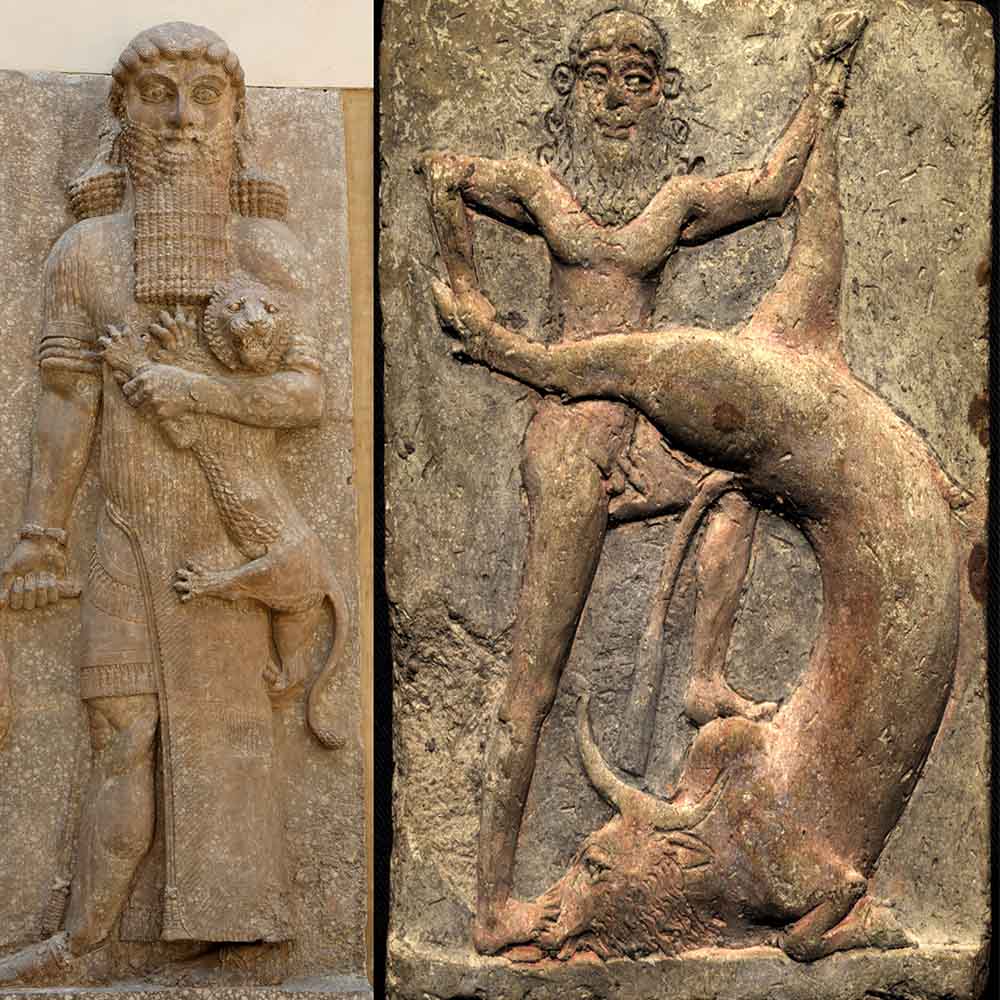
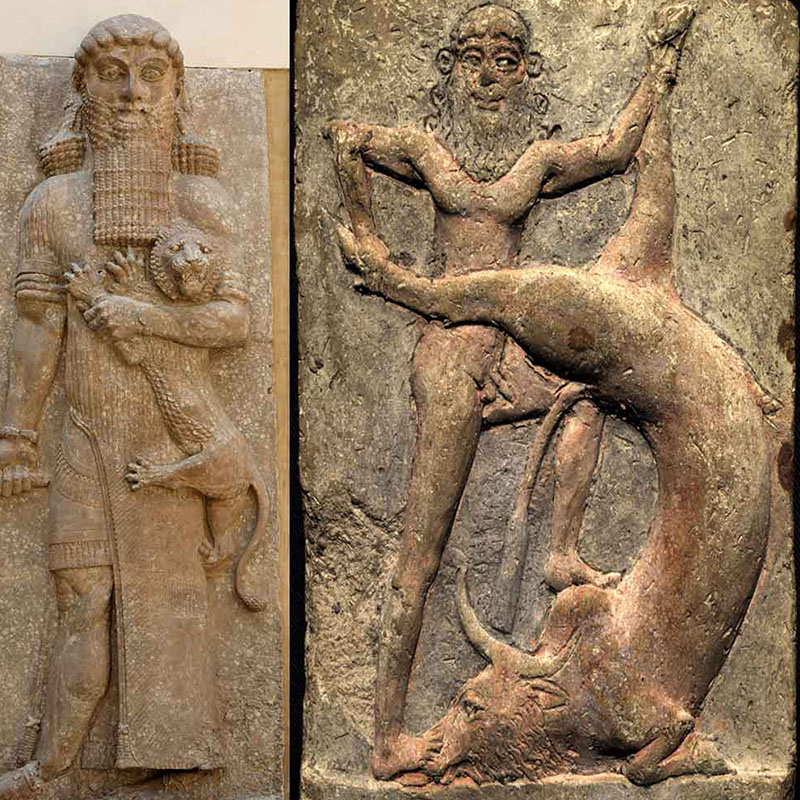
GILGAMESH
(“Gilgamesh – Wikipedia.” Photograph, 2000s. https://en.wikipedia.org/wiki/Gilgamesh)
Born: Circa 2700 BCE, Uruk, Ancient Mesopotamia
Died: Unknown
Notable
-
Legendary King of Uruk: Central figure in the Epic of Gilgamesh, one of the earliest known works of literature, celebrated as a heroic ruler.
-
Quest for Immortality: Pursued eternal life after the death of his friend Enkidu, exploring themes of mortality, legacy, and human purpose.
-
Builder of Uruk’s Walls: Credited with constructing the monumental walls of Uruk, symbolizing strength, protection, and civic pride.
-
Transformation Through Friendship: Evolved from a tyrannical ruler to a wise king through his bond with Enkidu, emphasizing personal growth and humility.
2100 BCE
BIOGRAPHY
The Epic of Gilgamesh is a foundational work of world literature originating in ancient Mesopotamia. The earliest Sumerian versions were composed around 2100 BCE, evolving from oral traditions and later written in cuneiform script on clay tablets. The most complete form, known as the Standard Babylonian version, was compiled by the scholar-priest Sîn-lēqi-unninni between 1300–1000 BCE.
The poem centers on Gilgamesh, the semi-divine king of Uruk, and explores his transformation through a quest for eternal life. Blending myth, history, and theological speculation, the narrative contains elements from multiple Sumerian myths (e.g., Gilgamesh and Huwawa, The Death of Gilgamesh) into a single literary epic.
Rediscovered in the 19th century in the ruins of Nineveh’s royal library, the epic remains a touchstone for understanding early human concerns about mortality, leadership, and the divine. Gilgamesh serves as a crucial text for educational studies around the world and touches on a wide variety of themes that are still relevant today.
BIBLIOGRAPHY
Epic of Gilgamesh, Standard Babylonian Version, Tablets I–XII (ca. 1200 BCE)
Each tablet in the Standard Babylonian version contributes to a specific act in Gilgamesh’s moral, spiritual, and psychological evolution.
Tablet I–II: Introduce Gilgamesh’s oppressive rule over Uruk. The gods create Enkidu to humble him. A friendship between the two forms and serves as a key focus within the narrative.
Tablet III–V: The two heroes embark on a journey to the Cedar Forest, where they confront and slay Humbaba, a monstrous guardian. This section explores glory, conquest, and divine wrath.
Tablet VI–VII: After spurning the goddess Ishtar, Gilgamesh angers the gods. They punish him by killing Enkidu. Enkidu’s death marks the transition from action to reflection on his internal character.
Tablet VIII–X: Grief-stricken, Gilgamesh sets out to find Utnapishtim, the only mortal granted eternal life by the gods, symbolizing humanity’s search for immortality and wisdom.
Tablet XI: Utnapishtim recounts the Mesopotamian flood narrative, which is greatly similar to the Genesis account of Noah. Gilgamesh fails the test for immortality but gains perspective.
Tablet XII: Possibly an earlier Sumerian addition. It depicts Enkidu’s ghost returning from the Underworld.
Epic of Gilgamesh, Old Babylonian Version (fragmentary; ca. 1800 BCE)
Assyrian Library Tablets, Nineveh (excavated by Austen Henry Layard, 1853)
Sîn-lēqi-unninni Recension (compiled ca. 1300–1000 BCE)
Influences & Notable For
Gilgamesh is best known for being one of the oldest texts ever discovered, found on cuneiform tablet fragments (over 15,000), and later compiled.
Aspects of the Epic of Gilgamesh can be seen within the Bible, correlating with aspects of individuals and settings. The flooding in Genesis is recollected with great similarities to the narrative stated within the Bible.
The Epic of Gilgamesh arose in a polytheistic, city-state-centered culture where divine authority and kingship were deeply intertwined.
Rooted in Sumerian stories, such as Gilgamesh and Huwawa and The Death of Gilgamesh, these stories were later combined into a coherent narrative in Akkadian.
Scholars debate the epic’s influence on the Book of Genesis, particularly:
The flood (Tablet XI vs. Genesis 6–9)
The tree of life motif (lost plant of immortality)
Adamic parallels in the transformation of Enkidu (wild → civilized)
The epic anticipates Greek heroic narratives (e.g., Achilles and Patroclus in The Iliad) and philosophical works concerned with mortality and meaning.
Famous quotes
- “There is no permanence.” – Tablet II
Spoken by Enkidu, this line highlights the impermanence of life on earth and how quickly earthly things, including life, can perish.- “Forget death and seek life!” – Tablet X
Siduri the alewife says this quote to Gilgamesh to highlight the importance of living life in the present and appreciating all that life brings with it.- “I have gained no victory over death.” – Tablet XI
Gilgamesh’s final realization after his failed quest depicts the impossibility of avoiding death, contributing to the theme of mortality.
Legacy & Significance
The Epic of Gilgamesh is widely considered the first literary masterpiece of world history and is frequently the starting point in world literature surveys.
Its flood narrative has been at the center of debates on cultural diffusion and textual borrowing across ancient civilizations.
Scholars such as Jeffrey Tigay and Benjamin Foster have traced the textual evolution from early Sumerian fragments to the Akkadian epic, highlighting its complex redaction history.
Themes of existential despair and transformation have made it central to 20th-century thought, influencing figures such as Joseph Campbell, Carl Jung, and Albert Camus.
In cultural memory, the epic is frequently cited in theological comparisons (e.g., parallels with Job or Ecclesiastes), psychological thought, and national narratives (e.g., Iraq’s reclamation of Mesopotamian heritage).
Modern Moments and Impact on 21st Century
2001–Present: Listed as a core text in comparative literature courses at Harvard, Oxford, and the University of Chicago (e.g., “Literature Humanities” curriculum at Columbia University).
2003: Gilgamesh: A New English Version by Stephen Mitchell published (Free Press, ISBN: 9780743261692).
2014: Newly recovered lines of Tablet V unveiled by the Sulaymaniyah Museum and the University of London. (Source: Iraq Journal of Archaeology, 2015)
2016: British Museum launches Gilgamesh: Hero of Mesopotamia exhibit featuring cuneiform tablets and interpretive media (BM Archives, Exhibit Catalog ID #BM-MESO-GIL-16).
2017–Present: Featured in UNESCO “Memory of the World” program (https://en.unesco.org/programme/mow).
2020: University of Pennsylvania releases full digital scan of their cuneiform holdings, including fragments of Gilgamesh (https://ccat.sas.upenn.edu).
Ongoing: Over 100 university syllabi list the Epic of Gilgamesh as required reading (e.g., Open Syllabus Project: https://opensyllabus.org).
Suggested Reading and Resources
Secondary Literature (Scholarship):
George, Andrew. The Epic of Gilgamesh: A New Translation. Penguin Classics, 1999. ISBN: 9780140449198.
Mitchell, Stephen. Gilgamesh: A New English Version. Free Press, 2004. ISBN: 9780743261692.
Tigay, Jeffrey H. The Evolution of the Gilgamesh Epic. University of Pennsylvania Press, 1982. ISBN: 9780812277849.
Foster, Benjamin R. Before the Muses: An Anthology of Akkadian Literature. 3rd ed., CDL Press, 2005.
Dalley, Stephanie, ed. Myths from Mesopotamia: Creation, the Flood, Gilgamesh, and Others. Oxford University Press, 2008.
Archival or Online Sources:
Electronic Text Corpus of Sumerian Literature (ETCSL): http://etcsl.orinst.ox.ac.uk
Project Gutenberg Edition (Gilgamesh): https://www.gutenberg.org/ebooks/11000
British Museum Cuneiform Database: https://www.britishmuseum.org/collection/search
Penn Museum Cuneiform Digital Collection: https://www.penn.museum/collections
UNESCO Memory of the World Register – Gilgamesh Tablets: https://en.unesco.org/programme/mow
SEEKER OF ETERNITY
(“Gilgamesh – Wikipedia.” Photograph, 2000s. https://en.wikipedia.org/wiki/Gilgamesh)
A stone relief carving of a bearded man in ancient attire holding a lion cub under one arm and a staff in the other, standing in profile on a textured wall panel.
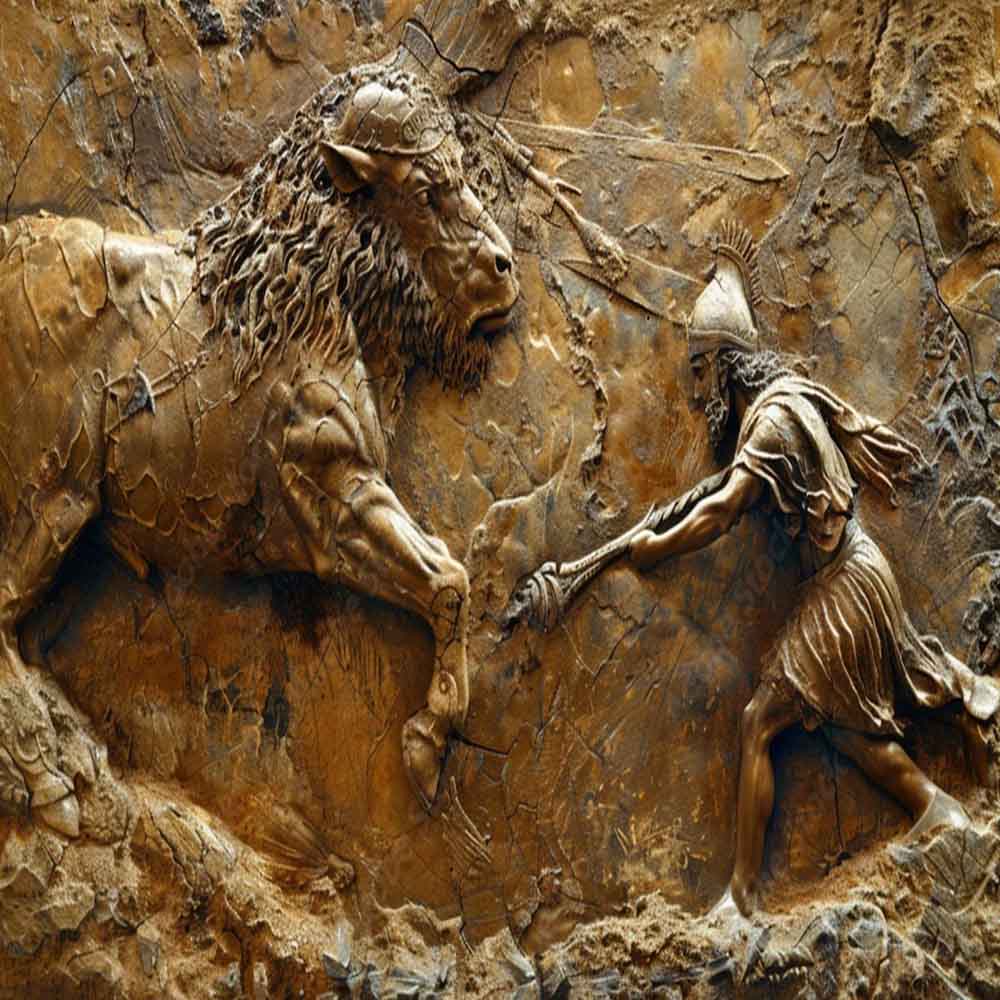
(AI-generated Image)
Gilgamesh, the legendary king of Uruk, was said to be two-thirds divine and one-third human, making him a superhuman hero with a knack for wrestling gods and building epic city walls.
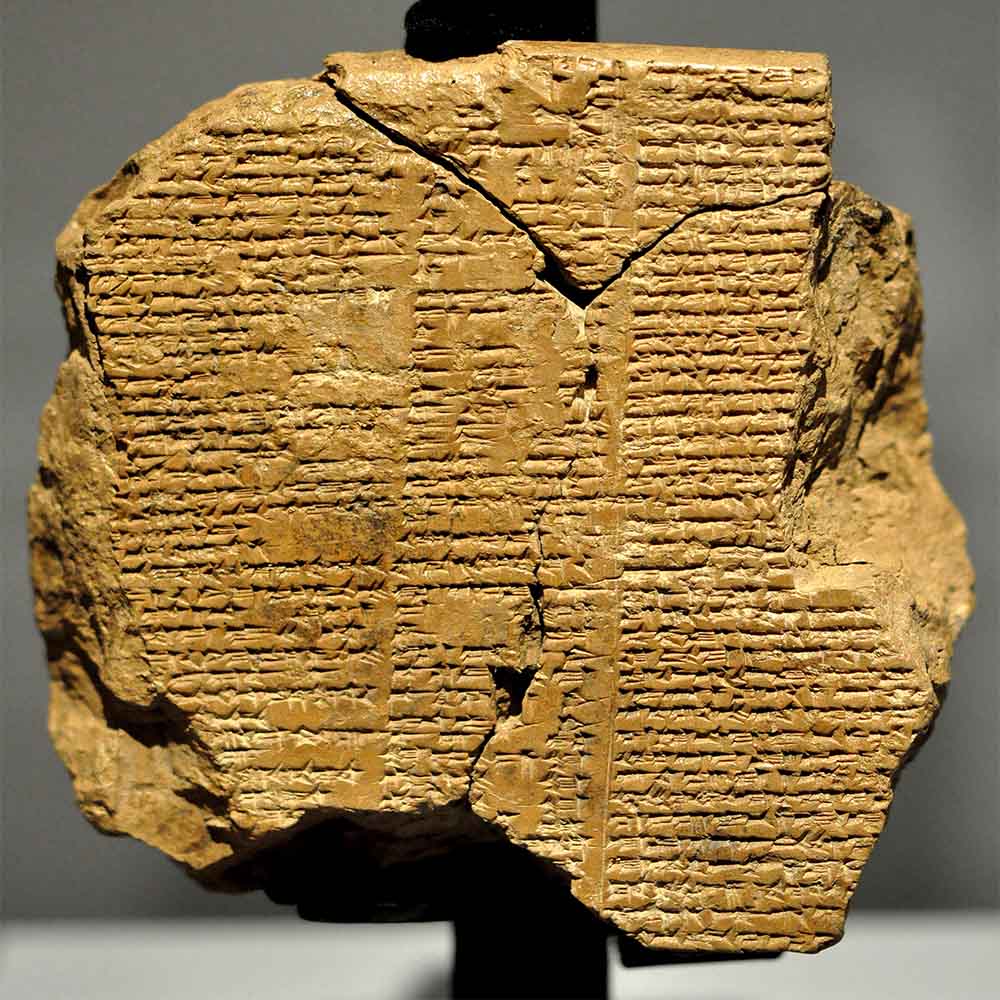
(Citation: “Epic of Gilgamesh – Wikipedia.” Photograph, 2000s. https://en.wikipedia.org/wiki/Epic_of_Gilgamesh)
An irregularly shaped clay tablet fragment with cuneiform inscriptions in columns, displayed on a transparent acrylic stand against a neutral background.