
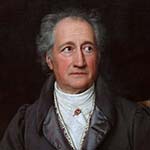
GOETHE
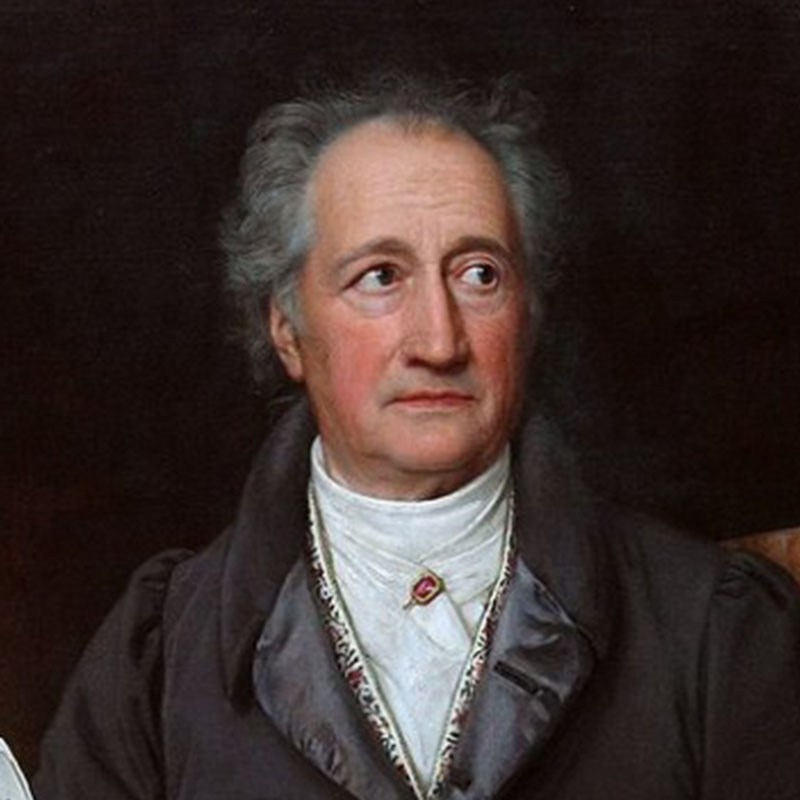
(Stieler, Joseph Karl. Goethe. Oil on canvas; 100 × 80 cm. 1828. Neue Pinakothek, Munich. Wikimedia Commons. https://commons.wikimedia.org/wiki/File:Goethe_(Stieler_1828).jpg.)
.jpg)
Born: August 28, 1749, Frankfurt am Main, Germany
Died: March 22, 1832, Weimar, Saxe-Weimar
Notable
-
Literary Pioneer: Central figure of Sturm und Drang and Weimar Classicism.
-
Faust: Author of Germany’s most influential literary work.
-
Romantic Influence: The Sorrows of Young Werther shaped the Romantic hero.
-
Polymath: Contributions as writer, scientist, and statesman.
Biography
Johann Wolfgang von Goethe (1749–1832) was a German literary titan—a poet, novelist, playwright, scientist, statesman, and philosopher. Born in Frankfurt am Main on August 28, 1749, he received a classical education encouraged by his father, Johann Caspar Goethe, an imperial councilor. Goethe studied law at Leipzig University but soon directed his energies toward literature and art, publishing poems and theatrical works even during his legal training. His literary fame soared with The Sorrows of Young Werther (1774), securing a place at the court of Saxe-Weimar-Eisenach, where he later became a key political, cultural, and scientific advisor. Goethe's interests ranged beyond literature—he conducted scientific work in optics, botany, and anatomy, and sparked international admiration through seminal works like Faust, philosophical treatises, and influential essays. He died in Weimar on March 22, 1832.
Influences & Notable For
Leading figure in the Sturm und Drang and Weimar Classicism movements, revolutionizing German and world literature.
Author of Faust, regarded as the greatest work of German literature.
The Sorrows of Young Werther—the archetype of the Romantic hero and a catalyst for the Romantic movement.
Ancillary achievements as a scientist (color theory, plant morphology) and statesman.
Famous quotes
“Whatever you can do or dream you can, begin it. Boldness has genius, power, and magic in it.” (Faust, Part I)
“He who moves not forward goes backward.” (Faust, Part I)
“A man should hear a little music, read a little poetry, and see a fine picture every day of his life, in order that worldly cares may not obliterate the sense of the beautiful.” (Wilhelm Meister’s Apprenticeship, Book II)
“Knowing is not enough; we must apply. Willing is not enough; we must do.”
“The world is a fine place worth fighting for, and I hate very much to leave it.” (Reported last words)
Legacy & Modern Significance
Goethe’s works underpin the development of German national identity and language, and his writings helped found several literary traditions, including the Bildungsroman and the Romantic movement.
His color theory, while superseded scientifically, influenced perception research and the arts.
Philosophers such as Schopenhauer, Hegel, Nietzsche, and Wittgenstein referenced his ideas in their works.
Freud, Carl Jung, and modern psychologists drew upon his concepts of personality and self-formation.
Faust and other works remain regularly performed and are studied worldwide, reflecting ongoing debates in ethics, epistemology, and cultural theory.
The Goethe-Institut, with branches globally, promotes German culture and language in Goethe’s name, and his influence persists across literature, philosophy, psychology, and the natural sciences.
Modern Moments & Impact on the 21st Century
Ongoing: The Goethe-Institut, established in 1951, continues to operate worldwide, promoting German language and culture in Goethe’s honor (goethe.de).
2024: Academic celebrations and new critical editions published for the 275th anniversary of Goethe's birth.
Ongoing (2000–present): Digital editions of Goethe’s works are available on platforms like Project Gutenberg and the German National Library.
Annual: International conferences and symposia dedicated to Goethe are held at institutions such as the Goethe Society of North America and the Goethe-Gesellschaft in Weimar.
Ongoing: His works are core syllabus material in universities globally; major performances of Faust and Werther are staged worldwide.
2025: The 20th anniversary of the Goethe Society of North America’s digital archive.
Influences & Intellectual Context
Classical and Enlightenment Traditions: Profound engagement with Greco-Roman literature, philosophy, and aesthetics.
Scientific Inquiry: Innovations influenced by Linnaeus (biology) and Newton (optics), though he often critiqued or diverged from mainstream theories.
Contemporaries: Friendship and collaboration with Friedrich Schiller (Weimar Classicism), as well as dialogue with European thinkers and poets.
Personal Interests: Broad curiosity included mineralogy (the mineral goethite is named for him), anatomy, and Eastern (especially Persian) literary traditions.
Suggested Reading & Resources
Secondary Literature (Scholarship)
Nicholas Boyle, Goethe: The Poet and the Age (2 vols., available from Oxford University Press)
T. J. Reed, Goethe (Oxford University Press, 1984)
Rüdiger Safranski, Goethe: Life as a Work of Art (Liveright, 2017)
Matthew Bell, Goethe: The Poet and the Age (Cambridge University Press, 2002)
Astrida Orle Tantillo, Goethe’s Modernity (Bloomsbury, 2010)
Archival or Online Sources
“Goethe’s Works,” Project Gutenberg (public domain): https://www.gutenberg.org/author/Goethe,+Johann+Wolfgang+von
POET OF REASON AND EMOTION
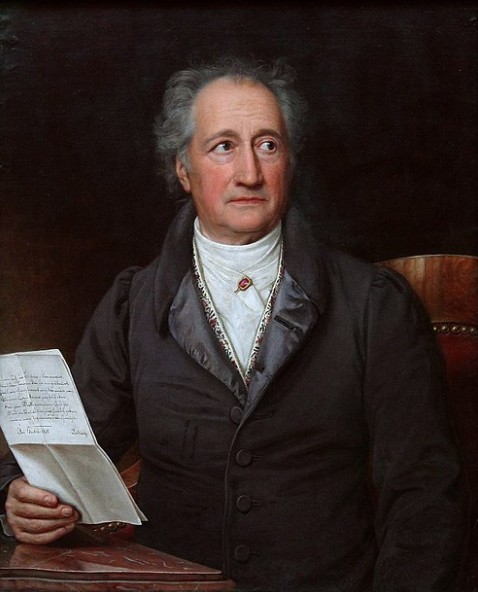
(Stieler, Joseph Karl. Goethe. Oil on canvas; 100 × 80 cm. 1828. Neue Pinakothek, Munich. Wikimedia Commons. https://commons.wikimedia.org/wiki/File:Goethe_(Stieler_1828).jpg.)
Joseph Karl Stieler's 1828 oil portrait of Johann Wolfgang von Goethe depicts the German writer in a red coat with a medal, his wise expression reflecting Faust and his humanistic vision, as celebrated in the Goodrich Seminar Room for exploring individual striving and freedom.
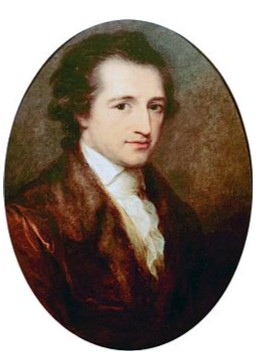
(Kauffmann, Angelica. Der junge Goethe. Oil on canvas; 60 × 50 cm. 1787. Wikimedia Commons. https://commons.wikimedia.org/wiki/File:Der_junge_Goethe,_gemalt_von_Angelica_Kauffmann_1787.JPG)

Angelica Kauffmann's 1787 oil portrait of the young Johann Wolfgang von Goethe shows him in a brown coat with powdered hair, capturing his early Sturm und Drang spirit and literary genius in The Sorrows of Young Werther.
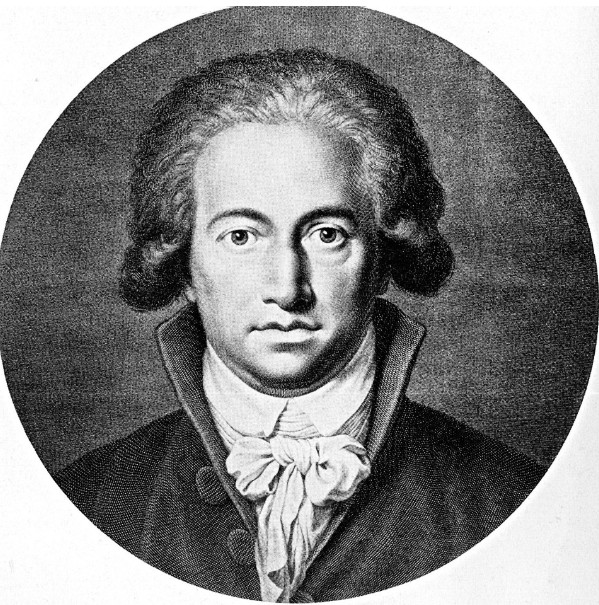
(Unknown. Goethe. Oil on canvas; 80 × 65 cm. 1791. Wikimedia Commons. https://commons.wikimedia.org/wiki/File:Goethe_1791.jpg.)

An anonymous 1791 painting of Johann Wolfgang von Goethe in a formal suit with a medal, against a neutral background, symbolizes his Weimar Classicism and contributions to literature, science, and the pursuit of personal development.