
GROOT
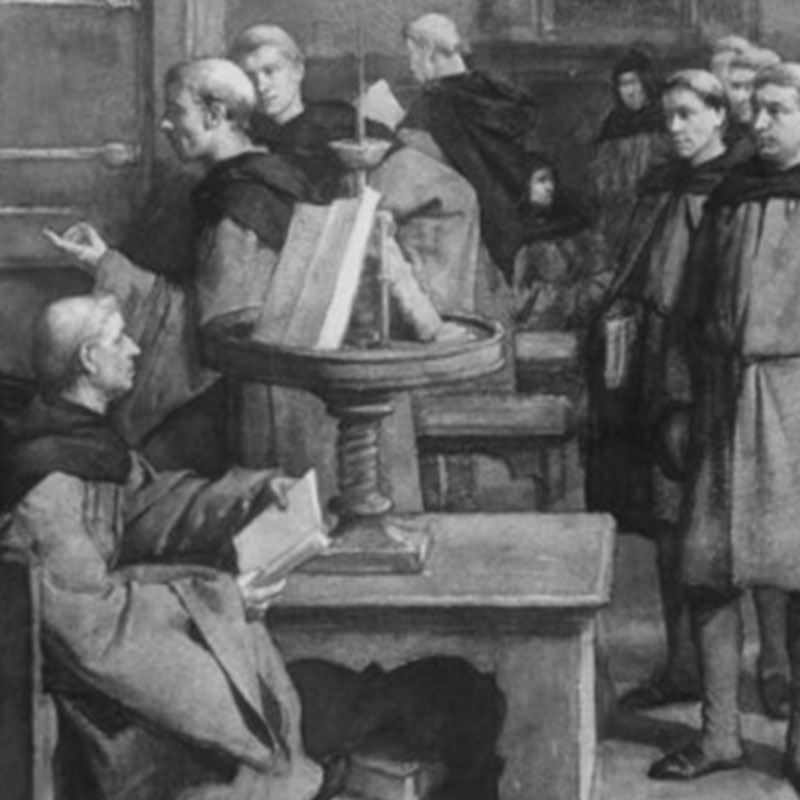
(Derkinderen, Antoon. Geert Grote met Volgelingen. Watercolor. ca. 1900. Wikimedia Commons. https://commons.wikimedia.org/wiki/File:Geert_Grote_met_volgelingen,_Aquarel_Antoon_Derkinderen.png.)

Born: October 1340, in the Hanseatic city Deventer at the Bishopric of Utrecht
Died: 20 August 1384 (at the age of 44) due to plague at Deventer
Notable
-
Devotio Moderna: Founded a movement emphasizing simple, personal faith in late medieval Europe.
-
Moral Reform: Preached sincere daily devotion and criticized clerical corruption.
-
Brethren of the Common Life: Established communal houses devoted to prayer, education, and copying texts.
-
Enduring Influence: Inspired figures like Thomas à Kempis and broadened access to vernacular devotion.
1400–1500 AD works
Biography
Geert Groote, also known as Gerhard Groet, was a religious Dutch Catholic deacon who founded the Brethren of Common Life. He was born in the Hanseatic city of Deventer, where his father held a good civic position. Being born into a rich family, he received an excellent education. He studied at the University of Paris, where he earned a Master of Arts degree. He later taught at Cologne and Paris, but at the age of 34, a serious illness led him to undergo a spiritual conversion. Being influenced by his friend Henry of Calar, Groote gave up his worldly lifestyle and devoted himself entirely to religious reform.
After conversion, Groote spent time in a Carthusian monastery, and in 1380, he became a deacon (Church Helper). He travelled across the Netherlands, speaking strongly against corrupt sermons, simony, and the poor morals of both priests and ordinary people. Many people were inspired by his message and started following him. He later formed a group called “Brethren of Common Life”—these were men and women who lived together in separate houses, prayed, earned by copying books, and helped poor people.
Groote died in 1384 from the plague while taking care of a sick friend. However, his influence continued through the movement he started, called Devotio Moderna (Modern Devotion). This movement focused on inner spirituality, a personal relationship with God, and following the example of Christ’s life. His ideas influenced many people, including Thomas à Kempis, who wrote The Imitation of Christ, which is one of the most popular Christian books ever written. The schools Groote’s followers started became well-known centers of learning and helped to spread reading, writing, and humanistic education across Northern Europe.
Influences & Notable For
Geert Groote is best known for founding the Devotio Moderna (Modern Devotion), a religious movement that transformed religious life (Christianity) around the 1300s in Northern Europe.
His movement emphasized simple, heartfelt faith and living a good Christian life every day, rather than just following church rituals, making religion more personal and practical.
As a popular priest, he drew such huge crowds that churches couldn't hold everyone. He spoke out against corruption in both the church clergy and ordinary people, calling for genuine religious reform and better moral living.
His greatest achievement was founding the Brethren of the Common Life, a community where people lived together, shared everything, and devoted themselves to prayer, education, and copying religious books.
The Brethren focused on meditation about Jesus's suffering and finding inner peace through quiet prayer, establishing nearly 100 houses across Europe.
Groote's ideas influenced many people, including Thomas à Kempis, who wrote the famous book The Imitation of Christ, which spread these teachings worldwide.
He translated the Book of Hours from Latin into everyday Dutch so regular people could read and pray in their own language, democratizing religious practice.
Famous quotes
"The farther a man knows himself to be free from perfection, the nearer he is to it." – Groote
"One who is at peace can draw good from everything." — Groote
“God is faithful, and he promised not to permit man to be tempted beyond his strength. But just as in proving someone, he permits him to be tempted, troubled, and distressed, so he also gives the ability to bear up and resist." – Groote
"Many of your companions, kin, and forefathers died in sin." – Groote
Legacy & Modern Significance
Geert Groote's transformation from being a wealthy, worldly cleric to being a humble religious leader left a lasting legacy that continues to shape Christian spirituality, education, and social reform throughout history.
Groote's Devotio Moderna movement, showing Christian faith as a practical, daily experience accessible to all people, has shaped Christian beliefs about the nature of personal devotion and the significance of finding God in ordinary life. The movement's emphasis on inner transformation through simple practices, like meditation on Christ's life and translating and copying sacred texts, has inspired Christian communities to seek authentic spirituality beyond institutional structures. The Imitation of Christ, written by one of his followers, Thomas à Kempis, is read daily by millions of people worldwide.
In terms of modern significance, Groote's approach to spirituality continues to be studied and practiced by scholars, spiritual directors, and believers around the world. Groote's ideas about simple prayer, educational reform, and making faith accessible to ordinary people remain relevant to current debates about religious literacy, how to pray and meditate, and how ordinary people can develop their spiritual lives. His message of personal transformation, combining "ardour and silence," continues to inspire individuals and communities to integrate spiritual practice into their daily lives. Educational institutions today use his model of teaching not just facts but also good character and service to others.
Modern Moments & Impact on the 21st Century
In 2018, Pope Francis's apostolic exhortation Gaudete et Exsultate emphasized holiness in everyday life, a theme central to Groote's Devotio Moderna movement.
In 2020, during COVID-19 lockdowns, there was increased interest in personal prayer practices and meditation at home, reflecting Groote's emphasis on personal spirituality outside institutional settings.
The Taizé Community in France continues to practice simple, repetitive prayer and silence that echo Groote's approach to accessible spirituality.
Modern prayer apps like Hallow, Pray As You Go, and Lectio 365 make daily prayer accessible in vernacular languages—the digital equivalent of Groote's Dutch prayer book translations.
Universities in the Netherlands continue to study and teach about the Devotio Moderna movement and its educational philosophy.
August 20 remains the feast day commemorating Geert Groote's death in various religious calendars.
Academic interest in the Devotio Moderna continues, with scholarly articles and books examining Groote's influence on education, spirituality, and reform movements.
Influences & Intellectual Context
Groote's main intellectual contribution was founding the Modern Devotion (Devotio Moderna) movement, which focused on practical spirituality rather than complex theology. He believed in making religion easily accessible to ordinary people by translating religious texts from Latin into Dutch, especially the Book of Hours prayer book. His approach emphasized imitating Christ through simple daily practices, meditation on Christ's life and death, and living ethically rather than engaging in abstract theological debates.
He was influenced by the mystic Jan van Ruysbroeck but rejected the highly speculative mysticism of Meister Eckhart. Instead, Groote promoted "ardour and silence"—passionate devotion combined with quiet meditation—as the path to inner peace. His 80 surviving letters and 10 treatises attacked corruption in the Church and provided practical guidance for spiritual living. Through the Brethren of the Common Life, which he founded, his ideas spread across Northern Europe, influencing education and eventually contributing to both the Renaissance and Reformation. His emphasis on personal religious experience and making faith accessible to all people through vernacular texts was revolutionary for his time.
Suggested Reading & Resources
Post, R.R. The Modern Devotion: Confrontation with Reformation and Humanism. Netherlands: Brill, 2022.
Hyma, Albert. The Brethren of the Common Life. United States: Wipf & Stock Publishers, 2004.
Connolly, James Louis. John Gerson: Reformer and Mystic. Belgium: Librairie Universitaire, Uystpruyst, 1928.
van Herwaarden, Jan. Between Saint James and Erasmus: Studies in Late-Medieval Religious Life – Devotion and Pilgrimage in the Netherlands. Netherlands: Brill, 2021.
Kroon, Marijn de. We Believe in God and in Christ. Not in the Church: The Influence of Wessel Gansfort on Martin Bucer. United States: Presbyterian Publishing Corporation, 2009.
PREACHER OF INNER PIETY AND HUMILITY
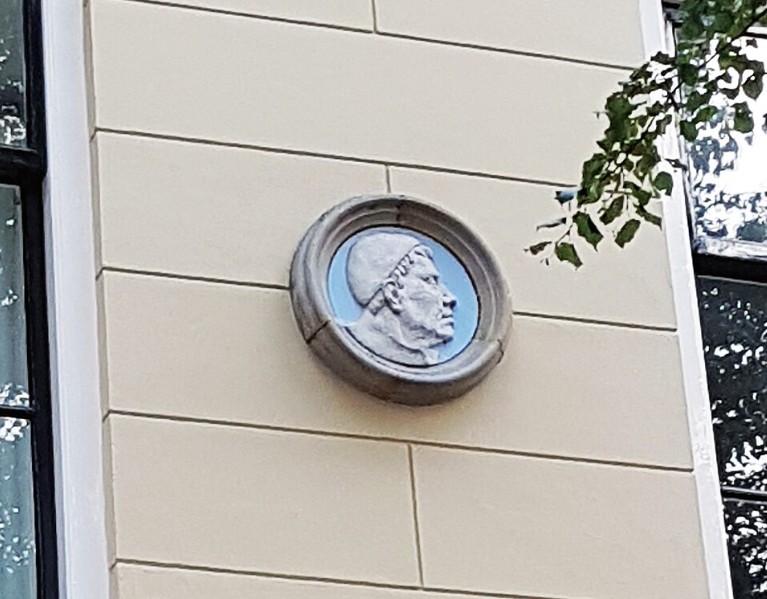
(Unknown. Fantasieportret Geert Grote. Oil on canvas. ca. 1850. Wikimedia Commons. https://commons.wikimedia.org/wiki/File:Fantasieportret_Geert_Grote.jpg.)

A 19th-century fantasy portrait of Geert Groote (1340–1384), the Dutch deacon and founder of the Brethren of the Common Life, depicts him in medieval clerical robes with a tonsure and book, symbolizing his Devotio Moderna movement's emphasis on personal piety and spiritual autonomy, as honored in the Goodrich Seminar Room for promoting inner religious freedom.
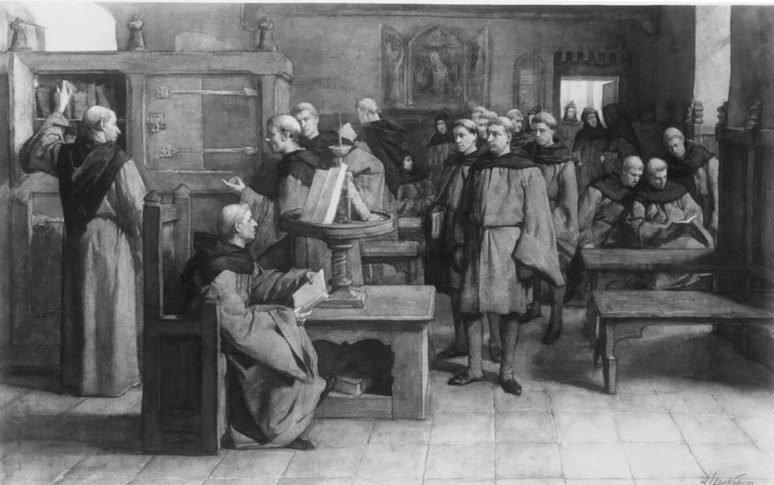
(Derkinderen, Antoon. Geert Grote met Volgelingen. Watercolor. ca. 1900. Wikimedia Commons. https://commons.wikimedia.org/wiki/File:Geert_Grote_met_volgelingen,_Aquarel_Antoon_Derkinderen.png.)
An early 20th-century watercolor by Antoon Derkinderen illustrates Geert Groote preaching to followers in simple robes, surrounded by devotees studying scripture, capturing his advocacy for vernacular religious texts and lay devotion, key to the Goodrich Seminar Room's theme of accessible spiritual liberty.
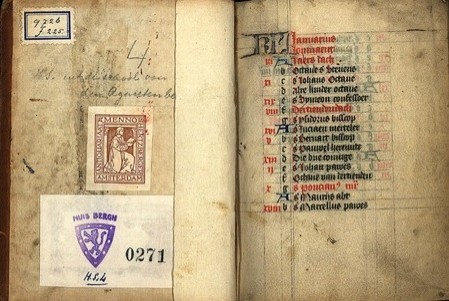
(Unknown. Book of Hours of Geert Groote. Manuscript illumination on vellum. ca. 1400. Kasteel Huis Bergh, 's-Heerenberg. Wikimedia Commons. https://commons.wikimedia.org/wiki/File:Getijdenboek_Geert_Grote_Kasteel_Huis_Bergh_%27s_Heerenberg.jpg.)

A page from the 15th-century Book of Hours of Geert Groote features an illuminated miniature of a contemplative monk in prayer, with intricate gold borders and Latin text, highlighting Groote's influence on meditative spirituality and reform within the Catholic Church, as commemorated in the Goodrich Seminar Room.