
HEIMSKRINGLA
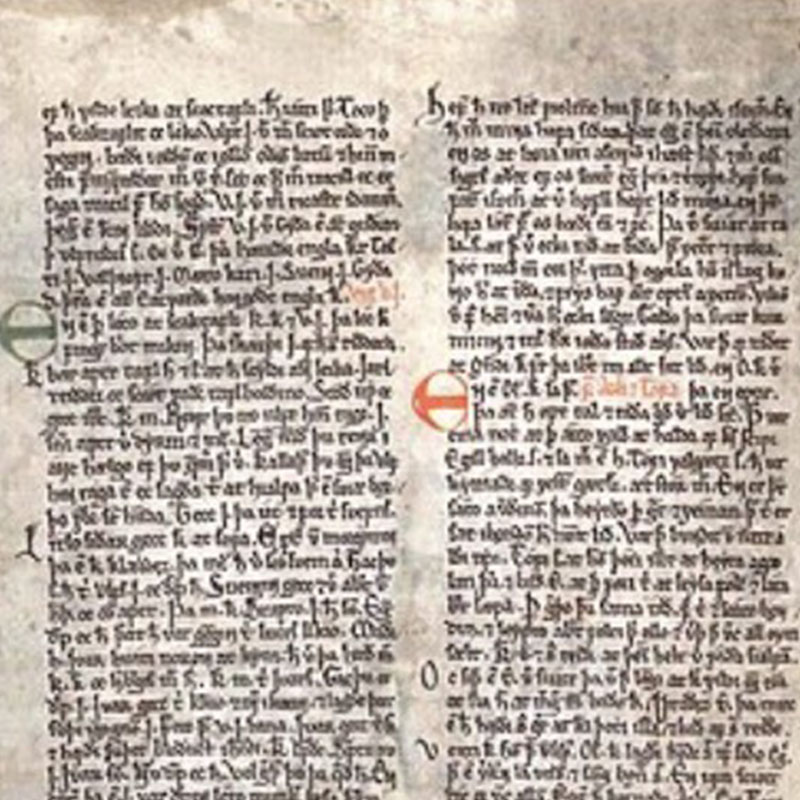
("https://upload.wikimedia.org/wikipedia/commons/thumb/7/73/Lbs_fragm_82%2C_0001v_-_1.jpg/330px-Lbs_fragm_82%2C_0001v_-_1.jpg")

Composed c. 1225–1235 CE by Snorri Sturluson.
Survives in ~50 manuscripts/fragments; ~700 pages in modern editions.
Notable
- National Chronicle of Norway: Foundational history of the Norwegian monarchy; used in royal propaganda.
- Saint Olaf’s Saga: Longest section; portrays Olaf II as martyr-king and Norway’s patron saint.
- Skaldic Authenticity: Over 600 verses cited as historical evidence.
- Political Realism: Explores kingship, law, conversion, and power struggles with detached irony.
1200–1300 AD works
Biography
Heimskringla (c. 1225–1235 CE) is a monumental saga chronicle of Norwegian kings from legendary origins to 1177 CE, attributed to the Icelandic chieftain, poet, and historian Snorri Sturluson (1179–1241). Comprising 16 sagas in three main parts—Ynglinga Saga, the lives of historical kings from Halfdan the Black to Harald Hardrada, and the civil war era—it is written in clear, objective Old Norse prose with embedded skaldic verses for authenticity. Named after its opening words “Kringla heimsins” (“the disc of the world”), it spans mythology, migration-age legends, Viking expansion, Christianization (c. 1000 CE), and the consolidation of royal power.
Modern scholars regard Heimskringla as the pinnacle of medieval Scandinavian historiography: a critical synthesis of oral skaldic poetry, Latin chronicles, earlier sagas, and Snorri’s political insight. It shaped national identity in Norway and influenced European historical writing, from Romantic nationalism to modern realism. Preserved in over 50 manuscripts, it remains the most authoritative source on early Norse kingship.
Influences & Notable For
- National Chronicle of Norway: Foundational history of the Norwegian monarchy; used in royal propaganda.
- Saint Olaf’s Saga: Longest section; portrays Olaf II as martyr-king and Norway’s patron saint.
- Skaldic Authenticity: Over 600 verses cited as historical evidence.
- Political Realism: Explores kingship, law, conversion, and power struggles with detached irony.
Famous quotes
“It is the nature of kings to be victorious when they fight with chieftains, but chieftains fall when they fight with kings.”
– Haralds saga Fairhair, Ch. 6
“A king is for victory, not for long life.”
– Harald Hardrada, Haralds saga Hardrada, Ch. 99
“The people must have a king, but the king must have the people.”
– Attributed to Snorri’s political philosophy (paraphrased).
Legacy & Modern Significance
Canonized as Norway’s national history; influenced 19th-century independence. Medieval: Basis for Flateyjarbók, Danish Gesta Danorum. Modern: Debates on historicity vs. artistry; gender, power, religion.
Sources:
Ármann Jakobsson, A Sense of Belonging: Morkinskinna and Icelandic Identity.
Modern Moments & Impact on the 21st Century
- 2011–2016: Viking Society for Northern Research published complete Finlay/Faulkes translation (3 vols.).
- 2018: 800th anniversary of St. Olaf’s cult; Heimskringla conferences (Oslo, Reykjavík).
- Ongoing: Full ON text + modern Norwegian on heimskringla.no; English at snorriportal.is.
- Ongoing: Core in Nordic history, literature, medieval studies (Oslo, Copenhagen, UCLA).
- 2020s: Cited in leadership studies, political theory, digital humanities (text mining skaldic verse).
- 2021: Netflix Vikings: Valhalla drew on Olaf’s saga; scholarly backlash and engagement.
Influences & Intellectual Context
- Skaldic Tradition: Þjóðólfr, Eyvindr, Sigvatr—used as primary sources.
- Earlier Sagas: Ágrip, Morkinskinna, Fagrskinna.
- Latin Historiography: Adam of Bremen, Saxo Grammaticus.
- Snorri’s Context: 13th-century Iceland; Sturlung civil wars; Norwegian allegiance.
Suggested Reading & Resources
Secondary Literature (Scholarship)
- Finlay, Alison & Faulkes, Anthony (trans.). Heimskringla (3 vols.). Viking Society, 2011–2016.
- Hollander, Lee M. Heimskringla: History of the Kings of Norway. Texas, 1964.
- Bagge, Sverre. Society and Politics in Snorri Sturluson’s Heimskringla. California, 1991.
- Whaley, Diana. Heimskringla: An Introduction. Viking Society, 1991.
- Ármann Jakobsson. Sturla Þórðarson and the Making of History. Routledge, 2021.
Archival or Online Sources
- Heimskringla.no: Full text (ON + NO) – https://heimskringla.no
- Encyclopædia Britannica: Heimskringla – https://www.britannica.com/topic/Heimskringla
CHRONICLE OF NORSE KINGS AND HEROES
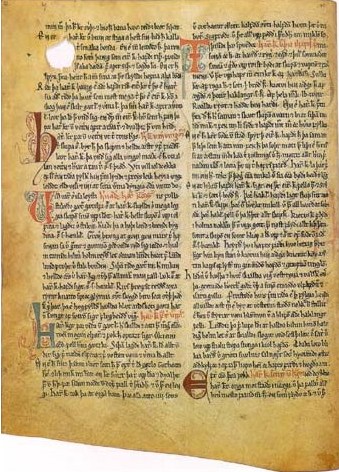
(Unknown. A Page of Heimskringla. Manuscript page on vellum. 13th century. Wikimedia Commons. https://commons.wikimedia.org/wiki/File:A_page_of_Heimskringla.jpg.)

A scanned page from a medieval manuscript of Snorri Sturluson's Heimskringla, featuring Old Norse text in black ink on vellum, with illuminated initials, representing the historical sagas of Norwegian kings and their legendary exploits.
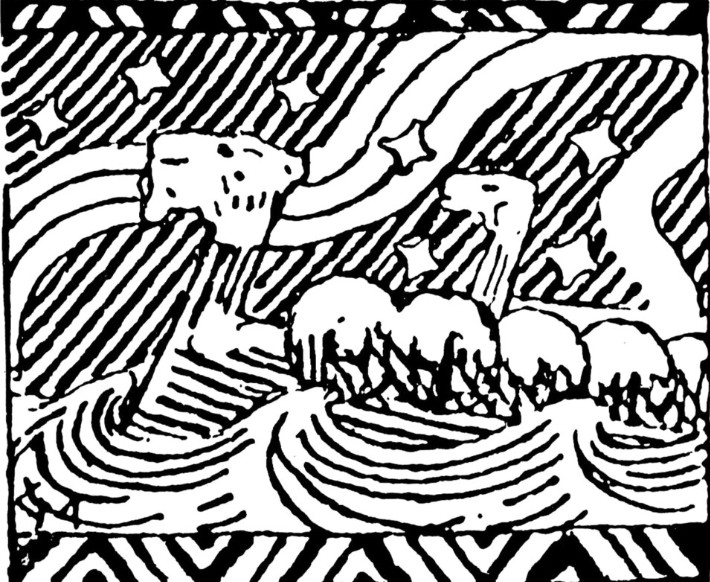
(Munthe, Gerhard. Vignette 4 from Harald Hårfagres Saga in Heimskringla. Illustration. 1899. Wikimedia Commons. https://commons.wikimedia.org/wiki/File:Harald_Haarfagres_saga_-_vignett_4_-_G._Munthe.jpg.)

Gerhard Munthe's 19th-century vignette illustrates Vikings sailing under the aurora borealis in Harald Hårfagre's saga from Heimskringla, with longships and dramatic northern skies evoking the mythic voyages of Norway's first king.
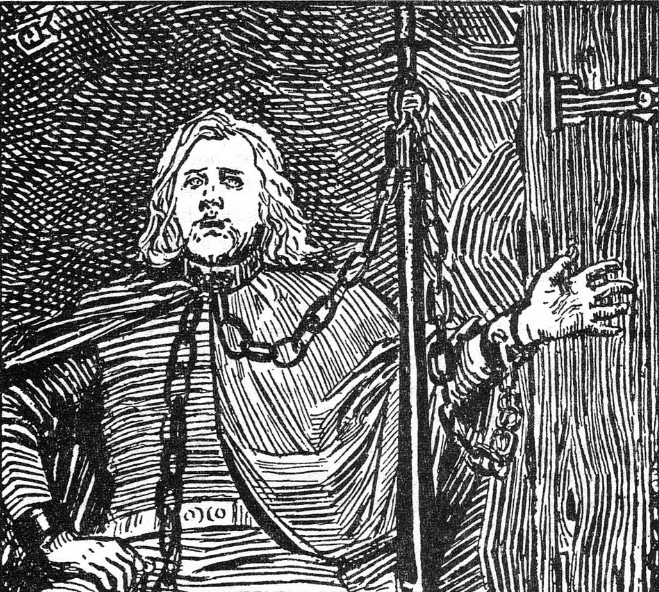
(Krohg, Christian. Skalden Berse in Prison from Olav den Hellige's Saga in Heimskringla. Illustration. 1899. Wikimedia Commons. https://commons.wikimedia.org/wiki/File:Olav_den_helliges_saga_-_Skalden_Berse_-_C._Krogh.jpg)
Christian Krohg's illustration for Olav den helliges saga in Heimskringla depicts the skald Bersi in chains composing poetry in prison under King Olaf, highlighting themes of royal justice and poetic defiance in Norse history.