
HUME
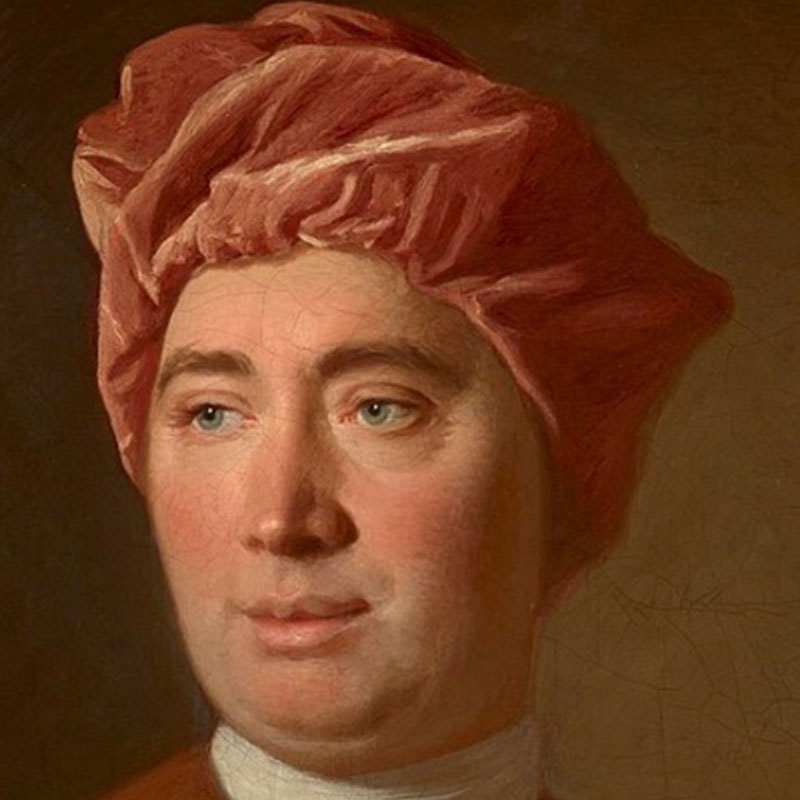
(Ramsay, Allan. David Hume, 1711–1776. Historian and Philosopher. Oil on canvas; 76 × 64 cm. 1766. Scottish National Portrait Gallery, Edinburgh. Wikimedia Commons. https://commons.wikimedia.org/wiki/File:Allan_Ramsay_-_David_Hume,_1711_-_1776._Historian_and_philosopher_-_Google_Art_Project.jpg.)

Born: 1711, Edinburgh, Scotland
Died: 1776, Edinburgh, Scotland
Notable
- Founder of Philosophical Empiricism in Britain: Developed a systematic skepticism grounded in human experience, sensation, and habit rather than innate ideas or divine revelation.
- Treatise of Human Nature (1739–40): Attempted to introduce the experimental method of reasoning into moral subjects, analyzing impressions, ideas, passions, and the principles of association.
- Principle of Causation as Customary Conjunction: Argued that belief in cause and effect arises not from reason but from observed constant conjunction and psychological habit, undermining metaphysical necessity.
1700–1800 AD works
Biography
David Hume, a Scottish philosopher, historian, economist, and essayist, is considered one of the most important figures in the history of Western philosophy. Born in Edinburgh in 1711, Hume was raised by his widowed mother after the death of his father. He studied law at the University of Edinburgh but soon discovered his passion for philosophy and literature. Hume's works encompass a wide range of topics, including epistemology, metaphysics, ethics, political philosophy, and economics. His writing is characterized by its clear, accessible style and its skepticism toward traditional philosophical doctrines.
Hume's most famous works include A Treatise of Human Nature (1739–1740), Enquiries Concerning Human Understanding (1748), and Dialogues Concerning Natural Religion (1779). Throughout his life, Hume was a controversial figure, facing criticism from both religious and philosophical circles for his skeptical views on religion and metaphysics. Despite this, his influence on subsequent philosophers, including Immanuel Kant and Adam Smith, cannot be overstated. Hume passed away in 1776, leaving behind a legacy that continues to shape philosophical discourse to this day.
Influences & Notable For
Notable For
David Hume is best known for his contributions to empiricism, skepticism, and naturalism in philosophy. His works challenged traditional philosophical views and laid the groundwork for modern philosophical thought. Hume's critiques of causality, induction, and the concept of the self have had a lasting impact on the field of epistemology. Additionally, his political and economic writings, including his advocacy for free trade and limited government intervention, have influenced the development of liberal political theory.
Influences
Hume was influenced by a wide range of thinkers, including John Locke, who built upon Locke's empiricist philosophy and theory of knowledge. Isaac Newton inspired Hume with his scientific method, which Hume sought to apply to the study of human nature. Francis Hutcheson's ideas on ethics and aesthetics shaped Hume's moral philosophy. Pierre Bayle influenced Hume's skepticism and critical approach to religious belief. Montesquieu's political philosophy also informed Hume's writings on government and liberty.
Famous quotes
- "Reason is, and ought only to be, the slave of the passions."
- "To be a philosophical skeptic is, in a man of letters, the first and most essential to being a sound, believing Christian."
- "Beauty is no quality in things themselves: it exists merely in the mind which contemplates them."
- "Generally speaking, the errors in religion are dangerous; those in philosophy only ridiculous."
Legacy & Modern Significance
David Hume's legacy lies in his profound impact on the development of modern philosophy. His skeptical and empiricist views have influenced generations of philosophers, including Immanuel Kant, who credited Hume with awakening him from his "dogmatic slumber." Hume's contributions to ethics, epistemology, and political theory continue to be studied and debated in philosophical circles around the world. His emphasis on the role of experience and observation in shaping human understanding has had a lasting impact on the fields of psychology and cognitive science.
Modern Moments & Impact on 21st Century
In 2011, the tercentenary of Hume's birth was celebrated with conferences, exhibitions, and academic events around the world.
The publication of new scholarly editions and translations of Hume's works continues to expand our understanding of his philosophy in the 21st century.
Digital resources such as online archives and databases make Hume's writings more accessible to a global audience, further cementing his influence on contemporary philosophical discourse.
Suggested Reading and Resources
Primary Works (in chronological order of first publication)
- Hume, David. A Treatise of Human Nature: Being an Attempt to Introduce the Experimental Method of Reasoning into Moral Subjects. London: John Noon, 1739–1740. The foundational text; read the Oxford Philosophical Texts edition for clarity.
- Hume, David. Essays Moral, Political, and Literary. Edited by Eugene F. Miller. Revised edition. Indianapolis: Liberty Fund, 1987. First compiled 1741–1777; includes “Of Miracles,” “Of the Standard of Taste,” and economic essays.
- Hume, David. An Enquiry concerning Human Understanding. Edited by Tom L. Beauchamp. Oxford: Clarendon Press, 2000. 1748/1751 recasting of Treatise Book I; more accessible entry point.
- Hume, David. An Enquiry concerning the Principles of Morals. Edited by Tom L. Beauchamp. Oxford: Clarendon Press, 1998. 1751; Hume’s favorite among his works.
- Hume, David. Dialogues concerning Natural Religion. Edited by Dorothy Coleman. Cambridge: Cambridge University Press, 2007. Posthumously published 1779; devastating critique of design arguments.
Key Secondary Literature
- Norton, David Fate. David Hume: Common-Sense Moralist, Sceptical Metaphysician. Princeton: Princeton University Press, 1982. Classic reconciliation of Hume’s skepticism and moral realism.
- Fogelin, Robert J. Hume’s Skepticism in the Treatise of Human Nature. London: Routledge & Kegan Paul, 1985. Lucid on causation, induction, and the “missing shade of blue.”
- Garrett, Don. Cognition and Commitment in Hume’s Philosophy. New York: Oxford University Press, 1997. Authoritative on Hume’s theory of mind and belief formation.
- Strawson, Galen. The Secret Connexion: Causation, Realism, and David Hume. Revised edition. Oxford: Oxford University Press, 2014. Bold “New Hume” interpretation challenging the anti-realist consensus.
- Harris, James A. Hume: An Intellectual Biography. Cambridge: Cambridge University Press, 2015. Magisterial contextual life; indispensable for understanding the Parisian triumph and Edinburgh scandal.
THE SCOTTISH SKEPTIC
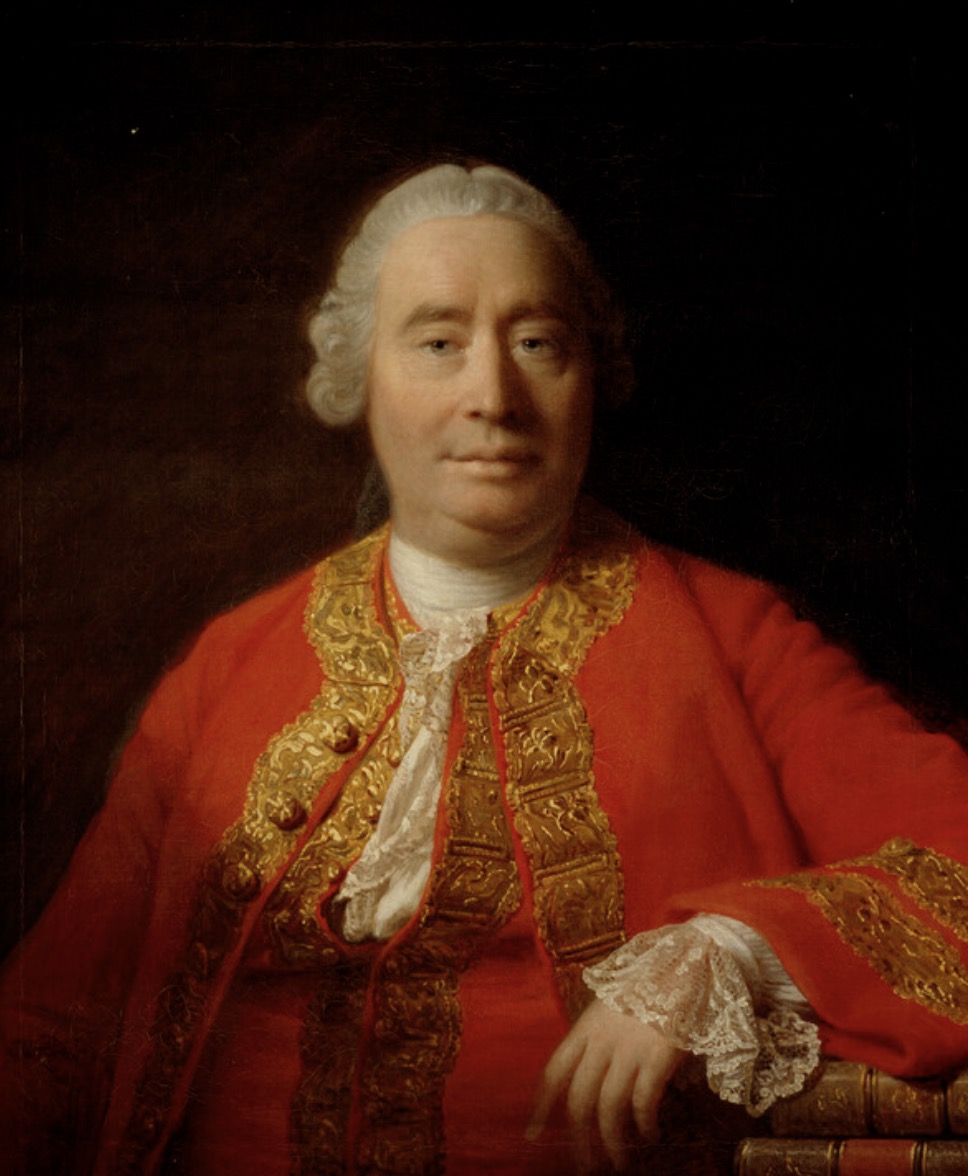
(Allan Ramsay. David Hume (1711–1776). 1766. Oil on canvas. Scottish National Portrait Gallery, Edinburgh. https://www.nationalgalleries.org/art-and-artists/2775.)
This iconic 1766 oil portrait by Allan Ramsay depicts the Scottish philosopher David Hume at age 55, during the height of the Enlightenment. Clad in a striking scarlet jacket and leaning on scholarly tomes, Hume gazes thoughtfully, embodying empiricism and skepticism. Housed in Scotland's National Galleries, it captures the thinker who profoundly shaped modern philosophy, influencing Kant and beyond.

(AI-generated image)
David Hume, the 18th-century colossus of Edinburgh, shattered the illusions of metaphysics with a single, serene insight: all knowledge springs from experience, and causation itself is but habit’s quiet tyranny. With wit as gentle as it was merciless, he dissolved miracles into probability, morality into sentiment, and the self into a bundle of perceptions—leaving philosophy forever humbled, yet electrified, by the boundless empire of the human mind.
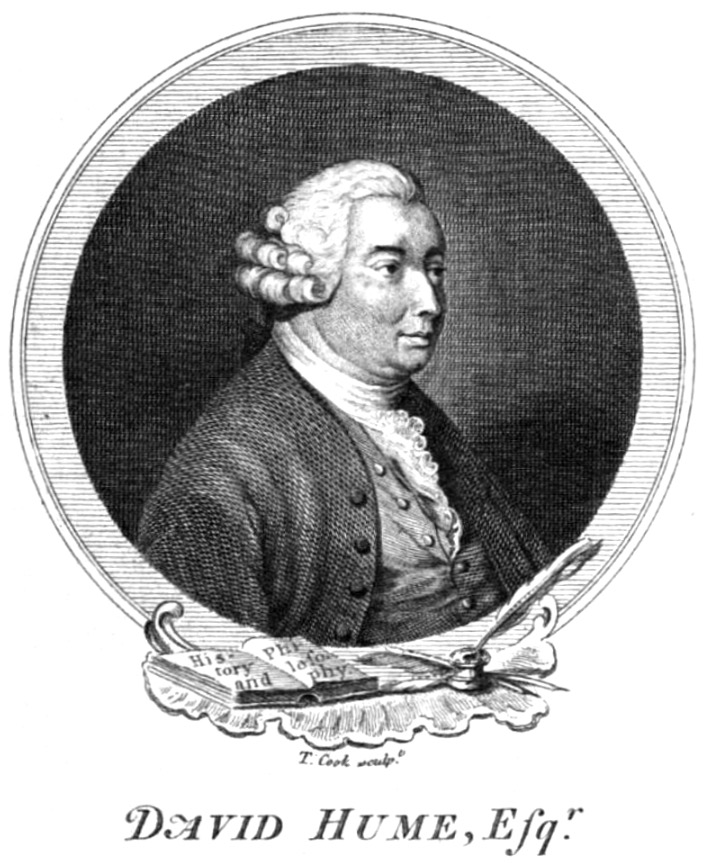
(Unknown. Portrait from The Life of David Hume. Engraving; 12 × 10 cm. 1777. Wikimedia Commons. https://commons.wikimedia.org/wiki/File:The_Life_of_David_Hume_-_Hume_(1777)_-_portrait.png.)
_-_portrait.png)
A frontispiece portrait from the 1777 edition of The Life of David Hume, engraved after Ramsay, shows the philosopher in profile with a book, symbolizing his autobiographical reflections and legacy in challenging metaphysical dogmas for empirical freedom.