
MAGNA CARTA
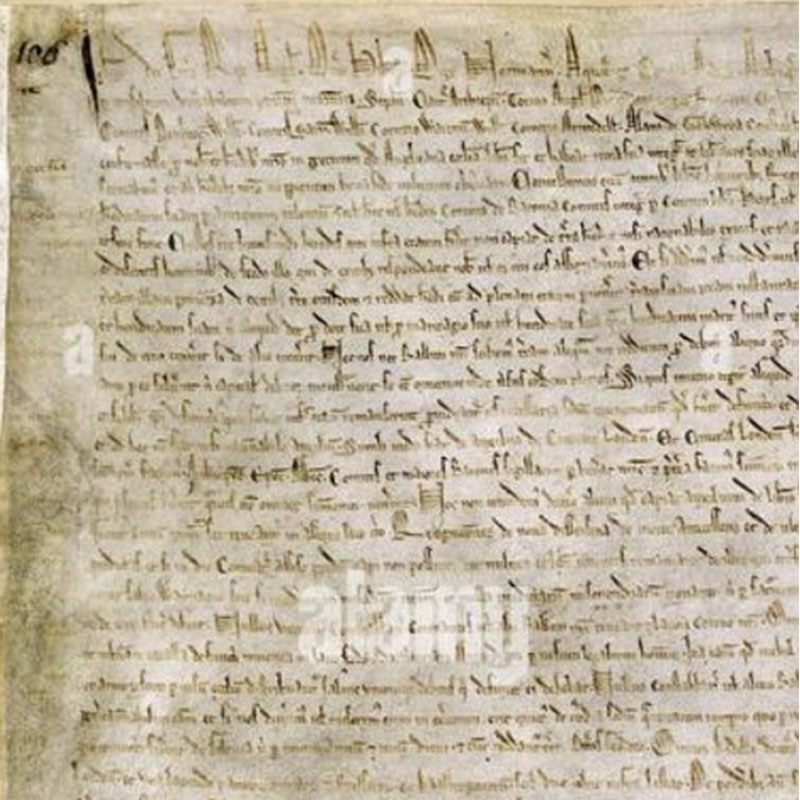
("https://c8.alamy.com/comp/2J5HEH2/one-of-four-surviving-copies-of-the-1215-magna-carta-this-copy-is-one-of-two-held-at-the-british-library-it-came-from-the-collection-of-sir-robert-cotton-who-died-in-1631-in-1731-a-fire-at-ashburnam-house-in-westminster-where-his-library-was-then-housed-destroyed-or-damaged-many-of-the-rare-manuscripts-which-is-why-this-copy-is-burnt-2J5HEH2.jpg")
-
Rule of Law: Established that the king is subject to the law.
-
Limits on Power: Restricted royal authority and protected noble rights.
-
Constitutional Legacy: Laid foundations for common law and democratic governance.
Biography
Magna Carta, Latin for "Great Charter," is a foundational document in English legal history that was issued in 1215 during the reign of King John of England. It was the result of a political crisis between the king and his barons, who were unhappy with his tyrannical rule and heavy taxation. The barons pressured King John to agree to a list of concessions that would limit his power and protect their feudal rights. The document was originally written in Latin and consisted of 63 clauses, addressing various grievances and establishing principles of justice and fairness. Despite being annulled by Pope Innocent III shortly after its creation, it was reissued and revised multiple times over the following decades.
Influences & Notable For
Magna Carta is best known for establishing the principle that the king is subject to the law rather than above it. It limited the power of the monarchy and protected the rights of the nobility, laying the foundation for constitutional law and individual liberties. While some of its clauses were specific to the feudal context of the time, others have had enduring significance in the development of common law and democratic governance.
Famous quotes
"To no one will we sell, to no one deny or delay right or justice." (Clause 40)
"No freeman shall be taken, or imprisoned, or outlawed, or exiled, or in any way harmed... except by the lawful judgment of his peers or by the law of the land." (Clause 39)
Legacy & Modern Significance
The legacy of the Magna Carta can be seen in its enduring influence on legal and political systems around the world. It has been cited as a source of inspiration for constitutional documents and declarations of rights in countries such as the United States, Canada, and Australia. The principles of limited government, due process, and individual liberty that are enshrined in the Magna Carta continue to shape debates about the rule of law and the relationship between rulers and citizens.
Modern Moments & Impact on the 21st Century
In 2007, the Magna Carta was designated as a UNESCO Memory of the World, recognizing its global significance as a foundational document of human rights and constitutional law.
The 800th anniversary of the Magna Carta in 2015 was marked by a series of events and exhibitions around the world, highlighting its continued relevance in the modern era.
Digital resources such as the British Library's online exhibition on the Magna Carta have made the document more accessible to a wider audience, fostering greater awareness of its historical importance.
Influences & Intellectual Context
The Magna Carta was influenced by a combination of legal traditions and political developments in medieval England. It drew on earlier charters and legal customs that sought to limit the power of the monarchy and protect the rights of the nobility. The document also reflected broader trends in European political thought, including the idea of a social contract between rulers and subjects and the concept of natural law. The Magna Carta has been seen as a precursor to later constitutional documents, such as the English Bill of Rights and the U.S. Constitution.
Suggested Reading & Resources
Brundage, James A. "Magna Carta and the Rule of Law." Cambridge University Press, 2014. Cambridge University Press
Carpenter, David. "Magna Carta." Penguin UK, 2015. Penguin
Magna Carta: Muse and Mentor. British Library, 2010. British Library
SYMBOL OF FREEDOM AND JUSTICE
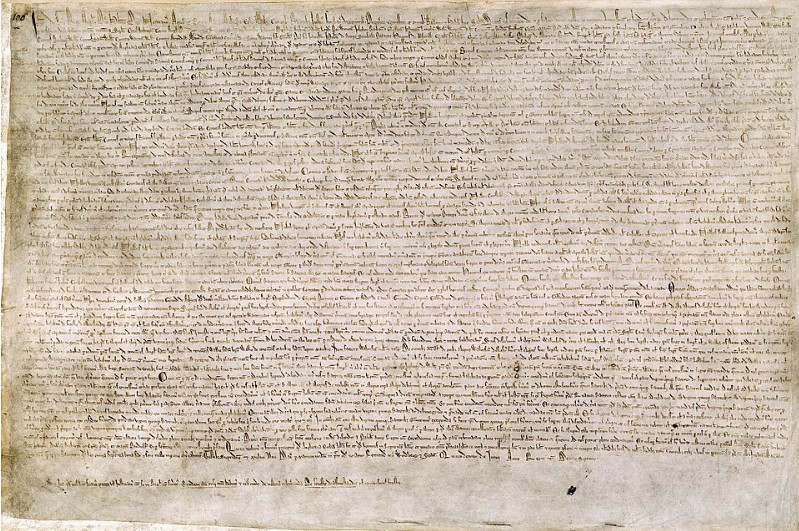
(Unknown. Magna Carta (Cotton MS Augustus II.106). Manuscript on parchment; 37.5 × 21 cm. 1215. British Library, London. Wikimedia Commons. https://commons.wikimedia.org/wiki/File:Magna_Carta_(British_Library_Cotton_MS_Augustus_II.106).jpg.)
.jpg)
A high-resolution photograph of the 1215 Magna Carta manuscript from the British Library's Cotton MS Augustus II.106, one of four surviving originals, featuring the Latin text on aged parchment with visible royal seal fragments, establishing fundamental legal protections against arbitrary royal authority and influencing modern constitutions worldwide.
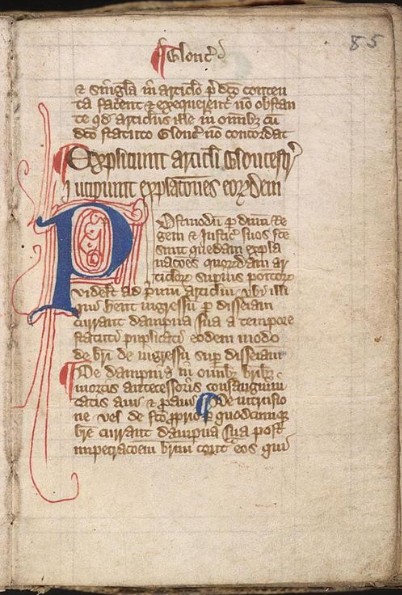
(Unknown. Magna Carta cum Statutis Angliae, Page 1. Printed book with illumination; folio size. 1531. British Library, London. Wikimedia Commons. https://commons.wikimedia.org/wiki/File:Magna_charta_cum_statutis_angliae_p1.jpg.)

The first page of the 1531 printed edition of the Magna Carta cum statutis Angliae, an illuminated manuscript facsimile with ornate Gothic script, red and blue initials, and decorative borders, preserving the charter's clauses alongside early English statutes for legal reference.
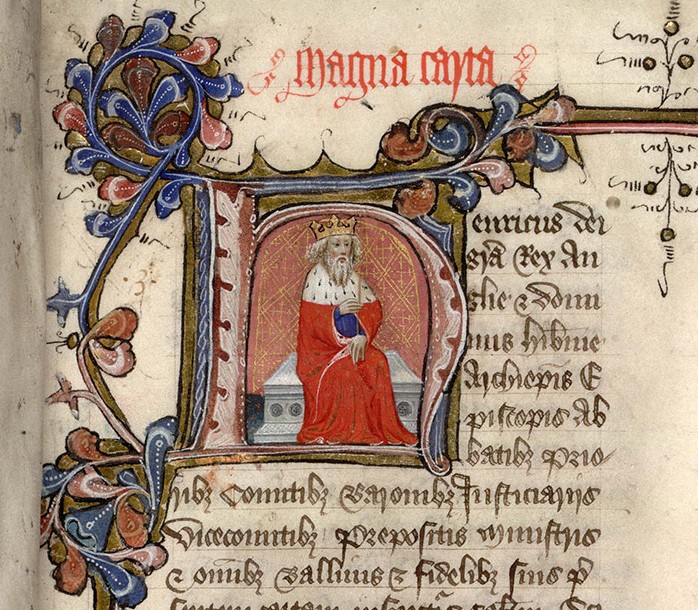
(Unknown. The Magna Carta Facsimile. Printed facsimile; 700 × 612 pixels. ca. 1900. The Huntington Library, San Marino, CA. https://www.huntington.org/verso/magna-charta.)
A 19th-century facsimile reproduction of the Magna Carta from The Huntington Library's collection, depicting the charter's text in elegant script on parchment-like paper, used for educational purposes to illustrate the document's historical and constitutional significance.