
NEWTON
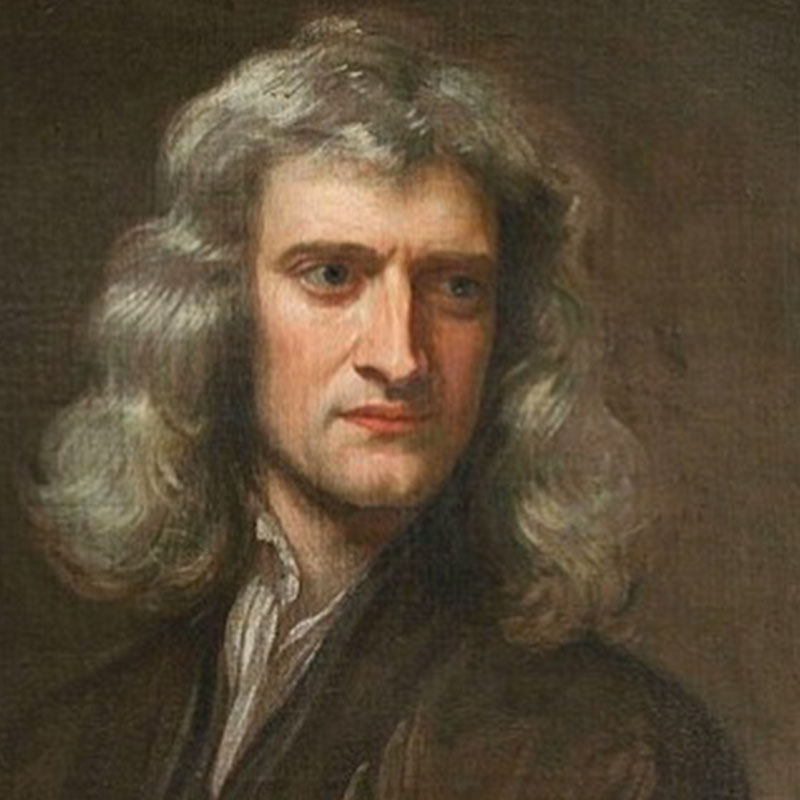
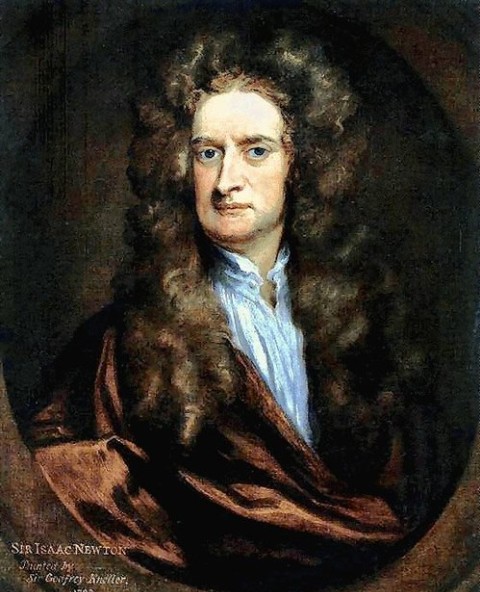
(Kneller, Godfrey. Portrait of Sir Isaac Newton. Oil on canvas. 1689. Wikimedia Commons. https://commons.wikimedia.org/wiki/File:Portrait_of_Sir_Isaac_Newton,_1689_(brightened).jpg.)
.jpg)
Born: January 4, 1643 (December 25, 1642, Old Style), Woolsthorpe, Lincolnshire, England
Died: March 31, 1727 (March 20, 1727, Old Style), London, England
Notable
- Formulating the three laws of motion and the law of universal gravitation.
- Authoring the Principia Mathematica, foundational to classical physics.
- Development of calculus (independently of Leibniz).
- Foundational work in optics, including the theory of light and color.
- Invention of the reflecting telescope.
Biography
Isaac Newton (4 January 1643 – 31 March 1727, N.S.) was an English mathematician, physicist, astronomer, alchemist, theologian, and author who emerged as one of the defining figures of the Scientific Revolution. Born in Woolsthorpe, Lincolnshire, Newton overcame early adversity after the death of his father and a difficult family life. He entered Trinity College, Cambridge, in 1661, where he was introduced to the “new philosophy” of figures like Galileo and Descartes but was largely self-taught in mathematics and natural philosophy. Newton’s academic career was marked by solitary study, explosive intellectual breakthroughs, and eventual recognition by the Royal Society. His magnum opus, the Philosophiæ Naturalis Principia Mathematica (“Mathematical Principles of Natural Philosophy,” 1687), reformulated the scientific view of the universe with his laws of motion and law of universal gravitation. Beyond physics and mathematics, he made lasting contributions to optics, built one of the first reflecting telescopes, and engaged in profound, if controversial, theological and alchemical studies. Later, Newton served as Warden and then Master of the Royal Mint, taking an active role in monetary reforms and anti-counterfeiting. Knighted by Queen Anne in 1705, he spent his final years as a prominent public figure and President of the Royal Society, dying in London at 84.
Influences & Notable For
Formulating the three laws of motion and the law of universal gravitation.
Authoring the Principia Mathematica, foundational to classical physics.
Development of calculus (independently of Leibniz).
Foundational work in optics, including the theory of light and color.
Invention of the reflecting telescope.
Famous quotes
“If I have seen further it is by standing on the shoulders of giants.” (Letter to Robert Hooke, 1675)
“To every action there is always opposed an equal reaction.” (Principia Mathematica, Book I, Third Law)
“Truth is ever to be found in simplicity, and not in the multiplicity and confusion of things.”
“I do not know what I may appear to the world, but to myself I seem to have been only like a boy playing on the seashore ... whilst the great ocean of truth lay all undiscovered before me.”
Legacy & Modern Significance
Newton’s laws form the backbone of physics and engineering curricula worldwide.
Calculus is core to mathematics, science, and engineering.
Principia Mathematica and Opticks remain central texts in the history of science.
Newton’s methods of scientific inquiry and emphasis on experimental evidence endure in scientific practice.
He continues to inspire philosophical, theological, and historical studies due to his broad intellectual vision and lasting contributions.
Modern Moments & Impact on the 21st Century
2023: Principia Mathematica and Opticks available as digital facsimiles via The Newton Project.
2025: BBC Teach and other major educational outlets produce new documentaries on Newton’s influence.
Ongoing: The Newton Project (Oxford University) continues to digitize and disseminate his manuscripts.
Ongoing: Newton’s laws, ideas, and biography feature in STEM education at K–12 and university levels globally.
Influences & Intellectual Context
Built upon classical traditions: Euclid, Archimedes, and Ptolemy in mathematics and astronomy.
Responded to and critiqued works by Galileo, Descartes, and Kepler (mechanics, heliocentrism).
Deeply influenced by biblical studies and alchemical traditions.
Engaged with contemporaries: Robert Hooke, Edmond Halley, Gottfried Wilhelm Leibniz.
Active in the Scientific Revolution and early Enlightenment, impacting the Royal Society and beyond.
Suggested Reading & Resources
Secondary Literature (Scholarship)
Westfall, Richard S., Never at Rest: A Biography of Isaac Newton. Cambridge: Cambridge University Press, 1980.
Feingold, Mordechai, The Newtonian Moment: Isaac Newton and the Making of Modern Culture. Oxford: Oxford University Press, 2004.
Hall, A. Rupert, Isaac Newton: Adventurer in Thought. Oxford: Blackwell, 1992.
Iliffe, Rob, Newton: A Very Short Introduction. Oxford: Oxford University Press, 2007.
Cohen, I. Bernard, and Smith, George E., eds. The Cambridge Companion to Newton. Cambridge: Cambridge University Press, 2002.
Archival or Online Sources
The Newton Project (digitized manuscripts and correspondence): https://www.newtonproject.ox.ac.uk/
Stanford Encyclopedia of Philosophy, “Isaac Newton” entry: https://plato.stanford.edu/entries/newton/
BBC Teach, “Isaac Newton: The man who discovered gravity”: https://www.bbc.co.uk/teach/articles/zh8792p
FOUNDATION OF CLASSICAL SCIENCE
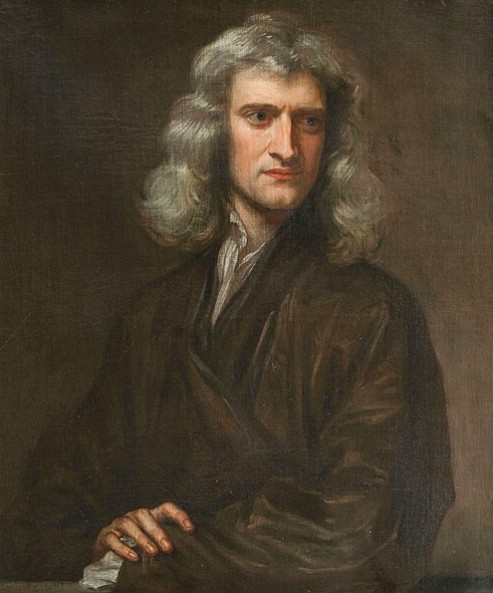
(Kneller, Godfrey. Portrait of Sir Isaac Newton. Oil on canvas. 1689. Wikimedia Commons. https://commons.wikimedia.org/wiki/File:Portrait_of_Sir_Isaac_Newton,_1689_(brightened).jpg.)
A brightened 1689 portrait of Sir Isaac Newton by Godfrey Kneller depicts the mathematician in a wig and robe, his piercing gaze reflecting his Principia Mathematica and laws of motion, as honored in the Goodrich Seminar Room for advancing scientific liberty.
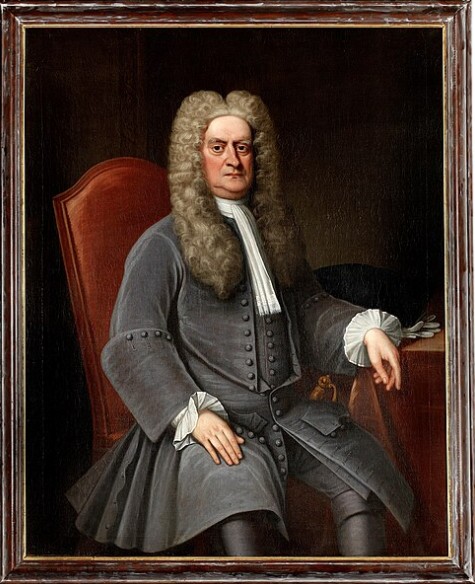
(Unknown. Isaac Newton, English School. Oil on canvas. ca. 1715–1720. Wikimedia Commons. https://commons.wikimedia.org/wiki/File:Isaac_Newton,_English_School,_1715-20.jpg.)

An English School portrait from 1715-1720 shows Isaac Newton seated in formal attire with a book, emphasizing his discoveries in optics and calculus that transformed natural philosophy and empirical inquiry.
(Unknown. Sir Isaac Newton. Oil on canvas. 1702. Wikimedia Commons. https://commons.wikimedia.org/wiki/File:Sir_Isaac_Newton_1702.jpg.)

A 1702 portrait of Sir Isaac Newton in a lace cravat and coat, with a serious expression, symbolizes his presidency of the Royal Society and commitment to observation over dogma, as celebrated in the Goodrich Seminar Room.