Plato

PLATO

Plato
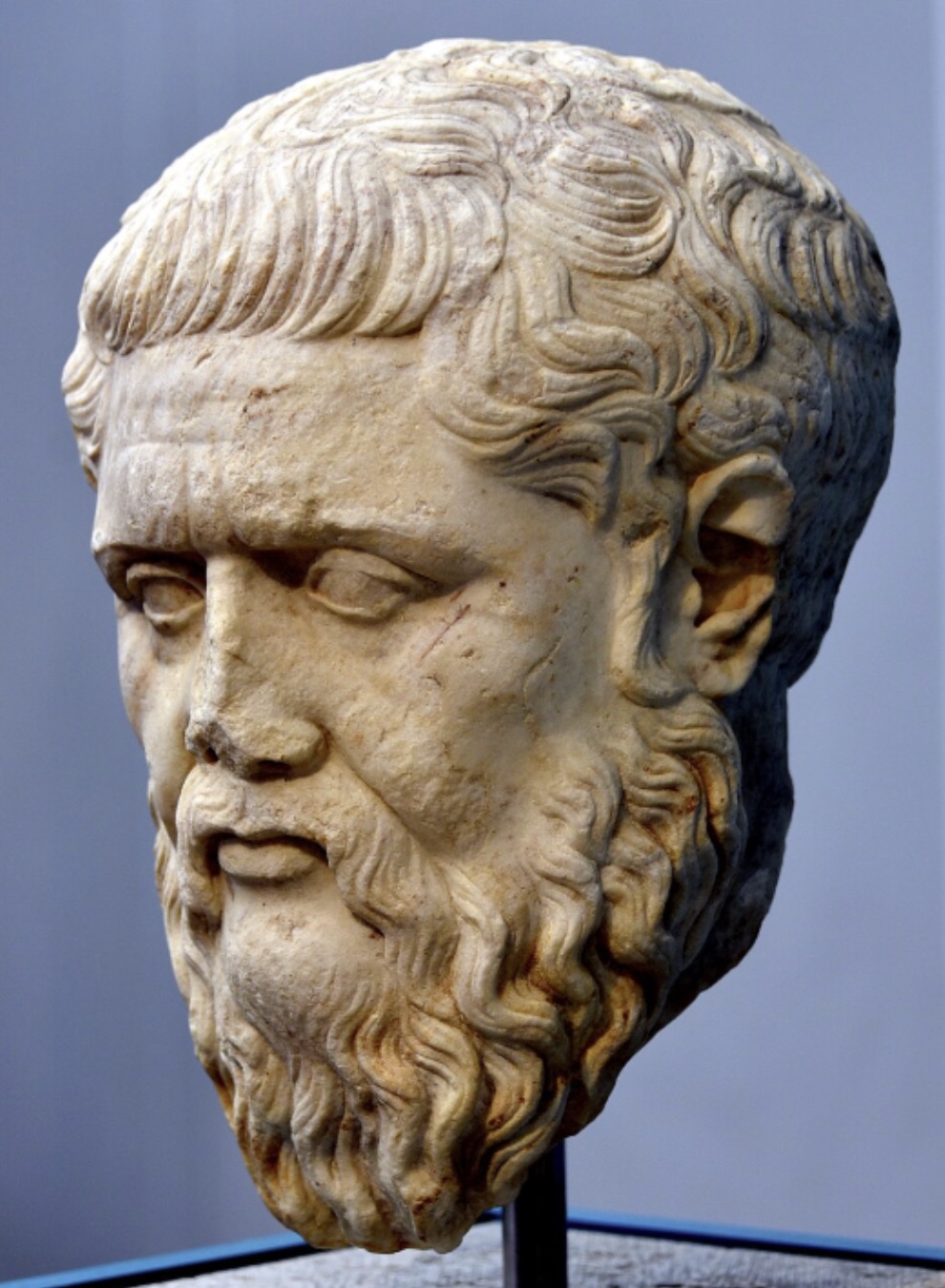
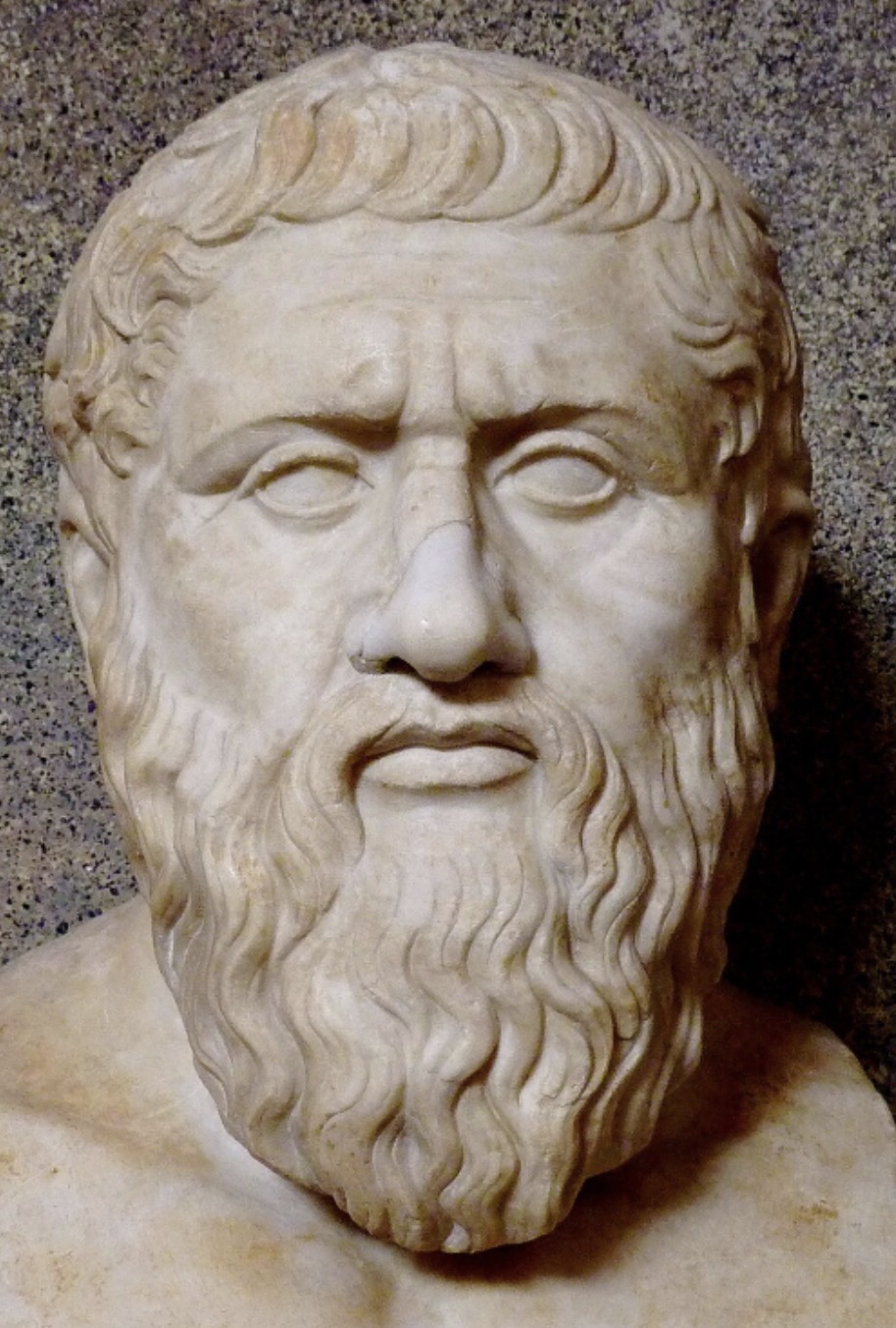
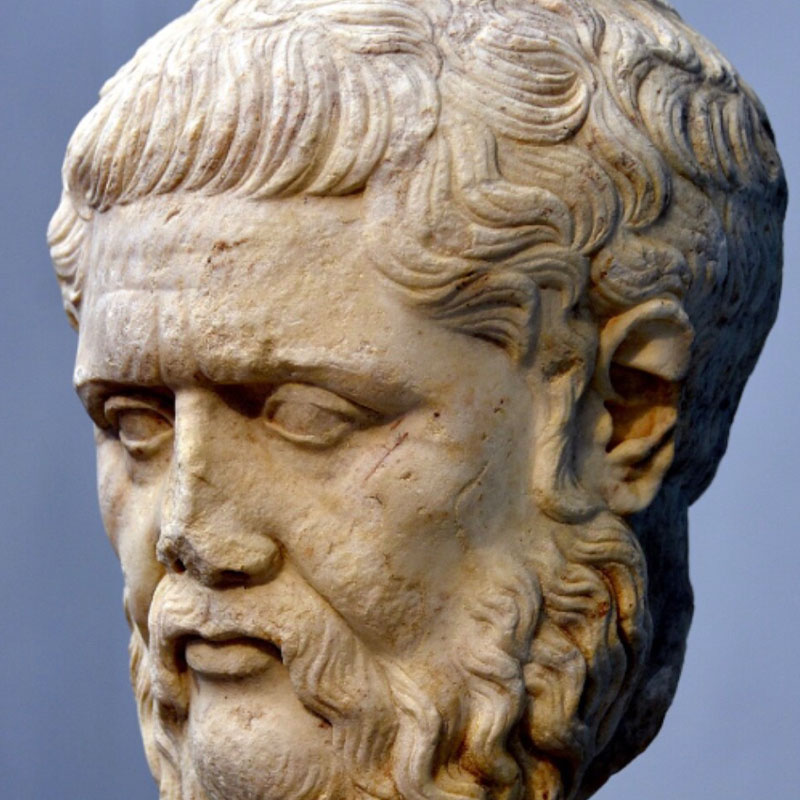
(“Marble bust of the Greek philosopher Plato. Roman copy (1st century CE) of an original (350-340 BCE). Altes Museum, Berlin.” Wikimedia Commons. 1st century CE (copy). Accessed October 5, 2025.)

Born: 427 BCE, Athens (possibly during the Peloponnesian War)

Died: 347 BCE, Athens

Notable

  • Theory of Forms: A metaphysical system positing that non-material abstract forms (e.g., Justice, Beauty) are more real than physical objects.
  • The Republic: A foundational philosophical text exploring justice, politics, education, the soul, and the philosopher’s role in society.
  • Philosopher-King: Plato’s political ideal of a ruler guided by wisdom and virtue rather than wealth or power.
  • Founding the Academy: The prototype for future universities, where he taught philosophy, mathematics, and science.

427-347 BCE

Biography

Plato (c. 428/427–348/347 BCE) was a Greek philosopher, writer, and foundational figure in Western philosophy. A student of Socrates and teacher of Aristotle, Plato founded the Academy in Athens, the first institution of higher learning in the Western world. His writings—mostly in the form of philosophical dialogues—explored ethics, politics, metaphysics, epistemology, art, and education. After the Trial of Socrates, Plato settled in Syracuse, founding the Platonic Academy around 383 BCE, where he mentored students until c. 366 BCE.

Plato’s work is inseparable from his philosophical method: dialectic, or philosophical questioning through dialogue. His major contributions include the theory of Forms, the concept of the philosopher-king, and a comprehensive vision of justice, knowledge, and the ideal state. His most famous student, Aristotle, would go on to diverge from Plato’s metaphysical ideas while building upon his methods and themes.

As the author of the most comprehensive accounts of Socrates and the teacher of Aristotle, Plato is central to the philosophy of both. Unlike the historian Xenophon, who emphasizes enkrateia (self-control), Plato positions the elenchus or “Socratic method” at the core of inquiry. This is further complicated by other ancient writers, such as Aristophanes, who portray Socrates as an irreverent atheist and sophist. Some scholars pose that Plato’s depiction represents a unique departure from Socratic philosophy instead of a precise preservation.

Neoplatonism and associated Aristotelian philosophy are at the core of both Christian and Islamic philosophy. Abu Nasr Muhammad al-Farabi and Thomas Aquinas are both recognized for their incorporation of Platonic metaphysics, while the structure of philosophical dialogue remained a dominant literary technique well into the nineteenth century.

    Bibliography & Major Works

    Major Dialogues (Selected by Theme):

    Ethics & Epistemology
    Euthyphro
    Apology
    Meno
    Phaedrus
    Symposium

    Metaphysics & Cosmology
    Phaedo
    Timaeus
    Parmenides
    Theaetetus
    Sophist

    Politics & Education
    Republic
    Laws
    Statesman
    Gorgias
    Protagoras

    Collected Editions:
    Platonis Opera (ed. John Burnet, Oxford Classical Texts, 1900–1907)
    Plato: Complete Works (ed. John M. Cooper, Hackett Publishing, 1997)

    Original Language: Ancient Greek
    Key Manuscripts: Medieval Greek manuscripts preserved in Byzantine libraries; modern editions are based on critical comparisons of these with Latin and Arabic translations.

    Influences & Notable For

    Theory of Forms: A metaphysical system positing that non-material abstract forms (e.g., Justice, Beauty) are more real than physical objects.

    The Republic: A foundational philosophical text exploring justice, politics, education, the soul, and the philosopher’s role in society.

    Dialectic Method: Developing and systematizing the Socratic method of questioning through dialogical inquiry.

    Philosopher-King: Plato’s political ideal of a ruler guided by wisdom and virtue rather than wealth or power.

    Founding the Academy: The prototype for future universities, where he taught philosophy, mathematics, and science.

    Allegories and Myths: His literary imagination—seen in the Allegory of the Cave, the Myth of the Charioteer, and the Atlantis story—continues to captivate both philosophers and artists.

    Famous quotes
    • “The unexamined life is not worth living.” — Apology

    • “Justice in the life and conduct of the State is possible only if it first resides in the hearts and souls of the citizens.” — Republic

    • “At the touch of love everyone becomes a poet.” — Symposium

    • “Knowledge is the food of the soul.” — Protagoras

    • “Those who tell the stories rule society.” — Attributed to Plato (interpretation of Republic)

    Major Works

    Key Work: The Republic

    Section – Description
    Books I–II: Introduction of justice, Socratic dialogue
    Books III–IV: The ideal city—education, censorship, and class structure
    Book V: The philosopher-king, role of women, abolition of family
    Book VI: Nature of the philosopher, the divided line
    Book VII: Allegory of the Cave, enlightenment, and education
    Books VIII–IX: Degeneration of political systems
    Book X: Critique of poetry, immortality of the soul

    Other Notable Dialogues:
    Timaeus: Cosmology and creation of the universe.
    Phaedo: Arguments for the immortality of the soul.
    Symposium: The nature and stages of love (Eros).
    Phaedrus: Love, rhetoric, and the soul’s ascent.
    Parmenides: Critique of the theory of Forms.

    Legacy & Modern Significance
    • Historical Interpretation and Reception:
      Ancient World: Revered by Neoplatonists, such as Plotinus; deeply influential on early Christian thought (e.g., Augustine).
      Medieval Period: Studied through translations (especially in Islamic philosophy and later in Scholasticism).
      Renaissance: Re-emerged as a central figure of humanism and philosophical idealism.
      Modern Philosophy: Influenced rationalism (Descartes, Kant), idealism (Hegel), and existentialism (Sartre, Camus).

    • Influence on Disciplines:
      Philosophy: Foundation of Western metaphysics, ethics, epistemology, and political theory.
      Psychology: Tripartite soul theory influenced Freud’s id, ego, and superego.
      Education: Socratic method remains a foundational pedagogical technique.
      Politics: Ideas about justice, governance, and civic virtue are central in modern political theory.

    Influences & Intellectual Context
    • Philosophical Influences:
      Socrates (469–399 BCE): Plato’s teacher; central figure in his early dialogues.
      Pythagoreans: Influenced his views on mathematics, harmony, and the soul.
      Parmenides & Heraclitus: Influenced Plato’s metaphysics, especially the contrast between permanence and change.

    • Cultural and Political Influences:

      Athenian democracy and its failures, including the execution of Socrates, shaped Plato’s skepticism of popular rule.
      The Peloponnesian War (431–404 BCE) and its aftermath colored his political pessimism.

    Suggested Reading & Resources

    Essential Editions & Commentaries:
    Plato: Complete Works, ed. John M. Cooper (Hackett, 1997)
    Julia Annas, An Introduction to Plato’s Republic (Oxford, 1981)
    Melissa Lane, Plato’s Progeny (Duckworth, 2001)
    Kenneth Dover, Greek Popular Morality in the Time of Plato and Aristotle (Oxford, 1974)

    Online Resources:
    Stanford Encyclopedia of Philosophy – Plato
    Internet Classics Archive – MIT
    Perseus Digital Library – Tufts University
    Loeb Classical Library
    Plato’s Dialogues in English and Greek – Project Gutenberg