TACITUS
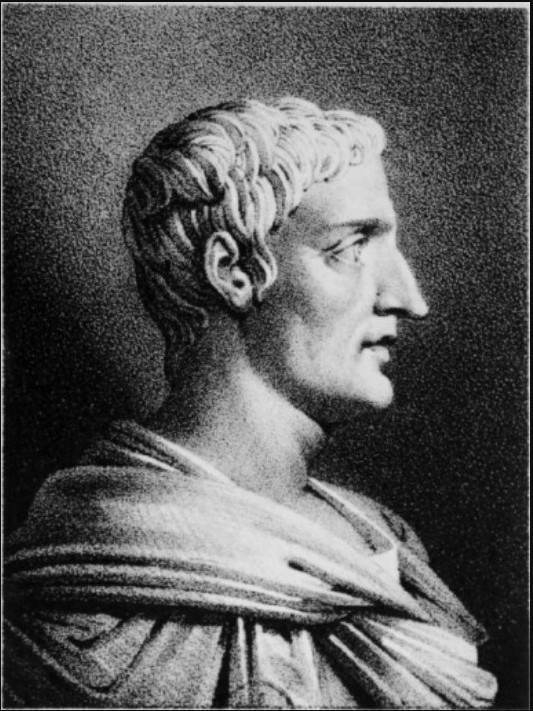
(Unknown. Gaius Cornelius Tacitus. Drawing. 1920. Wikimedia Commons. https://commons.wikimedia.org/wiki/File:Gaius_Cornelius_Tacitus.jpg.)
Born: Circa 56 AD (exact birth year remains uncertain)
Died: Around 120 AD
Notable
- Critique of Empire: Tacitus is revered for his unflinching portrayal of imperial excess, exploring how concentrated power erodes accountability and virtue.
- Psychological Insight: His work goes beyond political events to explore the motivations and inner lives of emperors and senators alike.
- Moral Perspective: A moralist at heart, Tacitus frequently reflects on the decline of Roman civic responsibility and virtue under authoritarian regimes.
- Ethnographic Innovation: Germania is a rare ancient source on non-Roman societies, offering a counterpoint to Roman norms and cultural assumptions.
56-120 AD
Biography
Publius Cornelius Tacitus (c. 56 – c. 120 AD) was a Roman historian, senator, and official, best known for his analysis of imperial Rome. His most famous works, The Annals and The Histories, provide a detailed, critical chronicle of the Roman Empire’s leadership, particularly from the reign of Tiberius to that of Domitian.
Tacitus is widely respected for his incisive commentary on the erosion of traditional Roman values under autocratic rule. His writings underscore themes of political manipulation, ethical decline, and the dangers inherent in unchecked authority.
Central Themes: The corrupting influence of absolute power, political maneuvering, the decline of civic virtue, and the inner workings of Roman imperialism.
Bibliography & Major Works
The Annals (Annales) – A critical historical account tracing events from the rule of Tiberius through to Nero, with sharp observations on the decline of moral and political standards.
The Histories (Historiae) – Covers the turbulent Year of the Four Emperors (69 AD) and the early Flavian dynasty, offering vivid narratives of civil war and regime change.
Germania – An ethnographic study contrasting Roman and Germanic cultures, notable for its admiration of Germanic customs as a foil to Roman decadence.
Agricola – A personal and political biography of Tacitus’ father-in-law, Gnaeus Julius Agricola, highlighting his campaigns in Britain and his restrained leadership style.
Influences & Notable For
-
Critique of Empire: Tacitus is revered for his unflinching portrayal of imperial excess, exploring how concentrated power erodes accountability and virtue.
-
Psychological Insight: His work goes beyond political events to explore the motivations and inner lives of emperors and senators alike.
-
Moral Perspective: A moralist at heart, Tacitus frequently reflects on the decline of Roman civic responsibility and virtue under authoritarian regimes.
-
Ethnographic Innovation: Germania is a rare ancient source on non-Roman societies, offering a counterpoint to Roman norms and cultural assumptions.
Famous quotes
“The more corrupt the state, the more numerous the laws.” – The Annals, Book 3
“The desire for power is the most dangerous of all passions.” – The Annals, Book 6
“In a state where corruption abounds, laws must be very numerous.” – The Annals, Book 3
Major Works
|
Title |
Focus |
|
The Annals |
A sober and critical chronicle of imperial rule from Tiberius to Nero. |
|
The Histories |
Documents the civil unrest of 69 AD and the rise of the Flavian emperors. |
|
Germania |
Ethnographic profile of Germanic tribes, contrasting them with Roman society. |
|
Agricola |
Celebrates the life and career of Tacitus’ father-in-law in Britain. |
Recurring Themes: Moral collapse, the psychology of rulers, resistance to tyranny, and the cultural tension between imperial Rome and indigenous societies.
Legacy & Modern Significance
Philosophical Influence: Tacitus’ reflections on power and ethics have shaped generations of political thinkers, from Enlightenment philosophers to modern theorists of governance.
Historiographical Impact: His analytical style and focus on character and morality remain essential to the study of Roman history.
Modern Parallels: Tacitus’ cautionary insights into despotism and civic decline are frequently referenced in discussions of modern authoritarianism.
Modern Moments & Impact on the 21st Century
Relevance Today: In an era of growing concern about state overreach and political ethics, Tacitus’ commentary remains strikingly pertinent.
Academic Use: His works are essential reading in university courses on history, philosophy, and classical studies.
Digital Access: Texts by Tacitus are widely available online, ensuring ongoing accessibility and scholarship.
Influences & Intellectual Context
Historical Setting: Tacitus wrote during the reigns of the Flavian dynasty and into the early second century. His perspective was shaped by the instability that followed Nero’s fall and the increasing autocracy of Roman leadership.
Stoic Philosophy: Stoicism’s emphasis on virtue, duty, and endurance under pressure heavily influenced Tacitus’ worldview, especially his reflections on moral integrity.
Literary Lineage: Building on the legacies of historians like Sallust and Livy, Tacitus adopted a more skeptical, concise, and morally reflective style.
Suggested Reading & Resources
Scholarly Works:
Syme, Ronald. Tacitus. Oxford University Press, 1958.
Oakley, Stewart. Tacitus and the Tacitean Tradition. Oxford, 1996.
Woodman, Tony. Tacitus: A Historical Commentary. Oxford, 2004.
Online Resources:
The Annals of Tacitus – Project Gutenberg
The Histories of Tacitus – Project Gutenberg
Germania – Sacred Texts Archive
VOICE OF ROME’S CONSCIENCE
(Julien. Portrait of Tacitus. Ink drawing. 1915. Wikimedia Commons. https://commons.wikimedia.org/wiki/File:Tacitus_portrait.jpg.)
A 1915 ink drawing of the Roman historian Tacitus by artist Julien, based on an antique bust, capturing the stoic features of the author of Annals and Histories.
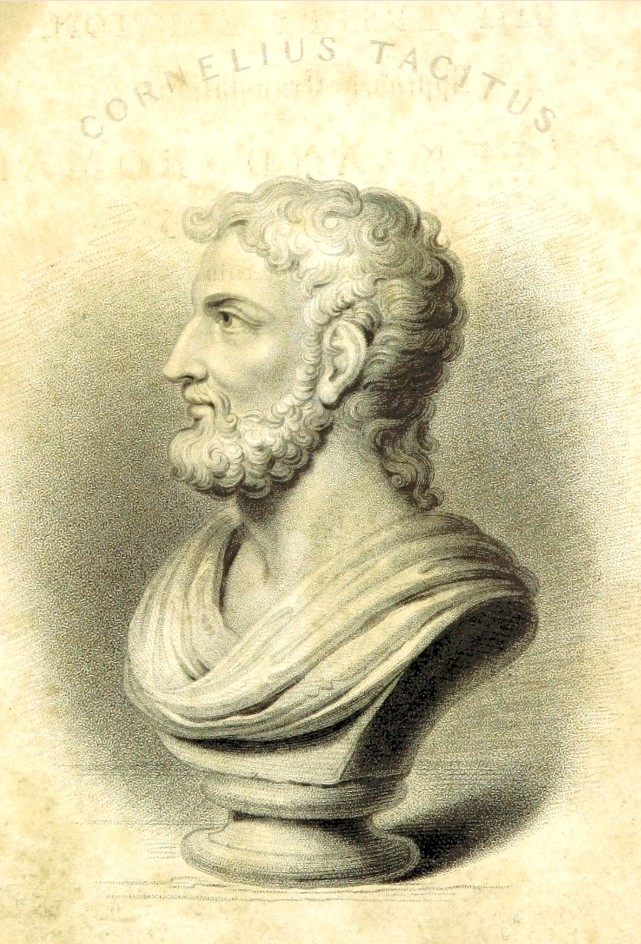
(Brooke (drawn) and S. Freeman (engraved). Cornelius Tacitus. Engraving. 1829. British Library, London. Wikimedia Commons. https://commons.wikimedia.org/wiki/File:MURPHY(1829)_p008_Cornelius_Tacitus.jpg.)
An engraving of Cornelius Tacitus, drawn by Brooke and engraved by S. Freeman, depicting a classical bust in profile, from an 1829 edition of his works.
(Unknown. Gaius Cornelius Tacitus. Drawing. 1920. Wikimedia Commons. https://commons.wikimedia.org/wiki/File:Gaius_Cornelius_Tacitus.jpg.)
A drawing of the Roman historian Gaius Cornelius Tacitus by an unknown illustrator, based on an antique bust, published in a 1920 historical book series.