
AQUINAS
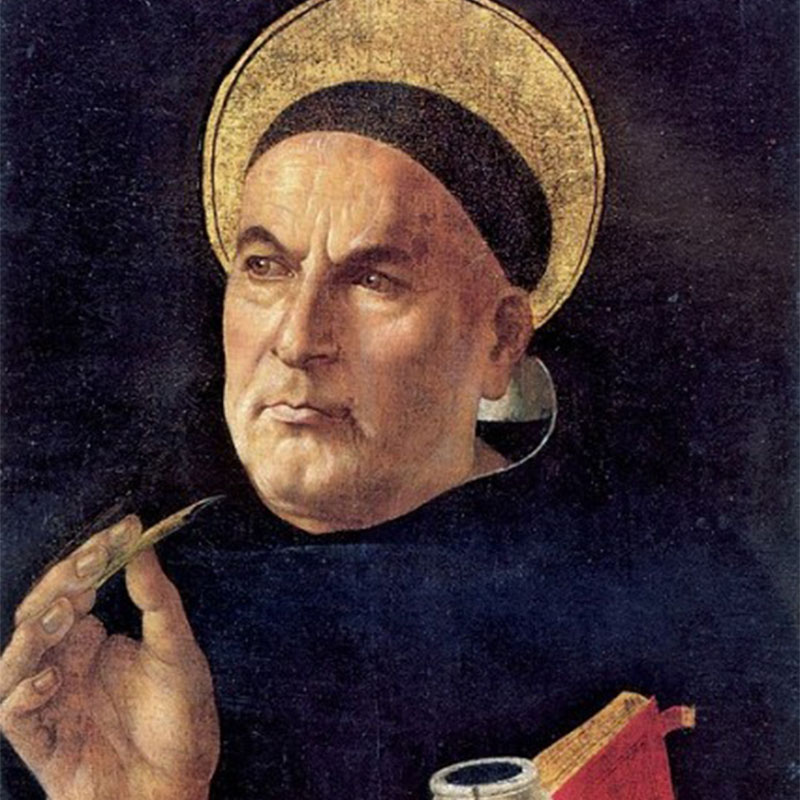
(Botticelli, Sandro. Thomas Aquinas. Painting. ca. 1481–1482. Uffizi Gallery, Florence. Wikimedia Commons. https://commons.wikimedia.org/wiki/File:Thomas_Aquinas_by_Sandro_Botticelli.jpg.)

Born: Circa 1225 CE, at Roccasecca (near Aquino), in the Kingdom of Sicily
Died: March 7, 1274 CE, at the Cistercian Abbey of Fossanova, Italy
Notable
-
Scholastic Theologian: Author of Summa Theologiae, a cornerstone of Christian theology.
-
Reason and Law: Formulated the Five Ways and a lasting theory of natural law.
-
Faith and Philosophy: Integrated Aristotle into Christian thought, shaping Scholasticism.
1200–1300 AD works
Biography
Thomas Aquinas (around 1225–1274 CE) was a Dominican friar and one of the most influential thinkers of the Middle Ages. Born into a noble family near Aquino in Italy, he surprised everyone by choosing a simple, devoted life with the Dominicans, despite his family’s objections.
He studied in major centers of learning like Naples, Cologne, and Paris, where he was mentored by the famous Albert the Great. Aquinas became famous for blending Aristotle’s philosophy with Christian beliefs, creating a thoughtful and lasting framework that shaped how theology was understood for centuries. His Summa Theologiae is a massive work that breaks down complex religious ideas in a clear and logical way.
Among his many contributions, Aquinas is best known for the “Five Ways”—his clever arguments for proving God’s existence—and for developing natural law theory, which explores how human reason relates to moral principles. He was canonized as a saint in 1323 and later honored as a Doctor of the Church in 1567. Today, his ideas still inspire debates in theology, ethics, philosophy, and even politics.
Influences & Notable For
Thomas Aquinas is best known for authoring the Summa Theologiae, one of the most influential texts in Christian theology. He proposed the Five Ways—philosophical arguments for God’s existence drawn from reason and nature—and developed a robust theory of natural law, which continues to influence ethics and legal philosophy.
He integrated Aristotelian philosophy into Christian theology, solidifying the Scholastic method, and was honored as both a Doctor of the Church and the Angelic Doctor for his theological clarity and depth.
Famous quotes
“To one who has faith, no explanation is necessary. To one without faith, no explanation is possible.” — Commentary on the Sentences
“The things that we love tell us what we are.” — Summa Theologiae
“Faith concerns things not seen, and hope concerns things not yet possessed.” — Summa Theologiae
“Wonder is the beginning of wisdom.” — Commentary on Aristotle’s Metaphysics
Legacy & Modern Significance
Aquinas remains central to Catholic thought, especially in moral theology, metaphysics, and political theory. His teachings on natural law still shape modern debates on ethics and constitutional law.
Named the patron of Catholic schools and universities by Pope Leo XIII, his thought was revived in the modern era through Neo-Thomism. His works are regularly cited in papal documents, including Aeterni Patris (1879) and Fides et Ratio (1998), which affirm the unity of faith and reason.
Modern Moments & Impact on the 21st Century
Philosophy
Thomistic metaphysics and ethics continue to influence contemporary discussions in analytic philosophy, particularly in philosophy of religion and moral realism.
Law and Ethics
Natural law theory, rooted in Aquinas, is frequently referenced in legal systems that ground moral rights and justice in human nature.
Theology and Ecumenism
Aquinas’s work is central in Catholic seminaries and is also engaged by Protestant and Orthodox scholars in ecumenical dialogue.
Digital Humanities
His entire corpus is accessible online, and scholars actively engage his writings in modern formats, including podcasts, videos, and scholarly databases.
Influences & Intellectual Context
Aquinas was deeply shaped by the thought of Aristotle, whose works had only recently become widely available in Latin. He also engaged the writings of Augustine, Boethius, Avicenna, Averroes, and Maimonides.
He worked within the context of the Scholastic tradition and the burgeoning medieval university system, especially in Paris and Naples. His methodology emphasized dialectical reasoning—faith and reason, Scripture and philosophy working in harmony.
Suggested Reading & Resources
Secondary Sources
Copleston, Frederick. Aquinas. Penguin Books, 1955
Kenny, Anthony. Aquinas on Being. Oxford University Press, 2002
McInerny, Ralph. A First Glance at St. Thomas Aquinas. Sophia Institute Press, 1990
Gilson, Étienne. The Christian Philosophy of St. Thomas Aquinas. Random House, 1956
Archival and Online Resources
Stanford Encyclopedia of Philosophy: https://plato.stanford.edu/entries/aquinas/
Internet Encyclopedia of Philosophy: https://iep.utm.edu/aquinas/
Corpus Thomisticum: https://www.corpusthomisticum.org
Thomistic Institute: https://thomisticinstitute.org
Aquinas 101 Video Series: https://aquinas101.thomisticinstitute.org
ARCHITECT OF CHRISTIAN PHILOSOPHY
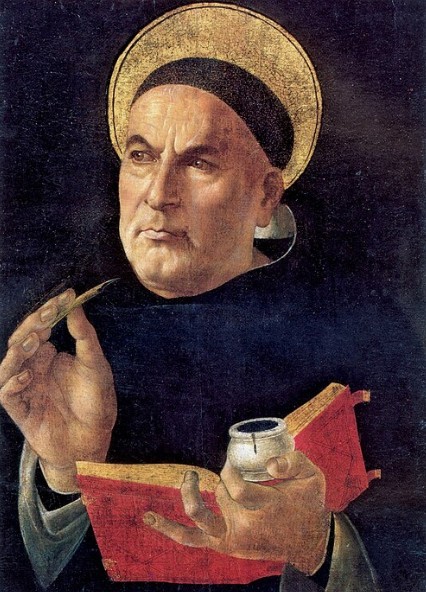
(Botticelli, Sandro. Thomas Aquinas. Painting. ca. 1481–1482. Uffizi Gallery, Florence. Wikimedia Commons. https://commons.wikimedia.org/wiki/File:Thomas_Aquinas_by_Sandro_Botticelli.jpg.)
Sandro Botticelli's Renaissance portrait of Saint Thomas Aquinas shows the theologian in Dominican robes, haloed and holding a book, with a serene expression against a neutral background, symbolizing his philosophical and theological genius.
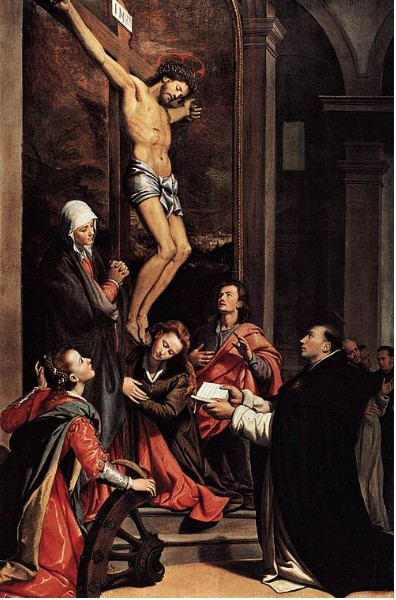
(Tito, Santi di. Vision of St. Thomas Aquinas. Oil on panel. 1593. Church of Santa Maria sopra Minerva, Rome. Wikimedia Commons. https://commons.wikimedia.org/wiki/File:Santi_di_Tito_-_Vision_of_St_Thomas_Aquinas_-_WGA22722.jpg.)

Santi di Tito's late Renaissance oil painting illustrates the Vision of Saint Thomas Aquinas, depicting him kneeling before the crucifix with a heavenly apparition, emphasizing his mystical experiences and scholastic achievements.
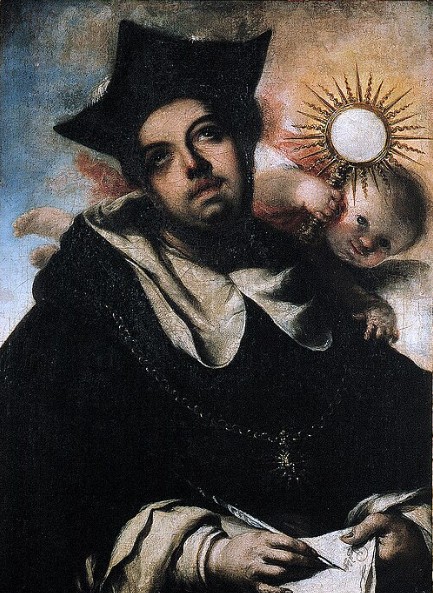
(Herrera the Younger, Francisco. Saint Thomas Aquinas. Oil on canvas. ca. 1656. Museo de Bellas Artes de Sevilla. Wikimedia Commons. https://commons.wikimedia.org/wiki/File:Herrera_thomas_aquinas.jpg.)

Francisco Herrera the Younger's Baroque oil painting portrays Saint Thomas Aquinas in dynamic pose, writing with divine inspiration, his face lit by a heavenly glow, highlighting his role as the "Angelic Doctor" of the Church.