UR-NAMMU CODE
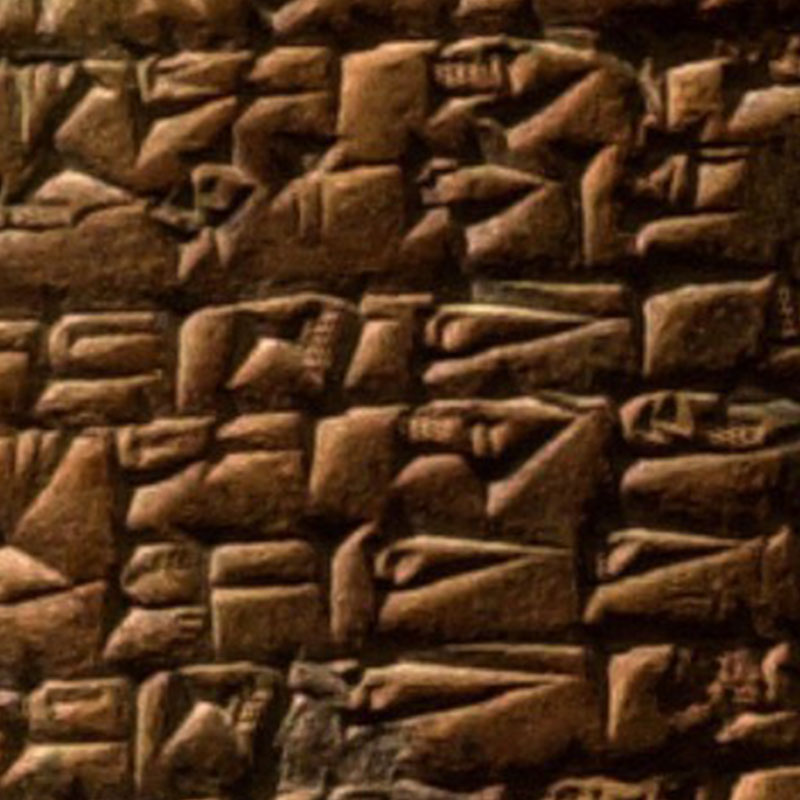
(“https://cdli.ox.ac.uk/images/p250820detail.jpg”)
Born: circa 2112 BCE, Ur, Ancient Sumer
Died: circa 2095 BCE
Notable
- Founder of the Third Dynasty of Ur: Established a significant ruling dynasty that brought stability and prosperity to Sumer.
- Code of Ur-Nammu: Created one of the earliest known legal codes, promoting justice, social order, and protection of the weak, influencing future legal systems.
- Practical Governance: Emphasized practical administration and infrastructure development, such as irrigation and ziggurat construction, for the benefit of the people.
2112-2095 BCE
Biography
The Ur-Nammu Code (or, the Code of Ur-Nammu) is one of the oldest known law codes in history. It was discovered in the ancient city of Ur in Mesopotamia (modern-day Iraq) and dates back to around 2100–2095 BCE during the Third Dynasty of Ur. The code consists of a series of laws inscribed on clay tablets, providing a glimpse into the legal system and societal values of the Sumerian civilization.
Scholars believe that the Ur-Nammu Code was established by Ur-Nammu, the king of Ur, who ruled most parts of ancient Mesopotamia from 2112–2095 BCE. Written in the Sumerian language, the code is significant not only for its antiquity but also for its influence on subsequent legal codes, including the famous Code of Hammurabi. The Ur-Nammu Code explained numerous laws and punishments that aimed to bring justice and order in society. While the complete text of the Ur-Nammu Code has not survived, fragments and copies have been found and studied by archaeologists and historians.
Bibliography & Major Works
Roth, Martha T. Law Collections from Mesopotamia and Asia Minor. Atlanta: Scholars Press, 1995.
Van De Mieroop, Marc. A History of the Ancient Near East ca. 3000–323 BC. 3rd ed., Blackwell, 2016.
Lambert, W.G. “The Historical Development of the Legal Systems of the Ancient Near East.” Journal of Near Eastern Studies, vol. 41, no. 2, 1982, pp. 101–117.
Jacobsen, Thorkild. The Sumerian King List. University of Chicago Press, 1939.
Michalowski, Piotr. The Lamentation over the Destruction of Ur. Eisenbrauns, 1989.
The Ur-Nammu Code consists of a series of laws inscribed on clay tablets that were discovered in the ruins of the ancient city of Ur. While the complete text of the code has not survived, scholars have reconstructed a significant portion of it based on fragments and copies found at various archaeological sites. The laws cover a wide range of topics, including criminal offenses, property rights, marriage and family law, capital offenses, and regulations related to commerce and trade.
Influences & Notable For
Significant Intellectual and Cultural Influences: Reflects a glimpse of ancient Sumerian civilization’s structured legal tradition, administrative complexity, and social hierarchy.
Historical and Cultural Context: Composed during the peak of Sumerian civilization, when the city of Ur was a thriving center of culture, trade, and political power in ancient Mesopotamia. The legal system reflected in the code was influenced by the prevailing social and religious beliefs of the time, which helped in maintaining order and justice in ancient Mesopotamia.
Contributions to Fields or Disciplines: Provides insight into ancient Near Eastern jurisprudence, civil law, and societal organization.
Notable Achievements and Recognition: Recognized as the earliest surviving written legal code recorded in history, establishing standards for justice, penalties, and civil responsibilities.
The Ur-Nammu Code is best known for being one of the oldest legal codes in human history. It predates the more famous Code of Hammurabi by several centuries and provides valuable insights into the legal and social structure of ancient Sumeria. The code is notable for its focus on justice, fairness, and the protection of vulnerable members of society, such as widows and orphans. It reflects the importance of maintaining order and resolving disputes in a structured manner within Sumerian society.
Famous quotes
- “If a man commits a murder, that man must be killed.”
- “If a man breaks a bone of another man, that man’s bone shall be broken.”
- “If a man knocks out the eye of another man, his eye shall be knocked out.”
- “If a man divorces his first-time wife, he shall pay (her) one mina of silver.”
- “If the wife of a man followed after another man and he slept with her, they shall slay that woman, but that male shall be set free.”
- “If a slave marries a native [i.e., free] person, he/she is to hand the firstborn son over to his owner.”
Legacy & Modern Significance
The Ur-Nammu Code has had a lasting legacy in the history of legal systems and jurisprudence, promoting law and social order.
The Ur-Nammu Code influenced the legal codes and traditions of Mesopotamia and helped to lay the foundation for the development of legal codes like Hammurabi’s and beyond.
Its emphasis on justice, fairness, and social order influenced subsequent legal traditions in the ancient Near East and provided a template for the codification of laws in other civilizations.
It serves as a key source for scholars, archaeologists, and historians to study the origins of civil and social structure in ancient Mesopotamia.
Modern Moments & Impact on 21st Century
In 2019, a new translation of the Ur-Nammu Code was published by a team of scholars, shedding new light on the legal principles and social norms of ancient Sumeria.
The Ur-Nammu Code has been the subject of academic conferences and symposia exploring its significance in the history of law and governance.
Digital resources and online databases have made the text of the Ur-Nammu Code more accessible to scholars and researchers interested in ancient legal systems.
Suggested Reading and Resources
Van De Mieroop, Marc. The Ancient Mesopotamian City. Oxford University Press, 2020.
Westbrook, Raymond. Ancient Mesopotamian Law: A Documentary History. Brill, 2010.
George, Andrew R. The Babylonian Gilgamesh Epic: Introduction, Critical Edition and Cuneiform Texts. Oxford University Press, 2003.
Maekawa, Kazuya. Ancient Mesopotamia: New Perspectives. ABC-CLIO, 2018.
Finkel, Irving L. The Ark Before Noah: Decoding the Story of the Flood. Hachette UK, 2014.
Martha Roth. Law Collections from Mesopotamia and Asia Minor. Atlanta: Scholars Press, 1997.
Samuel Noah Kramer. The Sumerians: Their History, Culture, and Character. Chicago: University of Chicago Press, 1963.
Citation: “Code of Ur-Nammu – World History Encyclopedia.” Photograph, 2000s. https://www.worldhistory.org/Code_of_Ur-Nammu/
PIONEER OF JUSTICE
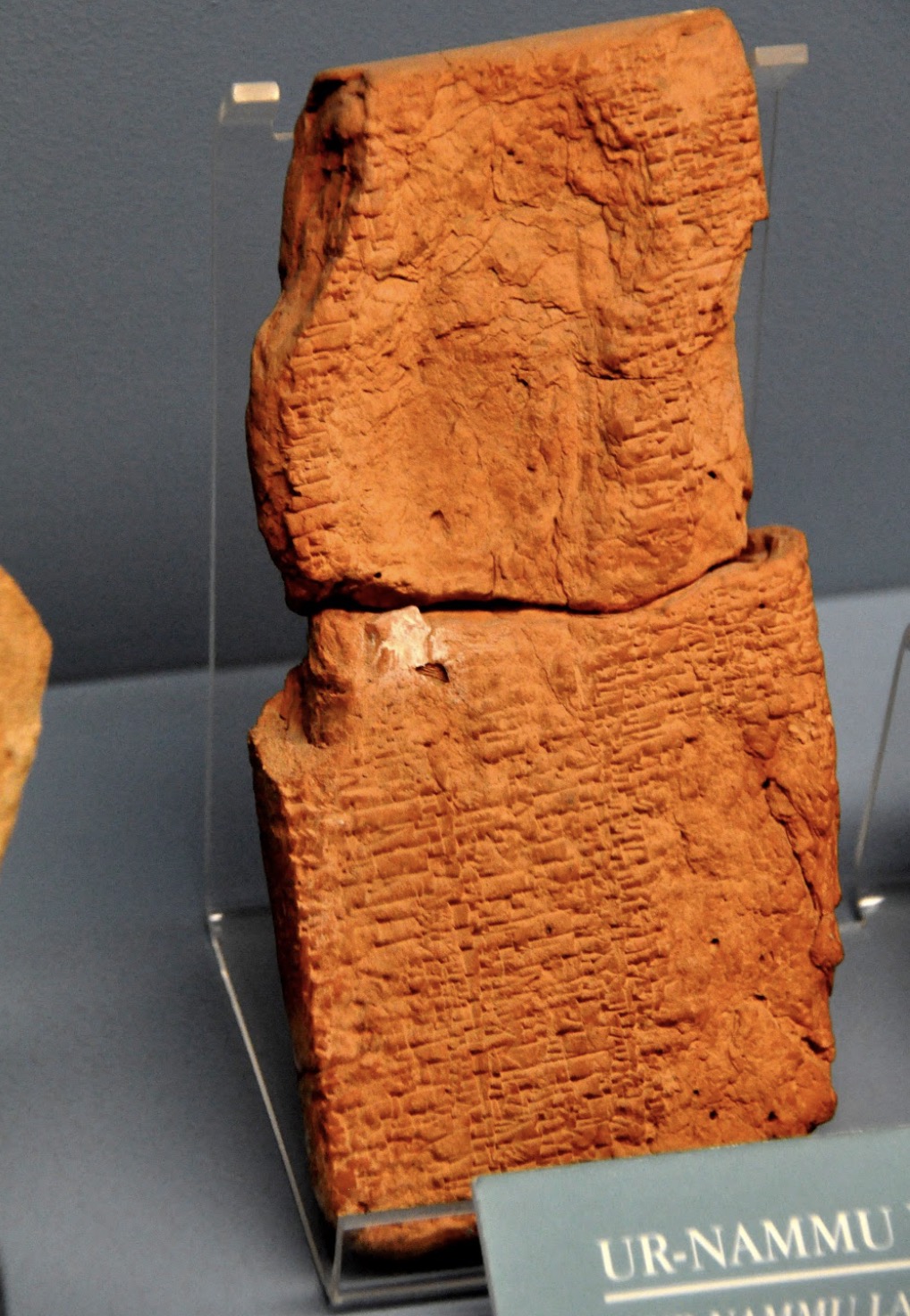
(“Code of Ur-Nammu – World History Encyclopedia.” Photograph, 2000s. https://www.worldhistory.org/Code_of_Ur-Nammu/)
Two reddish-brown clay fragments with inscribed text, stacked on a clear stand next to a blue label partially visible as “UR-NAMMU”.
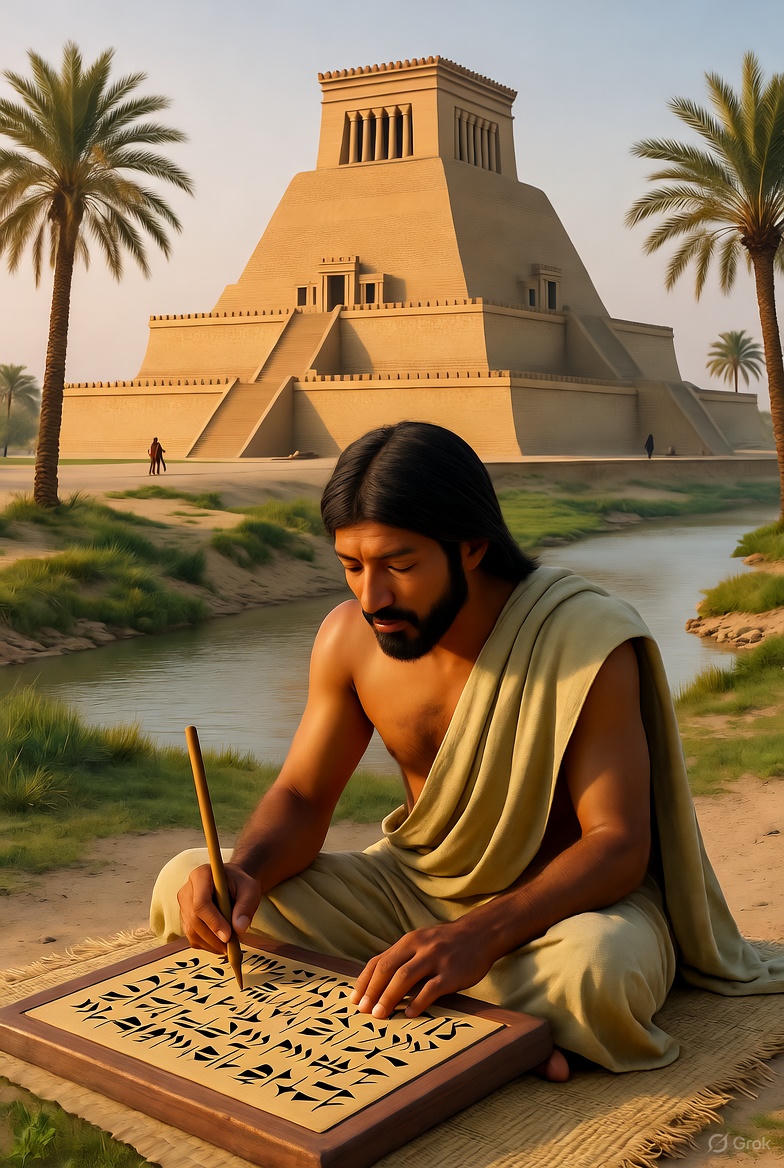
(AI-Generated)
In 2300 BC, Sumer, in ancient Mesopotamia (modern-day southern Iraq), thrived with city-states like Uruk and Ur, known for irrigation, ziggurats, and cuneiform writing. Skilled in trade and craftsmanship, the era saw conflicts that paved the way for the Akkadian Empire’s rise.
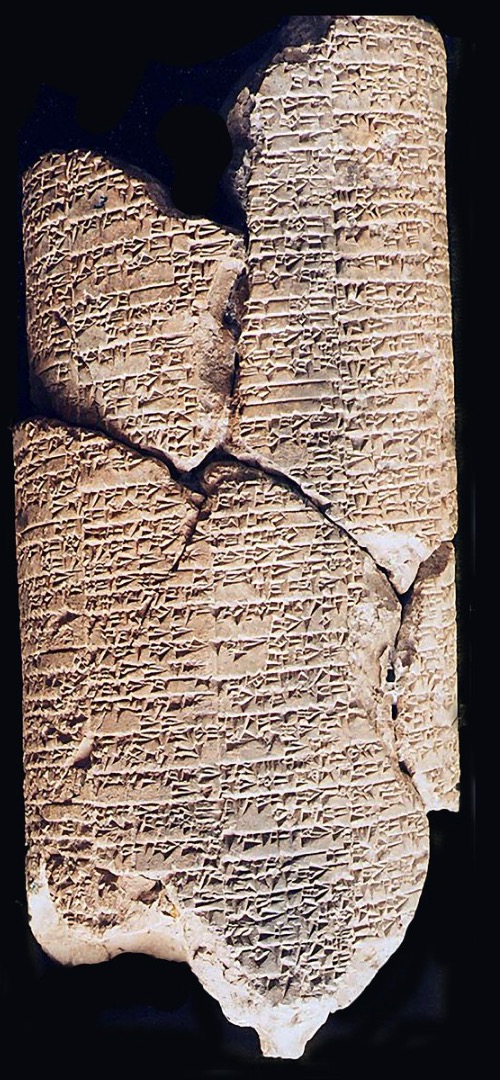
(“Code of Ur-Nammu.” Photograph, 2000s. https://www.meisterdrucke.us/fine-art-prints/Sumerian/149232/Code-of-Ur-Nammu.html)
A tall, broken cylindrical clay artifact with cuneiform inscriptions running vertically, set against a black background showing cracks and fragments.