VIRGIL
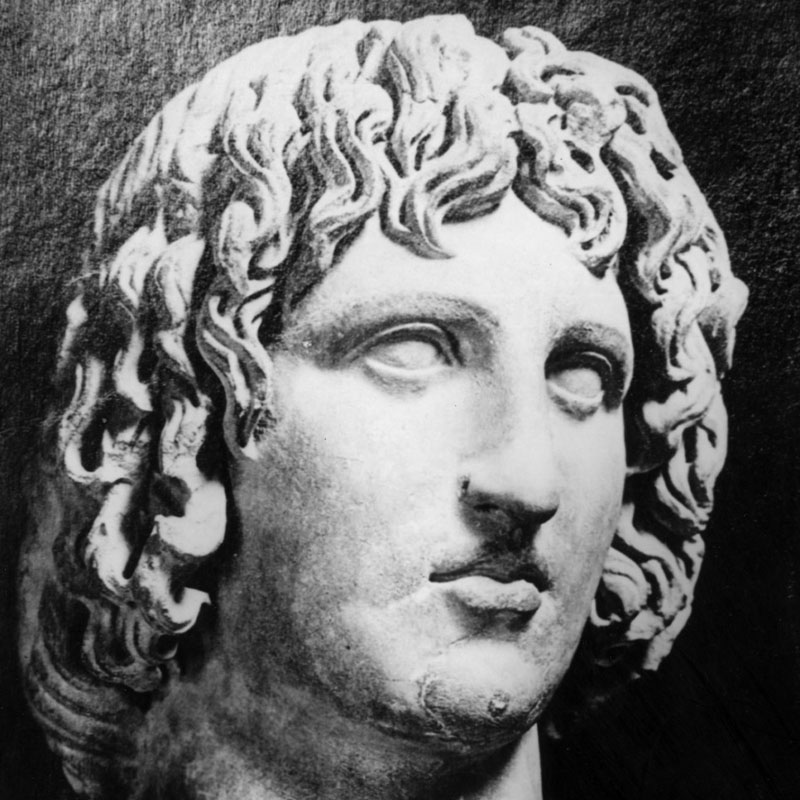
(Roman Sculptor. Bust of Virgil. Marble. ca. 45 BC. Wikimedia Commons. https://commons.wikimedia.org/wiki/File:Publius_Vergilius_Maro.jpg)
Born: 70 BCE, Andes near Mantua, Italy
Died: 19 BCE, Brundisium, Italy
Notable
-
Epic Poet of Rome: Wrote the Aeneid, linking Trojan exile to Rome’s imperial origins.
-
Poetic Innovation: Transformed pastoral and didactic poetry in the Eclogues and Georgics.
-
Pietas and Fate: Framed duty to gods, family, and state as central to human destiny.
70-19 BCE
Biography
Virgil (Publius Vergilius Maro, c. 70–19 BCE) was a Roman poet and the foremost literary figure of the Augustan Age. Born in Andes near Mantua (present-day northern Italy), Virgil received a classical education in rhetoric, philosophy, and poetry in Rome and Naples. He rose to prominence under the patronage of Emperor Augustus, crafting works that blended Greek literary models with Roman national identity. Virgil’s poetry—pastoral, didactic, and epic—celebrated rural life, agricultural reform, and the destiny of Rome under divine providence. His followers and imitators shaped the Latin literary canon, influencing European literature for centuries. His masterpiece, the Aeneid, was left unfinished at his death but completed and published posthumously by his literary executors.
Virgil’s poetry has been interpreted by modern scholars as a sophisticated synthesis of Hellenistic aesthetics and Roman imperialism. His emphasis on piety, fate, and civic duty aligned with Augustan propaganda while subtly questioning the costs of empire. Virgil’s work stood in dialogue with Homeric epic and Theocritan pastoral, ultimately eclipsing earlier Roman poets. Surviving Virgilian traditions integrated into medieval Christian allegory and Renaissance humanism.
Bibliography & Major Works
Major Published Works:
Aeneid (Aeneis)
Composed c. 29–19 BCE.
Survives in 12 books, an epic recounting Aeneas’s journey from Troy to Italy and the founding of Rome.
Original language: Latin (dactylic hexameter).
Georgics (Georgica)
Composed c. 37–29 BCE.
Survives in 4 books, a didactic poem on agriculture, labor, and the Italian countryside.
Eclogues (Bucolica)
Composed c. 42–37 BCE.
Survives in 10 pastoral poems modeled on Theocritus, exploring love, politics, and rural idealism.
Key Manuscripts and Editions:
Loeb Classical Library: Virgil, Eclogues, Georgics, Aeneid (trans. H. R. Fairclough, rev. G. P. Goold) – https://www.hup.harvard.edu/catalog.php?isbn=9780674995833
Oxford Classical Texts: P. Vergili Maronis Opera (ed. Mynors) – https://global.oup.com/academic/product/p-vergili-maronis-opera-9780198146537
Perseus Digital Library: Virgil (Original Text & Translations) – http://www.perseus.tufts.edu/hopper/text?doc=Perseus:text:1999.02.0055
Influences & Notable For
Notable For
Author of the Aeneid: National epic of Rome, linking Trojan refugees to the Julian gens and Augustan peace.
Pastoral Innovation: Eclogues established the bucolic genre in Latin, idealizing rural life amid civil war.
Didactic Poetry: Georgics combined practical farming advice with philosophical reflections on labor and nature.
Augustan Propaganda: Works subtly endorsed imperial ideology while exploring human suffering and moral ambiguity.
Sources:
Internet Encyclopedia of Philosophy: Virgil – https://iep.utm.edu/virgil/
Hardie, Philip. Virgil (Oxford University Press, 1998) – https://global.oup.com/academic/product/virgil-9780199226603
Influences
Homeric Epic: Aeneid reworks Iliad and Odyssey to forge Roman identity.
Hellenistic Poetry: Theocritus (Eclogues), Callimachus, Apollonius Rhodius.
Roman Predecessors: Ennius, Lucretius (Georgics responds to De Rerum Natura), Catullus.
Augustan Circle: Patronage of Maecenas; dialogue with Horace, Propertius, Ovid.
Sources:
Stanford Encyclopedia of Philosophy: Virgil – https://plato.stanford.edu/entries/virgil/
Ziolkowski, Theodore. Virgil and the Moderns (Princeton, 1993) – https://press.princeton.edu/books/paperback/9780691028553/virgil-and-the-moderns
Famous quotes
- “Arma virumque cano, Troiae qui primus ab oris / Italiam, fato profugus, Laviniaque venit / litora…” (“Of arms and the man I sing, who first from the coasts of Troy, exiled by fate, came to Italy and Lavinian shores…”) – Virgil, Aeneid 1.1–3 (Perseus – http://www.perseus.tufts.edu/hopper/textdoc=Perseus:text:1999.02.0055:book=1:card=1)
- “Felix qui potuit rerum cognoscere causas…” (“Happy the man who has been able to learn the causes of things…”) – Virgil, Georgics 2.490 (Perseus – http://www.perseus.tufts.edu/hopper/textdoc=Perseus:text:1999.02.0055:book=2:card=490)
- “Tantae molis erat Romanam condere gentem.” (“So massive was the labor to found the Roman race.”) – Virgil, Aeneid 1.33 (Perseus –http://www.perseus.tufts.edu /hopper/text?doc=Perseus:text:1999.02.0055:book=1:card=1)
Legacy & Modern Significance
Historical Reception: Immediate canonization; medieval Christian allegorization (Dante’s guide in Divine Comedy).
Renaissance Revival: Model for epic poetry (Tasso, Camões, Milton).
Modern Reappraisal: 20th-century scholars highlighted anti-imperial undertones, psychological depth, and ecological themes.
Ongoing Debates: Virgil in postcolonial studies, ecocriticism, and comparative epic.
Sources:
Hardie, Philip. The Cambridge Companion to Virgil (Cambridge, 2019) – https://www.cambridge.org/core/books/cambridge-companion-to-virgil/9781107170186
Putnam, Michael C.J. Virgil’s Epic Designs (Yale, 1998) – https://yalebooks.yale.edu/book/9780300073539/virgils-epic-designs/
Modern Moments & Impact on 21st Century
1997–2000: Loeb Classical Library released revised Fairclough/Goold translations of Virgil’s complete works, standard for Anglophone scholarship (Harvard University Press – https://www.hup.harvard.edu/catalog.php?isbn=9780674995833).
2019: Cambridge University Press published The Cambridge Companion to Virgil (2nd ed.), consolidating contemporary approaches to politics, gender, and reception (Publisher’s Page – https://www.cambridge.org/core/books/cambridge-companion-to-virgil/9781107170186).
Ongoing (1990s–Present): Virgil’s texts are fully digitized with facing translations on the Perseus Digital Library, a flagship platform for classical studies.
Ongoing (2010s–Present): Classics and comparative literature departments worldwide include Virgil in core curricula, as seen in syllabi from Yale, Oxford, and University of São Paulo.
Ongoing (2000s–Present): The Stanford Encyclopedia of Philosophy and Internet Encyclopedia of Philosophy maintain peer-reviewed entries on Virgil, serving global researchers (SEP – https://plato.stanford.edu/entries/virgil/, IEP – https://iep.utm.edu/virgil/).
2021: Princeton University Press reissued Theodore Ziolkowski’s Virgil and the Moderns in paperback, underscoring Virgil’s role in 20th-century literature (Publisher’s Page – https://press.princeton.edu/books/paperback/9780691028553/virgil-and-the-moderns).
Ongoing (2020s): Virgilian themes of exile, empire, and environmental crisis appear in conferences of the Society for Classical Studies and interdisciplinary panels on epic and ecology.
Suggested Reading and Resources
Secondary Literature (Scholarship)
Hardie, Philip. The Cambridge Companion to Virgil (2nd ed.). Cambridge University Press, 2019 – https://www.cambridge.org/core/books/cambridge-companion-to-virgil/9781107170186
Putnam, Michael C.J. Virgil’s Epic Designs: Ekphrasis in the Aeneid. Yale University Press, 1998 – https://yalebooks.yale.edu/book/9780300073539/virgils-epic-designs/
Ziolkowski, Theodore, and Jan M. Ziolkowski. Virgil and the Moderns. Princeton University Press, 1993 (repr. 2021) – https://press.princeton.edu/books/paperback/9780691028553/virgil-and-the-moderns
Williams, R.D. Virgil: Aeneid I–VI (Commentary). Bristol Classical Press, 1996 – https://www.bloomsbury.com/us/virgil-9781853997167/
O’Hara, James J. True Names: Vergil and the Alexandrian Tradition of Etymological Wordplay. University of Michigan Press, 2017 – https://www.press.umich.edu/6682/true_names
Archival or Online Sources
Perseus Digital Library: Virgil (Original Text & Translations) – http://www.perseus.tufts.edu/hopper/text?doc=Perseus:text:1999.02.0055
Internet Encyclopedia of Philosophy: Virgil – https://iep.utm.edu/virgil/
Stanford Encyclopedia of Philosophy: Virgil – https://plato.stanford.edu/entries/virgil/
World History Encyclopedia: Virgil – https://www.worldhistory.org/Virgil/
THE BEE OF MANTUA
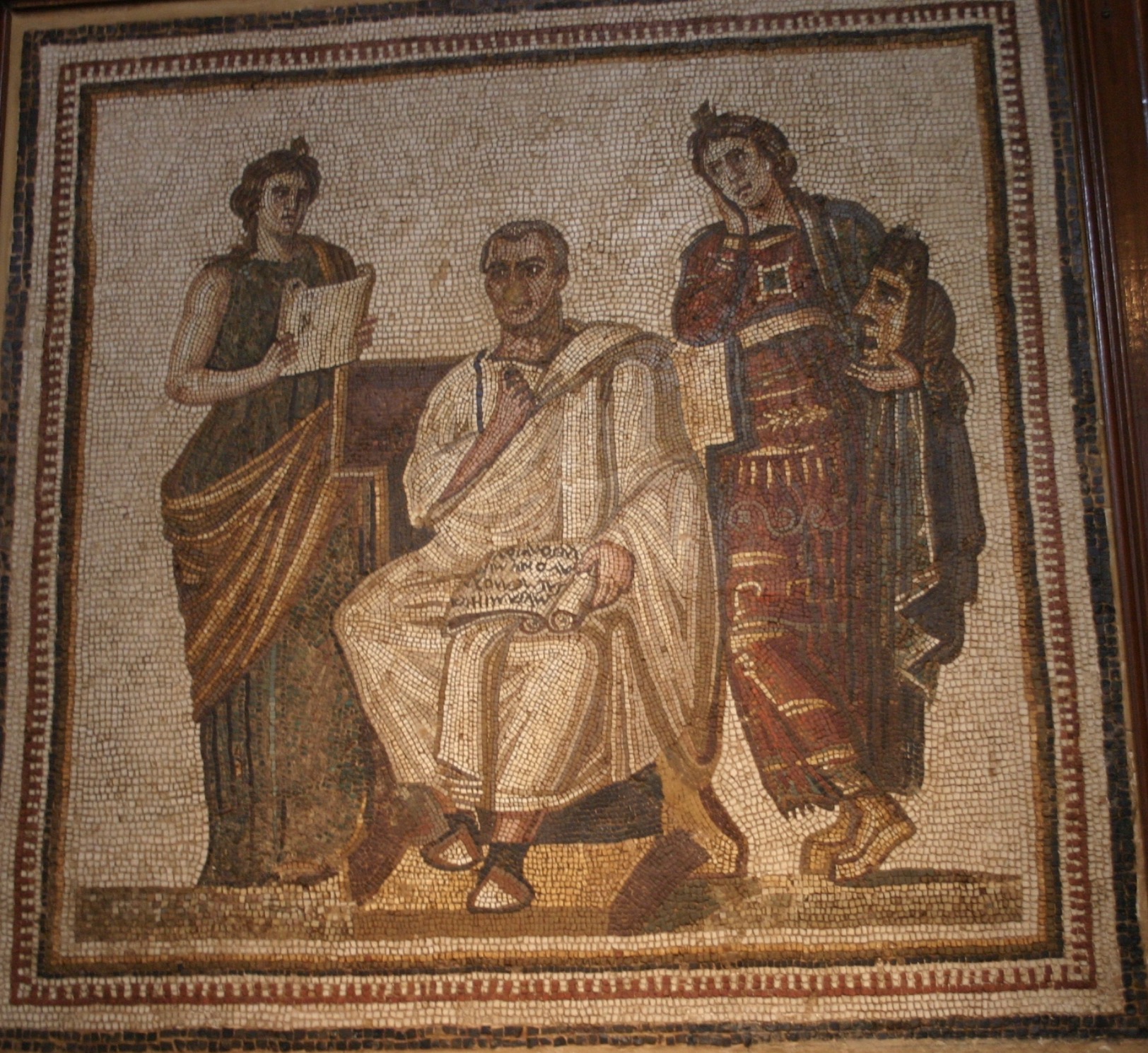
(Unknown. Virgil Mosaic. Marble mosaic. 3rd century AD. Bardo National Museum, Tunis, Tunisia. Wikimedia Commons. https://commons.wikimedia.org/wiki/File:Virgile.JPG)
This 3rd-century AD Roman mosaic depicts the poet Virgil holding a volume of the Aeneid, flanked by the muses Clio (history) and Melpomene (tragedy), discovered in Sousse, Tunisia, and exemplifying his central role in classical literature.
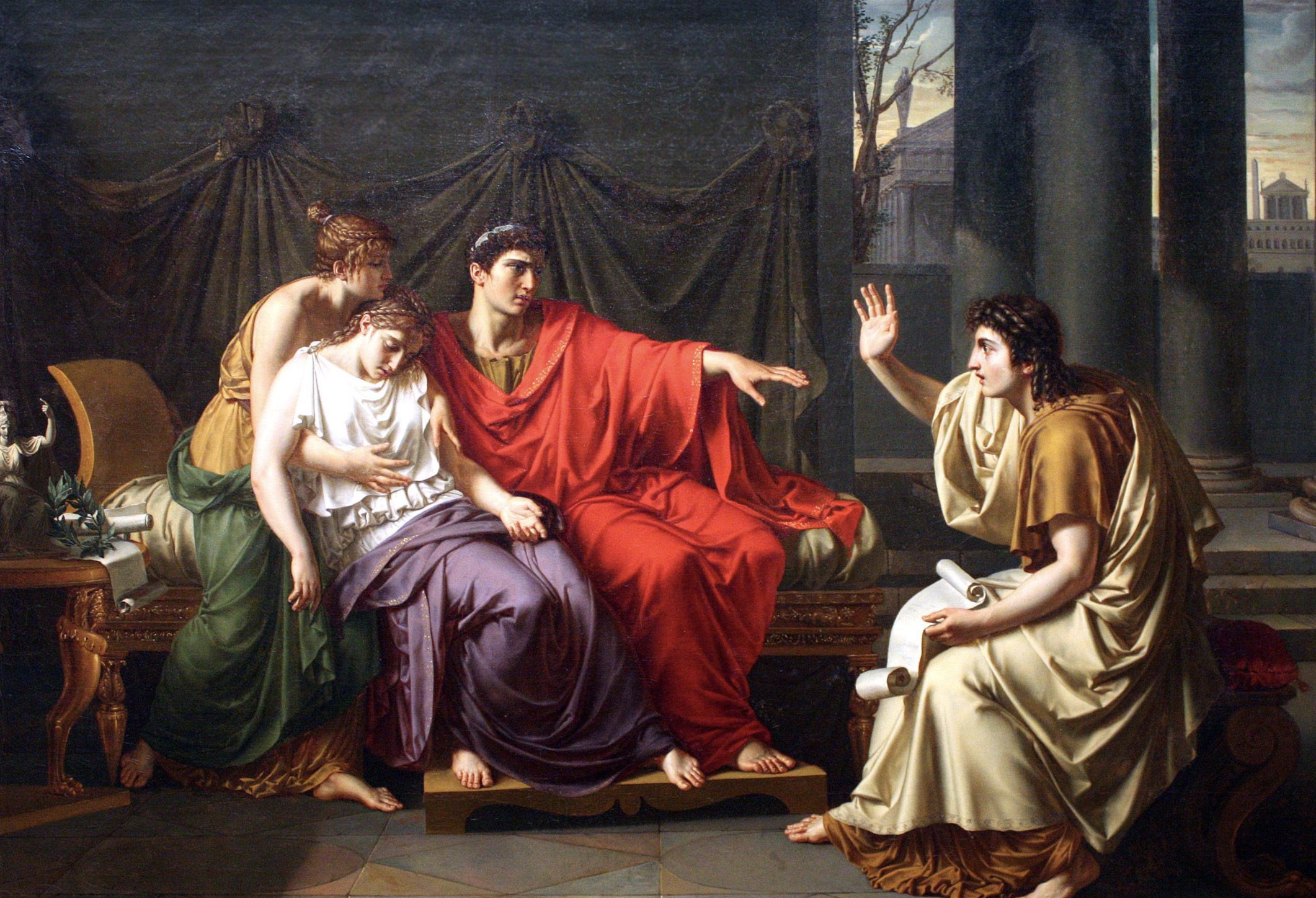
(Jean-Baptiste Wicar, Virgil Reading the “Aeneid” to Augustus, Octavia, and Livia, 1790–93, oil on canvas, 111.1 × 142.6 cm, Art Institute of Chicago, https://www.artic.edu/artworks/17161/virgil-reading-the-aeneid-to-augustus-octavia-and-livia.)
Jean-Baptiste Wicar’s Virgil Reading the Aeneid to Augustus, Octavia, and Livia (1790–93) captures a legendary moment of literary intimacy: the poet reciting his epic to the imperial family. Octavia’s faint, said to stem from hearing her dead son Marcellus praised, blends personal grief with public myth, making the painting a poignant emblem of art’s power to move both heart and empire.
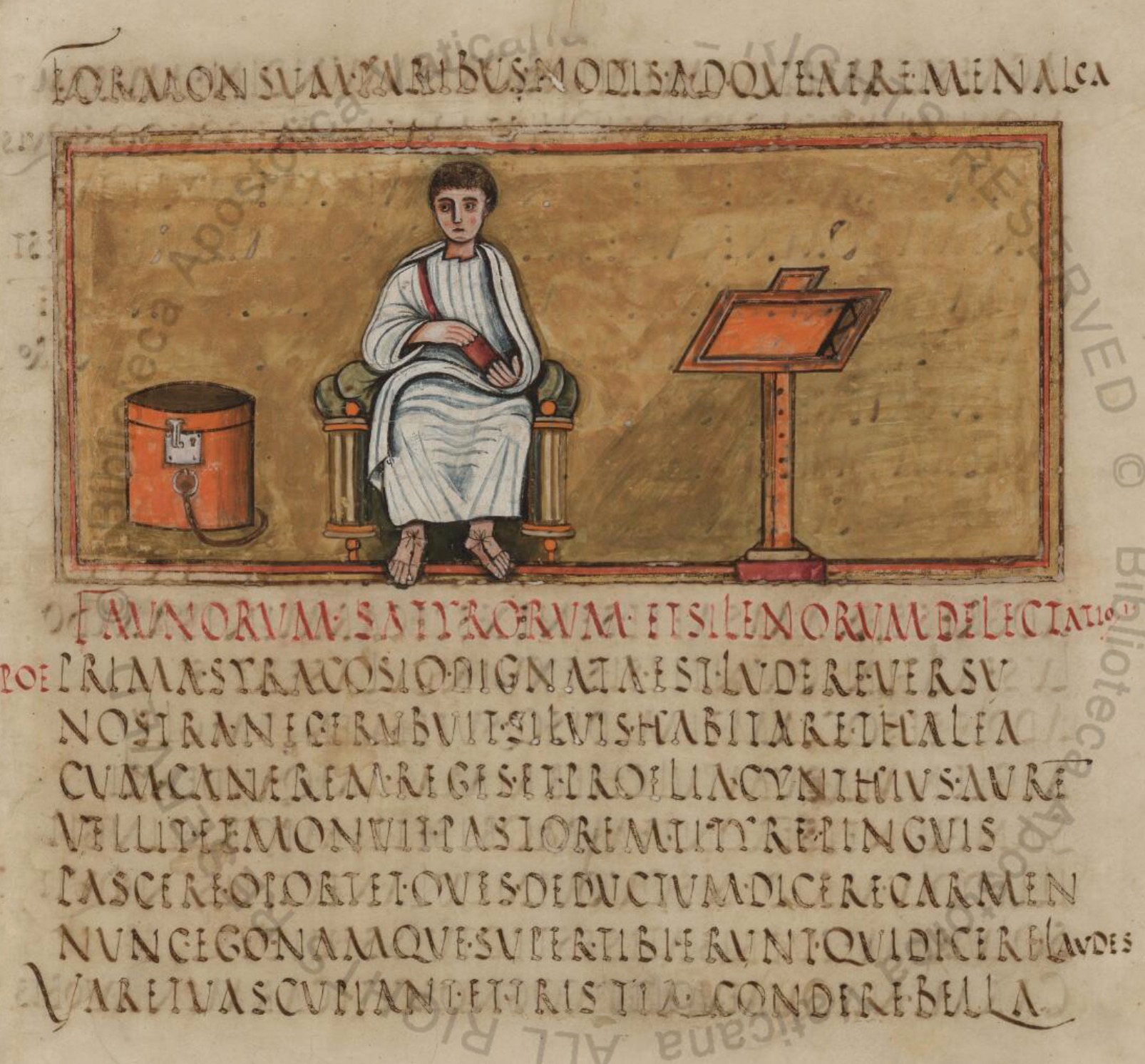
(Unknown. Folio 14r of the Vergilius Romanus. Manuscript illumination on vellum. 5th century. Vatican Library, Vatican City. Wikimedia Commons. https://commons.wikimedia.org/wiki/File:RomanVirgilFolio014rVergilPortrait.jpg.)
Folio 14r from the 5th-century Vergilius Romanus manuscript features a seated portrait of Virgil holding a scroll, rendered in vibrant colors on vellum, capturing the ancient poet in a contemplative pose.